

AI Art vs. Human Creativity: Can a Machine Be a True Artist?
This article explores how algorithms challenge human creativity, intentionality, and the future of art in a human-AI collaborative landscape.
INDUSTRIES
Rice AI (Ratna)
3/6/20266 min read
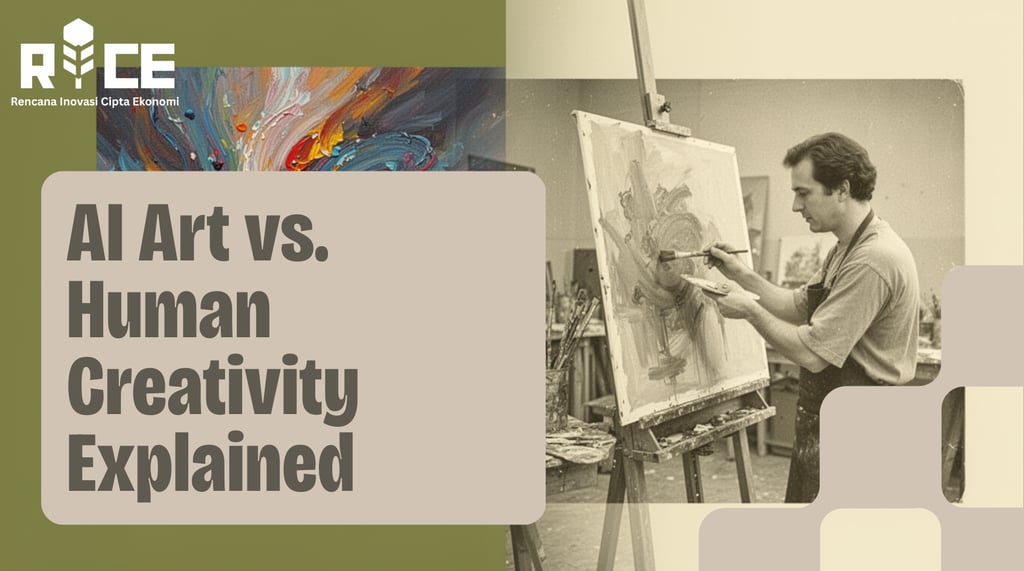
The artistic landscape is undergoing a profound transformation. What does it mean when a machine generates an image so compelling, so unique, that it challenges our very notions of authorship and creativity? The rise of AI art generators has sparked an intense debate: can algorithms truly create art, or are they merely sophisticated tools replicating existing styles? This question cuts to the heart of what we define as artistic expression, probing the boundary between human ingenuity and artificial intelligence.
As we look to the future, understanding this intersection is crucial for artists, technologists, and enthusiasts alike. The distinction between creation and replication, emotion and algorithm, intentionality and computation, is blurring. This discussion isn't just academic; it has profound implications for the art world, intellectual property, and our understanding of human distinctiveness in a rapidly evolving digital age. Join us as we delve into this complex dialogue, exploring whether a machine can indeed possess the essence of a true artist.
What Constitutes Art: A Philosophical Inquiry
Traditional Definitions vs. AI's Contribution
Historically, art has been understood as a deeply human endeavor, an expression of thought, emotion, and experience. From cave paintings to classical symphonies, art has served as a mirror to the human condition, reflecting our joys, struggles, and aspirations. The artistic process often involves intuition, deliberate choice, and a nuanced understanding of culture and context. These traditional definitions emphasize intentionality the artist's conscious decision to convey a message or evoke a feeling. Art has often been seen as a form of communication, a dialogue between the creator and the observer, imbued with personal significance.
The advent of AI-generated art forces a re-evaluation of these long-held beliefs. When an AI generates a stunning piece, is it acting with intent? Does it experience emotion or possess a unique worldview? Algorithms operate on data and programming, not on self-awareness or lived experience. While the output can be aesthetically pleasing or thought-provoking, the underlying mechanism is computational. This raises critical questions about the very essence of creativity. Can something be considered art if its "creator" lacks consciousness? Or is the aesthetic outcome, regardless of its origin, sufficient for it to be labeled as art? The debate extends to the value we place on the narrative behind a piece the artist's story, struggles, and inspirations which AI currently cannot replicate.
The Mechanics of AI Art Generation
Beyond Randomness: The Role of Human Curation
At its core, AI art generation relies on sophisticated algorithms and vast datasets. Generative Adversarial Networks (GANs) and Variational Autoencoders (VAEs) are among the most common architectures. These models are trained on millions of images, learning patterns, styles, and compositional elements. A GAN, for instance, consists of two neural networks: a generator that creates new images and a discriminator that evaluates their authenticity against real-world examples. Through this adversarial process, the generator becomes incredibly adept at producing novel, realistic, and often artistic outputs. This isn't mere randomness; it's a deep statistical understanding of visual aesthetics derived from human-created works.
However, the "creation" is not entirely autonomous. The process begins with human input, often in the form of text prompts or initial image parameters. This "prompt engineering" is itself an emerging art form, requiring skill and imagination to guide the AI toward a desired outcome. Furthermore, human creators curate the datasets that train these models, influencing the AI's "understanding" of art history and aesthetics. Crucially, human hands also select, refine, and interpret the AI's output. An AI might generate hundreds of images based on a prompt, but it's a human artist who chooses the most compelling, makes adjustments, or combines elements to realize a specific vision. Here at Rice AI, we recognize the paramount importance of this collaborative dynamic. Our platform is meticulously designed to provide intuitive tools for AI art generation, giving creators maximum control over the iterative process. We believe the future of art lies in empowering human artists with advanced technology, allowing them to sculpt and refine AI outputs to perfectly match their unique artistic intent and vision. This ensures that while AI provides the generative power, the human element of selection and direction remains central to the creative journey.
The Human Element: Intent, Emotion, and Experience
The Artist's Journey vs. Algorithmic Output
One of the most compelling arguments for the irreplaceable nature of human creativity centers on intent, emotion, and lived experience. Human art is often a deeply personal narrative, a manifestation of the artist's unique perspective on the world, shaped by their upbringing, culture, joys, sorrows, and intellectual pursuits. A painting might be the result of years of struggle, a symphony an outpouring of profound grief, or a sculpture a commentary on societal injustice. These works are imbued with a certain "soul" or "spirit" that resonates with audiences because it taps into shared human experiences, even as it expresses individual ones. The connection we feel to a piece of art often comes from an understanding, conscious or unconscious, of the human journey that led to its creation.
Can an AI, however sophisticated, replicate this profound wellspring of artistic motivation? An algorithm processes data; it does not fall in love, experience heartbreak, or confront existential dilemmas. While AI can simulate styles and generate novel combinations, it does so without subjective consciousness. The emotional impact of AI art, if present, is often a projection by the human observer, who interprets the generated image through their own emotional lens. The "story" behind an AI artwork is primarily technical how it was prompted, what dataset it used rather than a reflection of personal growth or an emotional landscape. This distinction underscores a fundamental difference: human artists create from experience, while AI creates patterns derived from simulated experiences. For many, true artistry demands this deeply embedded human context, something beyond mere aesthetic output.
Collaboration or Competition? The Future of Creativity
Empowering Human Artists with AI
The prevailing narrative often pits AI against human artists in a zero-sum game, but a more nuanced perspective envisions a symbiotic future. Instead of viewing AI as a competitor, we can embrace it as an extraordinarily powerful tool for creative augmentation. AI can serve as a tireless assistant, capable of rapidly generating thousands of iterations, exploring diverse stylistic possibilities, or even developing entirely new aesthetic languages based on a prompt. This liberates human artists from tedious tasks, allowing them to focus on conceptualization, emotional depth, and the overarching artistic vision. Imagine an artist struggling with a specific composition; an AI could quickly render dozens of variations, providing fresh perspectives and accelerating the ideation process.
Many contemporary artists are already integrating AI into their workflows. They use AI for initial concept generation, to create impossible textures, to generate backgrounds, or to experiment with visual effects that would be prohibitively time-consuming otherwise. The human artist remains the director, the visionary, the one who injects meaning and personal touch into the final piece. AI amplifies human capabilities, enabling creators to push artistic boundaries and realize visions that were previously unattainable. This collaboration represents a new frontier for creativity, where technology enhances, rather than diminishes, human artistic expression. At Rice AI, we are committed to being at the forefront of this revolution. Our platform is continually evolving to provide cutting-edge AI tools that foster true collaboration, empowering artists and designers to leverage artificial intelligence to bring their most imaginative and unique visions to life with unprecedented efficiency and innovative capabilities. We believe this partnership between human creativity and AI technology is where the most exciting advancements in art will unfold.
Conclusion
The question of whether a machine can be a true artist is not easily answered, nor is it likely to receive a definitive "yes" or "no" in the near future. What AI art unequivocally demonstrates is its remarkable capacity to generate novel, complex, and often beautiful visual and auditory forms. These creations challenge our perceptions and expand the very definition of what art can be. However, when we consider the essence of "true artistry," many argue that it requires qualities inherently tied to human consciousness: intentionality, emotion, subjective experience, and the unique narrative of a lived life. An AI operates on algorithms and data; it does not experience the joy of discovery, the pain of rejection, or the profound connection that fuels human creative endeavors.
The value of art lies not solely in its aesthetic output, but often equally in the process of its creation and the intent behind it. The human artist imbues a piece with a part of themselves, a reflection of their innermost world. This is where the machine, despite its incredible generative power, currently falls short. AI can mimic, extrapolate, and combine, but it cannot authentically feel or intend in the human sense.
Therefore, the most productive way forward is not to view AI as a replacement for human artists, but rather as an extraordinary partner. AI stands as an unparalleled tool for augmentation, offering new avenues for exploration, efficiency, and boundary-pushing creativity. It allows artists to visualize concepts faster, experiment more broadly, and execute technically complex ideas with greater ease. The future of creativity, as envisioned by platforms like Rice AI, is one where human ingenuity is amplified by artificial intelligence. It's a future where artists leverage powerful AI tools to articulate their unique visions, ensuring that the soul of the art remains firmly anchored in human experience while its potential is limitlessly expanded by technology. We are entering an exciting era of human-AI synergy, where the core of artistry remains human, yet its reach becomes truly boundless.
Are you ready to explore the exciting possibilities of AI-powered creativity? Dive into the tools and resources available on platforms like Rice AI and join the conversation. Share your thoughts, your art, and your predictions for the future of human-AI collaboration in the creative industries.
#AIArt #HumanCreativity #GenerativeAI #ArtAndTechnology #FutureOfArt #DigitalArt #AIArtists #MachineLearning #CreativeTech #ArtDebate #RiceAI #InnovationInArt #ArtisticExpression #AIvsHuman #DeepLearning #DailyAIIndustry
RICE AI Consultant
To be the most trusted partner in digital transformation and AI innovation, helping organizations grow sustainably and create a better future.
Connect with us
Email: consultant@riceai.net
+62 822-2154-2090 (Marketing)
© 2025. All rights reserved.
+62 851-1748-1134 (Office)
IG: @riceai.consultant