

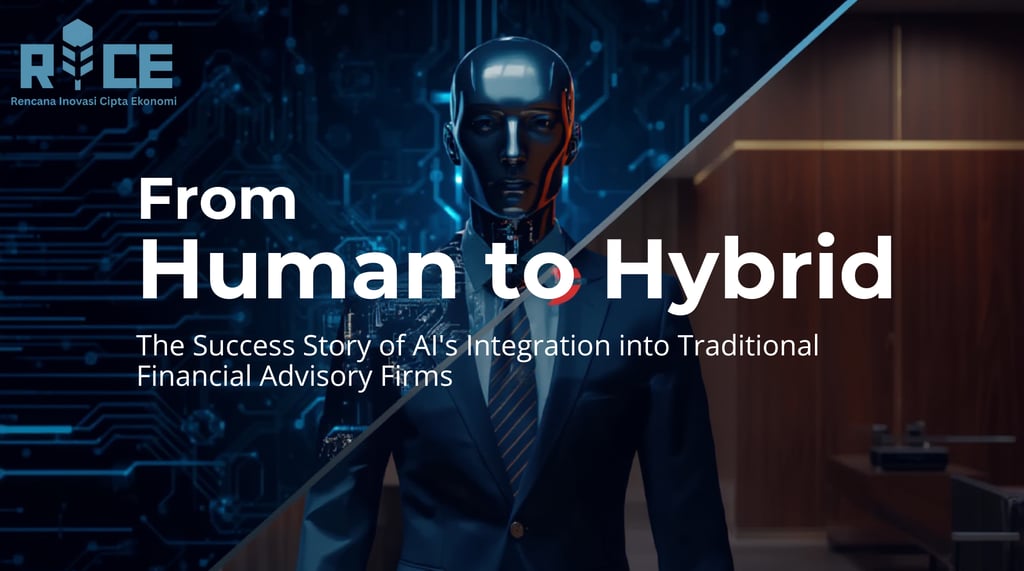
From Human to Hybrid: The Success Story of AI's Integration into Traditional Financial Advisory Firms
Explore how traditional financial advisory firms are successfully integrating AI to create powerful hybrid models, enhancing client experiences, boosting efficiency, and driving sustainable growth
TECHNOLOGY
Rice AI (Ratna)
1/21/20268 min read
The landscape of financial advisory is undergoing an unprecedented transformation. What was once exclusively the domain of human expertise is now evolving into a powerful synergy, merging traditional wisdom with cutting-edge artificial intelligence. Many predicted a clash, a future where machines would replace advisors. Instead, we are witnessing a "hybrid" revolution, a success story where AI augments human capabilities, redefining client service and operational efficiency for traditional firms.
This shift isn't merely about adopting new tools; it's about fundamentally rethinking how value is delivered in wealth management. Traditional firms, initially hesitant, are now discovering that embracing AI is not just about staying relevant but thriving in a competitive, data-driven world. This article explores the journey from human-centric to hybrid models, detailing the challenges overcome, the strategies adopted, and the immense benefits realized by firms leading this charge. Rice AI has been at the forefront of this evolution, guiding numerous firms through their digital transformation.
The Initial Resistance: Navigating Skepticism and Legacy Systems
The prospect of integrating artificial intelligence into the deeply personal and trust-based realm of financial advisory was met with considerable skepticism. For decades, the industry thrived on face-to-face interactions, bespoke advice, and a human touch. Introducing algorithms and automated processes seemed, to many, antithetical to this core ethos.
Fear of Replacement: The Human Element
A primary concern among financial advisors was the fear of being replaced by machines. This apprehension was understandable, given early narratives that positioned AI as a disruptive force capable of automating complex tasks. However, the true value of a financial advisor extends beyond mere data analysis; it encompasses empathy, psychological understanding, and the ability to navigate clients through life's most significant financial decisions. The fear was that the indispensable human connection, trust, and nuanced judgment would be lost, eroding the very foundation of client relationships. Firms grappled with how to communicate AI's role as a supportive co-pilot rather than a substitute.
Technical Hurdles and Integration Challenges
Beyond the human element, traditional financial advisory firms faced significant technical hurdles. Many operated on legacy IT infrastructures that were not designed for the rapid deployment and intricate integration of AI solutions. The sheer complexity of connecting new AI platforms with existing CRM systems, portfolio management software, and compliance tools presented a daunting task. Data security was another paramount concern; handling sensitive client financial data with new, often cloud-based, AI systems required rigorous security protocols and strict adherence to evolving regulatory compliance standards. The investment in time, capital, and skilled personnel for such an overhaul seemed prohibitive to many, further contributing to their initial reluctance.
A Symbiotic Relationship: Redefining Financial Advisory with AI
Despite initial reservations, forward-thinking firms recognized the immense potential of AI not as a competitor, but as a powerful collaborator. This recognition ushered in the era of the "hybrid model," a strategic fusion of human expertise and artificial intelligence. The success of this model lies in its ability to leverage the strengths of both, creating a service offering that is greater than the sum of its parts.
AI as an Augmentation, Not a Replacement
The core tenet of the hybrid model is that AI serves as an augmentation tool, empowering human advisors rather than replacing them. AI excels at processing vast amounts of data, identifying patterns, and executing repetitive tasks with unparalleled speed and accuracy. This includes predictive analytics for market trends, automated report generation, rebalancing portfolios based on predefined rules, and personalizing client communications. By offloading these data-intensive and time-consuming tasks to AI, financial advisors are freed from administrative burdens. This allows them to allocate more time to strategic thinking, client education, complex problem-solving, and relationship building – areas where human intelligence, creativity, and empathy are irreplaceable. Robo-advisors, for instance, handle basic portfolio management, allowing human advisors to focus on high-net-worth clients or those with complex financial situations requiring nuanced guidance.
The Power of Human-Centric Advice
In an increasingly commoditized financial world, human-centric advice remains the ultimate differentiator. The hybrid model reinforces this by enabling advisors to deepen their engagement with clients. With AI handling the analytical heavy lifting, advisors can dedicate themselves to understanding clients' life goals, emotional drivers, and unique circumstances. They can provide comfort during market volatility, offer bespoke advice for intricate estate planning, or guide families through generational wealth transfer. This human touch builds stronger trust, fosters loyalty, and ensures that financial plans are not just mathematically sound but also deeply aligned with clients' personal aspirations. The symbiotic relationship ensures that clients receive both the efficiency and data-driven insights of advanced AI, combined with the irreplaceable empathy and strategic foresight of a human advisor.
Strategies for a Seamless Transition
The successful integration of AI into traditional financial advisory firms wasn't a sudden leap but a carefully planned strategic evolution. Firms that excelled adopted a structured approach, focusing on pilot programs, comprehensive training, and robust data governance. These strategies mitigated risks and ensured a smooth, effective transition.
Strategic Pilot Programs and Phased Rollouts
One of the most effective strategies for AI adoption involved implementing strategic pilot programs. Rather than a full-scale overhaul, firms chose to test AI solutions within specific departments or with a subset of clients. This allowed them to evaluate the technology's performance, gather real-world feedback, and identify potential challenges in a controlled environment. Lessons learned from these pilots informed subsequent phases, enabling a more informed and refined rollout across the organization. This phased approach minimized disruption, managed expectations, and built internal confidence in the new technologies. It also provided valuable insights into workflow adjustments and user acceptance, ensuring that the final integration was both effective and embraced by staff.
Comprehensive Advisor Training and Upskilling
The success of the hybrid model hinges on empowering human advisors to effectively utilize AI tools. This required a significant investment in comprehensive training and upskilling programs. These programs focused not just on technical proficiency – teaching advisors how to use the new software – but also on conceptual understanding, demonstrating why AI tools enhance their work and benefit clients. Training covered interpreting AI-generated insights, leveraging automated reporting, and using AI-powered client engagement platforms. By positioning AI as a powerful assistant, firms transformed potential fear into excitement and fostered a culture of continuous learning. Advisors became skilled navigators of both human relationships and advanced financial technology, solidifying their role as indispensable guides. Rice AI offers tailored training programs designed specifically for financial advisors, ensuring they are proficient and confident in leveraging AI for superior client outcomes and operational excellence.
Data Governance and Ethical AI Implementation
At the heart of any successful AI integration in finance is robust data governance and a steadfast commitment to ethical AI practices. Given the sensitive nature of financial data, firms prioritized establishing stringent data privacy frameworks, ensuring compliance with regulations like GDPR and CCPA. This involved secure data storage, transparent data usage policies, and comprehensive audit trails. Furthermore, firms developed clear ethical guidelines for AI deployment, addressing potential biases in algorithms and ensuring fairness in automated decision-making. Transparency about how AI is used and the limitations of its capabilities built trust with both clients and regulators. Prioritizing data integrity, security, and ethical considerations from the outset was non-negotiable, safeguarding client interests and maintaining the firm's reputation. Rice AI’s solutions are built with ethical AI principles and robust data governance at their core, providing peace of mind and ensuring regulatory compliance for our partners.
Quantifiable Impact: The Rewards of AI Adoption
The transition to a hybrid financial advisory model is not just about philosophical alignment; it delivers tangible, measurable benefits across the board. From revolutionizing client engagement to streamlining operations and bolstering risk management, AI's impact on traditional firms is profound and demonstrably positive.
Enhanced Client Experience and Personalization
Perhaps the most significant impact of AI integration is the radical improvement in client experience and the ability to offer hyper-personalized advice. AI-powered analytics can process a client's entire financial history, risk tolerance, and declared goals to generate highly customized financial plans far more rapidly than human advisors alone. Chatbots and virtual assistants provide 24/7 access to information, answer common queries, and even facilitate basic transactions, enhancing convenience and responsiveness. Moreover, AI can detect subtle changes in a client's financial behavior or market conditions, enabling advisors to offer proactive, timely advice tailored precisely to individual needs. This level of personalized engagement fosters deeper relationships and significantly boosts client satisfaction and loyalty.
Operational Efficiency and Cost Reduction
The automation of routine, repetitive tasks by AI has led to substantial gains in operational efficiency and significant cost reductions for traditional firms. Tasks such as client onboarding, compliance checks, data entry, report generation, and trade execution can be handled by AI systems with minimal human intervention. This not only accelerates workflows but also reduces the likelihood of human error. Advisors and support staff are freed from administrative burdens, allowing them to focus on higher-value activities that directly impact client outcomes and firm growth. The streamlining of back-office operations translates directly into reduced operational overhead, faster service delivery, and improved overall productivity, allowing firms to allocate resources more strategically. Our clients at Rice AI have consistently reported significant improvements in client satisfaction and a 20-30% reduction in operational overhead after implementing our hybrid AI solutions, demonstrating concrete returns on investment.
Risk Management and Predictive Insights
AI plays a pivotal role in enhancing risk management capabilities and providing invaluable predictive insights. Advanced machine learning algorithms can analyze vast datasets to identify patterns indicative of fraud, detect market anomalies that might otherwise be missed, and assess credit risk with greater accuracy. Predictive analytics can forecast potential market shifts, regulatory changes, or client needs, enabling advisors to proactively adjust strategies and mitigate risks. This enhanced foresight allows for more robust portfolio management, more secure transactions, and better compliance adherence. By augmenting human intuition with data-driven predictions, AI empowers financial advisory firms to make more informed decisions, safeguard client assets, and navigate complex financial environments with greater confidence and precision.
The Future is Hybrid: Sustaining the AI-Human Synergy
The journey from initial skepticism to widespread success in integrating AI into traditional financial advisory firms is a testament to the industry's adaptability and foresight. What began as a potential threat has transformed into an indispensable partnership, creating a more robust, efficient, and client-centric financial advisory landscape. The hybrid model has unequivocally proven that AI does not diminish the human element; instead, it elevates it, empowering advisors to deliver unparalleled service and strategic guidance.
This success story is not merely a chapter in technological adoption; it represents a fundamental paradigm shift. Firms that have embraced this transformation are reaping the rewards of enhanced client experiences, significant operational efficiencies, and superior risk management capabilities. The future of financial advisory is undeniably hybrid, characterized by a continuous evolution where AI tools become even more sophisticated, offering deeper insights and more seamless integration into daily workflows. We will see AI’s role expand into adaptive learning systems that constantly refine advice based on real-time market changes and individual client progression.
For traditional financial advisory firms, embracing this hybrid approach is no longer a luxury but a competitive necessity. Those who continue to resist the integration of artificial intelligence risk falling behind, unable to match the speed, personalization, and efficiency offered by their digitally advanced counterparts. The ability to harness AI effectively will define the leaders of tomorrow's financial services industry. It is about future-proofing operations, attracting new talent, and meeting the evolving expectations of a digitally native client base.
Ready to lead your firm into this exciting hybrid future? Learn how Rice AI can help your firm harness the transformative power of artificial intelligence to redefine client service and achieve operational excellence. Our state-of-the-art AI solutions and expert consulting are designed to seamlessly integrate with your existing frameworks, ensuring a smooth transition and sustainable growth. We are committed to guiding you through this pivotal transformation, providing the tools and expertise to build your successful hybrid future.
#AIinFinance #HybridAdvisory #FinancialTechnology #WealthManagement #DigitalTransformation #FinTech #RoboAdvisors #ClientExperience #OperationalEfficiency #FutureofFinance #AIintegration #FinancialInnovation #RiceAI #SmartAdvisory #DailyAITechnology
RICE AI Consultant
To be the most trusted partner in digital transformation and AI innovation, helping organizations grow sustainably and create a better future.
Connect with us
Email: consultant@riceai.net
+62 822-2154-2090 (Marketing)
© 2025. All rights reserved.

+62 851-1748-1134 (Office)
IG: @riceai.consultant