

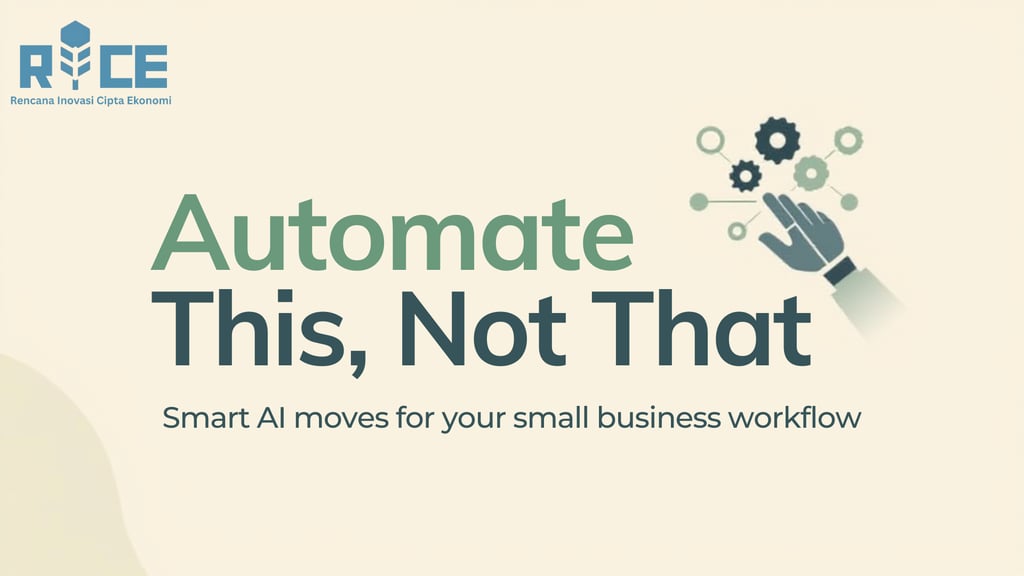
Automate This, Not That: Smart AI Moves for Your Small Business Workflow
Learn to automate high-impact tasks while preserving the human touch, boosting efficiency, customer experience, and growth.
INDUSTRIES
Rice AI (Ratna)
2/11/20268 min read
The future of small business is inextricably linked with Artificial Intelligence (AI). We are at the precipice of a new era where strategic AI integration isn't just an advantage, but a necessity for sustained growth and competitiveness. Many small business owners, however, grapple with the daunting question: where do I even begin? The key isn't to automate everything, but rather to automate smartly, distinguishing between high-impact applications and those that could lead to more headaches than efficiencies.
This guide will illuminate the path, helping you identify crucial areas where AI can truly transform your operations. We’ll explore what to automate to gain significant leverage and what to approach with caution, ensuring your AI initiatives yield genuine value without compromising essential human elements. By understanding these distinctions, small businesses can harness the power of AI to boost productivity, enhance customer experiences, and unlock unprecedented growth.
The Strategic Imperative: Why Smart Automation Matters for Small Businesses
In today’s dynamic market, small businesses often operate with lean teams and limited resources. This makes efficiency and strategic resource allocation paramount. AI offers a powerful solution, but its adoption must be purposeful and well-informed to truly move the needle.
Understanding AI's True Potential for SMEs
AI, or Artificial Intelligence, extends far beyond simple chatbots. For small businesses, it encompasses tools that can analyze vast datasets, learn from patterns, automate repetitive tasks, and even make predictions. The true potential lies in its ability to augment human capabilities, freeing up valuable time for strategic thinking and creative problem-solving. This shift allows small business owners to focus on core competencies and innovation, rather than getting bogged down in mundane operational tasks.
Beyond Simple Task Automation: Identifying High-Impact Areas
While automating routine tasks like scheduling emails or basic data entry is beneficial, smart AI moves go deeper. They involve leveraging AI to solve complex problems, improve decision-making, and create new value. Think about areas where significant time is consumed, errors are common, or insights are difficult to extract manually. These are often the prime candidates for intelligent automation. Identifying these strategic touchpoints is where the true competitive advantage begins to emerge, allowing for more impactful use of artificial intelligence in your daily operations.
The Cost of Inefficient AI Adoption
Rushing into AI implementation without a clear strategy can be costly. It can lead to wasted resources, integration challenges, and disillusionment when expected results don't materialize. Automating the wrong tasks, or over-automating processes that require human nuance, can alienate customers and staff alike. Furthermore, implementing complex AI systems without adequate data readiness or technical support can create new bottlenecks instead of resolving existing ones. This highlights the importance of a thoughtful, phased approach to AI strategy, especially for small businesses.
Automate This: High-Impact AI Applications for Small Businesses
Strategic AI adoption focuses on areas where AI can deliver substantial ROI by optimizing processes, enhancing customer interaction, and providing actionable insights. These are the "automate this" scenarios that can truly transform a small business workflow.
Customer Service: Elevating Engagement with AI Chatbots & Virtual Assistants
One of the most immediate and impactful areas for AI is customer service. AI-powered chatbots and virtual assistants can handle routine inquiries 24/7, answer FAQs, guide customers through processes, and even resolve common issues without human intervention. This ensures consistent, fast support, improving customer satisfaction and freeing human agents to tackle more complex or sensitive cases. Imagine your small business offering round-the-clock support, a service typically reserved for larger enterprises. Rice AI understands these unique challenges and offers tailored AI solutions that integrate seamlessly into your existing customer support infrastructure, helping you elevate engagement efficiently.
Personalized Marketing & Sales Automation
AI excels at processing and understanding customer data, making it invaluable for marketing and sales.
* Targeted Advertising: AI algorithms can analyze customer demographics, behavior, and preferences to segment audiences and deliver highly personalized ad campaigns. This maximizes ad spend efficiency by reaching the right people with the right message.
* Lead Scoring & Nurturing: AI can score leads based on their likelihood to convert, helping sales teams prioritize their efforts. Automated email sequences, personalized content recommendations, and dynamic pricing adjustments can be triggered by AI, nurturing leads more effectively.
Content Creation: Tools powered by generative AI can assist in drafting marketing copy, social media posts, and even blog outlines, significantly accelerating content production.
Data Analysis for Smarter Decision-Making
Small businesses collect a wealth of data, often without the means to fully leverage it. AI can transform this raw data into actionable insights.
* Sales Forecasting: AI models can analyze historical sales data, market trends, and external factors to predict future sales with greater accuracy. This aids in inventory management, staffing, and strategic planning.
* Operational Optimization: AI can identify inefficiencies in supply chains, production processes, or service delivery, suggesting improvements that lead to cost savings and increased throughput.
* Customer Insights: Beyond personalization, AI can uncover deeper customer preferences, common pain points, and emerging trends, informing product development and service enhancements. Rice AI’s analytical tools are designed to make complex data accessible and understandable for small business owners, turning raw numbers into strategic advantages.
Streamlining Back-Office Operations
Many administrative tasks, while necessary, consume considerable time and resources. AI can significantly streamline these internal processes.
* HR and Onboarding: AI can automate parts of the recruitment process, such as resume screening and initial candidate communication. For onboarding, AI can manage document collection, automate training module assignments, and answer common new-hire questions.
* Accounting and Finance Support: AI-powered tools can automate invoice processing, expense categorization, reconciliation of transactions, and even flag potential financial anomalies. This reduces manual errors and frees up accounting staff for higher-level financial analysis.
* Inventory Management: For retail or manufacturing small businesses, AI can predict demand fluctuations, optimize stock levels, and automate reordering, minimizing waste and ensuring product availability.
Not That: Where Small Businesses Should Exercise Caution with AI
While AI's potential is vast, it's equally important to understand its limitations and avoid missteps that could harm your business. These are the "not that" scenarios, urging a thoughtful and often human-centric approach.
Avoiding Common Pitfalls in AI Implementation
The allure of AI can sometimes lead to hasty decisions. A common pitfall is attempting to automate processes that are too complex, too nuanced, or require a level of creative problem-solving that current AI simply cannot replicate. Another mistake is failing to adequately prepare data for AI systems; garbage in, garbage out holds true for artificial intelligence. Without clean, relevant, and sufficient data, even the most sophisticated AI will underperform. Over-reliance on AI without human oversight can also lead to critical errors going unnoticed, impacting reputation and profitability.
Don't Automate Empathy: The Human Touch Remains Paramount
At the heart of many small businesses is a personal connection with customers. AI, while efficient, struggles with genuine empathy, complex emotional understanding, and nuanced communication.
* Sensitive Customer Interactions: For complaints, unique problems, or highly personalized sales, a human touch builds trust and loyalty in a way AI cannot.
* Creative Problem Solving: When a customer has an issue that falls outside predefined scripts or requires an innovative solution, human intervention is indispensable.
* Building Relationships: Long-term customer relationships thrive on genuine connection. Automating every interaction can strip away the very essence that makes a small business special. Always ensure there’s a clear escalation path to a human for complex or emotionally charged interactions.
Data Overload vs. Actionable Insights
AI systems can process enormous amounts of data. However, simply having more data or generating countless reports doesn't equate to better decision-making. The "not that" here is failing to curate and interpret the data intelligently.
* Irrelevant Data: Feeding AI systems with irrelevant data can lead to skewed insights and misguided strategies. Focus on collecting data that directly supports your business objectives.
Lack of Interpretation: AI can present patterns, but human intelligence is crucial for interpreting what those patterns mean* for your specific business context, customer base, and market.
* Analysis Paralysis: Generating too many metrics or reports without a clear strategy for using them can lead to analysis paralysis, where decision-making becomes bogged down rather than accelerated. Rice AI helps filter the noise, focusing on delivering truly actionable intelligence.
The Trap of Over-Customization Early On
While custom AI solutions can be powerful, for small businesses, starting with highly customized, complex systems can be an expensive and unnecessary trap.
* High Initial Investment: Developing bespoke AI solutions requires significant upfront capital and specialized expertise, which may be beyond the reach of many SMEs.
* Maintenance Complexity: Custom systems often demand ongoing maintenance, updates, and specialized IT support, adding to operational costs.
* Limited Flexibility: Over-customized solutions might be less adaptable to changing business needs or evolving market conditions compared to more modular, off-the-shelf AI tools. Begin with proven, scalable AI solutions and consider customization only when specific, high-value needs are clearly identified and validated.
Implementing AI Strategically: A Roadmap for Small Business Owners
Embarking on your AI journey requires a methodical approach. A strategic roadmap ensures that your investments in artificial intelligence yield tangible returns and contribute positively to your business’s future.
A Phased Approach to AI Integration
Rather than a "big bang" implementation, a phased approach allows small businesses to test the waters, learn, and adapt. Start with smaller, less critical areas, gain confidence, and then gradually expand AI's role across your operations. This minimizes risk and allows for continuous improvement. Iterative deployment helps build internal expertise and stakeholder buy-in, crucial for long-term success.
Step 1: Identify Your Bottlenecks and Opportunities
Before implementing any AI solution, thoroughly assess your current workflows.
* Pinpoint Pain Points: Where are processes slow, error-prone, or excessively manual? These are your primary targets for automation.
* Seek Growth Opportunities: Where could AI unlock new revenue streams, improve customer satisfaction, or enhance product offerings?
* Consult Your Team: Your employees are on the front lines and often have the best insights into operational inefficiencies and areas where AI could genuinely assist. Prioritizing processes that are repetitive, rules-based, and high-volume will typically offer the quickest returns on your AI investment.
Step 2: Pilot Small, Prove Value, Then Scale
Once you’ve identified a high-impact area, select a specific AI tool or solution and implement it on a small scale.
* Define Clear Metrics: Establish measurable goals for your pilot project (e.g., reduce customer response time by X%, automate Y% of data entry).
* Monitor and Evaluate: Closely track the performance of the AI solution against your metrics. Gather feedback from employees and customers.
* Iterate and Optimize: Use the insights gained from the pilot to refine the AI's configuration, adjust processes, and address any unforeseen challenges.
* Scale Gradually: Only when the pilot has demonstrably proven its value should you consider expanding the AI solution to wider applications across your business. This pragmatic approach minimizes financial risk and ensures that your AI investments are truly impactful. Rice AI can help small businesses structure these pilot programs effectively, providing the framework and support needed to prove value quickly and efficiently.
Step 3: Prioritize Data Readiness and Ethical Considerations
Successful AI relies heavily on high-quality data. Simultaneously, ethical considerations are non-negotiable.
* Data Quality and Accessibility: Ensure your data is clean, accurate, consistent, and easily accessible. Invest in data hygiene practices. Without robust data, AI systems cannot learn effectively or provide reliable insights.
* Privacy and Security: Understand the data privacy implications of any AI solution you implement. Comply with all relevant regulations (e.g., GDPR, CCPA). Secure customer and business data meticulously.
Transparency and Fairness: Be transparent with employees and customers about how AI is being used. Address potential biases in AI algorithms to ensure fair treatment and equitable outcomes. As a trusted partner, Rice AI prioritizes ethical AI development and deployment, helping you navigate these complex considerations responsibly.
The Future is Smart: Embracing AI with Rice AI
The journey of AI integration for small businesses is not about replacing human ingenuity, but about augmenting it. By embracing a "automate this, not that" philosophy, small business owners can strategically deploy AI to elevate efficiency, enhance customer experiences, and foster sustainable growth. The distinction lies in understanding where AI can truly add value versus where human insight, empathy, and decision-making remain irreplaceable.
The era of merely considering AI has passed; now is the time for decisive, intelligent action. Whether it’s streamlining customer interactions, powering personalized marketing campaigns, or unlocking hidden insights from your data, the smart application of artificial intelligence offers an unparalleled competitive edge. Don't be overwhelmed by the possibilities; instead, empower your business by making informed, strategic choices about AI integration.
Ready to unlock the full potential of AI for your small business without falling into common traps? Rice AI specializes in guiding small businesses through this transformative journey. Our expertise helps you identify the "automate this" opportunities, navigate the "not that" pitfalls, and implement scalable AI solutions tailored to your unique needs. Let Rice AI be your strategic partner in building a smarter, more efficient, and more successful future.
#SmallBusinessAI #AIforSMB #WorkflowAutomation #SmartAI #BusinessEfficiency #DigitalTransformation #AITips #TechForBusiness #AutomateSmart #RiceAI #FutureOfWork #AIStrategy #SmallBizTech #ProductivityHacks #IntelligentAutomation #DailyAIIndustry
RICE AI Consultant
To be the most trusted partner in digital transformation and AI innovation, helping organizations grow sustainably and create a better future.
Connect with us
Email: consultant@riceai.net
+62 822-2154-2090 (Marketing)
© 2025. All rights reserved.
+62 851-1748-1134 (Office)
IG: @riceai.consultant