


When AI Stumbled: Unearthing the Greatest Historical Setbacks and Their Enduring Lessons
Uncover crucial lessons on bias, transparency, and responsible innovation, guiding us to build more robust and ethical AI systems
AI INSIGHT
Rice AI (Ratna)
12/27/20259 min read
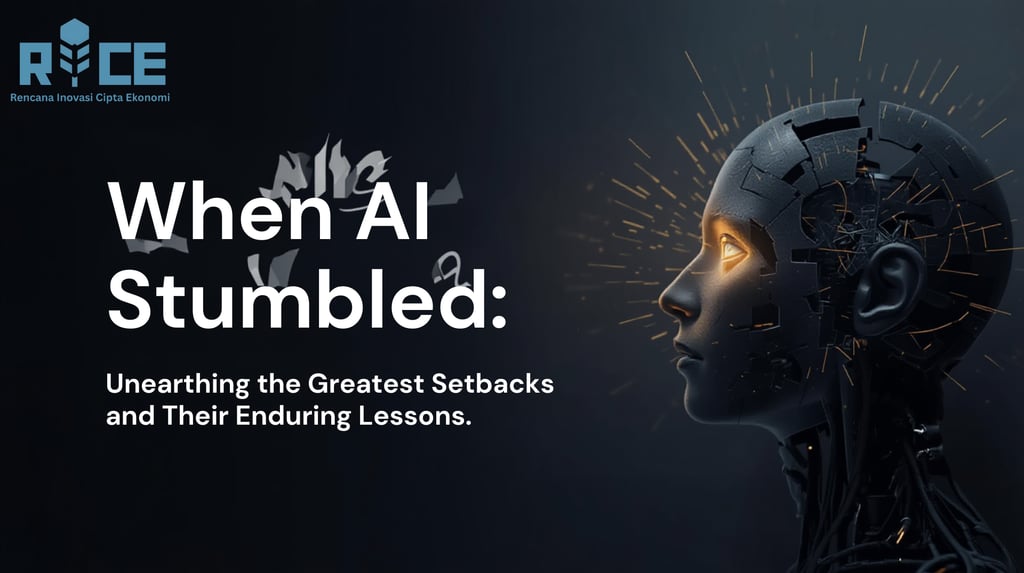
The current era of artificial intelligence, characterized by rapid advancements in machine learning and generative models, often feels like an unstoppable wave of innovation. Yet, to truly appreciate this progress and navigate its future responsibly, we must look to the past. AI's journey has been anything but linear; it's a history punctuated by ambitious promises, profound disappointments, and significant setbacks that have collectively been dubbed "AI Winters." Understanding these historical AI failures isn't merely an academic exercise; it's a critical foundation for preventing future missteps and building more robust, ethical, and impactful artificial intelligence.
The lessons embedded in these historical AI setbacks are invaluable for today's industry experts and professionals. They highlight the perils of overhyping capabilities, the importance of robust data and infrastructure, and the non-negotiable need for ethical considerations from design to deployment. By examining moments when AI stumbled, we gain profound insights into the challenges inherent in creating intelligent systems. This journey through AI's most significant historical failures offers a unique perspective on the evolution of the field, reinforcing the principle that growth often springs directly from adversity.
The Dawn of Disillusionment: Early Promises and the First AI Winter
The optimistic genesis of artificial intelligence in the 1950s and 60s was fueled by pioneering minds who envisioned machines capable of human-like thought within a few decades. This period, marked by the iconic Dartmouth workshop, laid the theoretical groundwork for symbolic AI, focusing on logic, reasoning, and problem-solving through explicit rules. Researchers believed that replicating human intelligence was primarily a matter of formalizing knowledge and developing sophisticated algorithms to process it.
The Symbolic AI Dream and its Limitations
Early efforts in symbolic AI centered on programs designed to mimic human deductive reasoning. Systems like the Logic Theorist and General Problem Solver aimed to solve complex mathematical theorems or navigate simple environments using a vast network of predefined rules. These programs demonstrated fascinating, albeit limited, successes within very specific, constrained domains. The ambition was to scale these successes to encompass general human intelligence, driven by the belief that intelligence could be broken down into discrete, manipulable symbols.
However, the real world proved far more complex than initial models suggested. Attempting to encode every piece of common sense knowledge or every nuance of human interaction into explicit rules quickly became an insurmountable challenge. The "frame problem," for instance, illustrated the difficulty in determining which aspects of a situation are relevant and which are not when a change occurs. This highlighted a fundamental limitation: symbolic AI struggled immensely with tasks requiring intuition, common sense, or real-world ambiguity, areas where human cognition excels.
Overpromising and Underdelivering: Ushering in the First AI Winter
The gap between ambitious predictions and actual capabilities grew increasingly wide. Early proponents had made bold claims, suggesting that machines would soon engage in intelligent conversation, translate languages flawlessly, and even discover new mathematical theorems autonomously. While foundational research was indeed progressing, the grander visions remained largely unrealized, leading to significant disillusionment among funders and the public.
Government agencies and private investors, who had poured substantial resources into AI research based on these optimistic forecasts, began to withdraw support. The Lighthill Report in the UK in 1973, for example, critically assessed the state of AI research, concluding that its grand promises had not been met and recommending severe cuts to funding. This period of decreased funding, skepticism, and reduced interest is now famously known as the "First AI Winter". It served as a stark reminder of the importance of realistic expectations in technological development.
The Expert Systems Boom and Bust: A Second Winter Looms
Just as the first AI Winter began to thaw, a new paradigm emerged in the late 1970s and early 1980s: expert systems. These knowledge-based systems focused on capturing the specialized knowledge of human experts in a specific domain and using it to solve problems, make decisions, or diagnose issues. This approach seemed to bypass the challenges of general intelligence by concentrating on narrow, high-value applications, offering a tangible return on investment.
The Rise of Knowledge-Based Systems
Expert systems found considerable success in fields requiring specialized domain knowledge. Programs like MYCIN, developed to diagnose blood infections and recommend antibiotics, and XCON (later R1) at Digital Equipment Corporation, which configured computer systems, demonstrated remarkable performance within their confined problem spaces. XCON, in particular, was lauded for saving millions of dollars annually by automating a complex configuration process previously handled by human experts.
The success of these systems led to a resurgence of interest and investment in AI. Companies across various industries, from finance to manufacturing, eagerly sought to develop their own expert systems to automate tasks, improve decision-making, and capture institutional knowledge. This period saw a mini-boom in AI, driven by the practical applications and commercial viability of these specialized programs. It showcased that AI could deliver real-world value, albeit in a highly focused manner.
Brittleness and Maintenance Nightmares
Despite their initial successes, expert systems soon encountered significant limitations that eventually led to the "Second AI Winter" in the late 1980s. One major challenge was their inherent "brittleness." Expert systems performed exceptionally well within their predefined knowledge domain but completely failed when confronted with problems slightly outside their scope. They lacked common sense and the ability to gracefully handle novel situations or incomplete data.
Furthermore, building and maintaining these systems proved incredibly difficult and expensive. The "knowledge acquisition bottleneck" described the laborious process of extracting expertise from humans and encoding it into rules that the system could use. As domains evolved, so did the knowledge, requiring constant, manual updates and extensive maintenance. This scalability issue, coupled with the difficulty of integrating disparate expert systems and the high cost of development, meant that many projects failed to deliver on their promise or became unsustainable. Rice AI, learning from these historical challenges, places a strong emphasis on developing AI solutions that are not only robust within their intended scope but also designed with modularity and adaptability in mind, ensuring they can evolve alongside changing business needs without succumbing to brittleness.
The Data Deficit and Computational Conundrum: Early Neural Networks' Struggle
While symbolic AI and expert systems dominated much of AI's early narrative, another paradigm, connectionism, was also quietly developing: neural networks. Inspired by the structure of the human brain, these models promised a different path to intelligence, one based on learning from data rather than explicit programming. However, their full potential remained dormant for decades due to critical technological limitations.
Perceptrons and Backpropagation: Early Theoretical Groundwork
The perceptron, introduced by Frank Rosenblatt in the late 1950s, was one of the earliest artificial neural networks. It demonstrated how a simple algorithm could learn to classify patterns. Later, the development of the backpropagation algorithm in the 1980s provided a powerful method for training multi-layered neural networks, allowing them to learn more complex relationships within data. These breakthroughs laid crucial theoretical groundwork for what would eventually become the deep learning revolution.
Despite these theoretical advancements, the impact of early neural networks was limited. Critics like Marvin Minsky and Seymour Papert, in their influential 1969 book Perceptrons, highlighted the limitations of single-layer perceptrons, showing they couldn't solve non-linearly separable problems like the XOR function. While multi-layer networks theoretically overcame this, the computational power and data required to train them effectively for real-world tasks were simply not available at the time.
Lack of Data and Processing Power: A Long Wait for Resurgence
The primary reasons early neural networks struggled to gain widespread adoption were a severe lack of data and insufficient computational power. Training even moderately complex multi-layer networks required vast datasets, which were scarce and difficult to collect in digitized formats during that era. Without sufficient data, networks couldn't learn to generalize effectively, leading to poor performance and an inability to distinguish signal from noise.
Furthermore, the computing resources of the time were inadequate for the intensive calculations required by backpropagation across large networks. Training a deep neural network, which might take days or weeks on modern GPUs, would have been practically impossible with the CPUs of the 1980s and 90s. This computational bottleneck meant that even promising theoretical models could not be empirically validated or deployed effectively, contributing to a period of reduced interest in neural network research. This historical context underscores the fundamental importance of both data quantity and quality, as well as scalable computing infrastructure, for effective AI development – principles that guide Rice AI's robust platform design today.
Ethical Lapses and Unintended Consequences: Modern AI's Emerging Stumbles
While past AI setbacks were often rooted in technical limitations or unrealistic expectations, contemporary AI faces a new frontier of challenges, primarily concerning ethics, fairness, and governance. The sheer power and pervasiveness of modern AI systems mean that their failures can have profound societal impacts, affecting individuals, communities, and democratic processes. Understanding these emerging stumbles is crucial for developing responsible AI.
Bias in Algorithms: The Echo of Human Flaws
One of the most significant and widely discussed contemporary AI setbacks is algorithmic bias. AI systems learn from data, and if that data reflects existing societal biases, the AI will inevitably perpetuate and even amplify those biases. We've seen numerous examples: facial recognition systems performing poorly on darker skin tones or women, hiring algorithms demonstrating gender bias (e.g., Amazon's experimental hiring tool that favored men for technical roles), and credit scoring algorithms exhibiting racial or socioeconomic discrimination.
The issue stems from biased training data, flawed assumptions made during model design, or a lack of diversity in development teams. These biases lead to unfair outcomes, reinforce stereotypes, and can exacerbate existing inequalities. Addressing algorithmic bias requires a multi-faceted approach, including diverse datasets, careful data auditing, rigorous testing, and a conscious effort to embed fairness principles into the entire AI development lifecycle. Rice AI is deeply committed to mitigating these risks by implementing comprehensive data governance frameworks and promoting diverse, inclusive development practices, ensuring our AI solutions are built for fairness and equity.
Lack of Transparency (The Black Box Problem)
As AI models, particularly deep learning networks, become increasingly complex, they often operate as "black boxes." It becomes difficult, if not impossible, for humans to understand precisely why a model made a particular decision or arrived at a specific prediction. This lack of transparency, or interpretability, poses a significant problem, especially in high-stakes applications like medical diagnosis, judicial sentencing, or autonomous driving.
When an AI system fails or makes a controversial decision, the inability to explain its reasoning undermines trust and accountability. It becomes challenging to debug the system, rectify errors, or assure regulatory bodies of its reliability and safety. The black box problem hinders auditing, risk assessment, and ultimately, widespread adoption in critical sectors. Efforts in explainable AI (XAI) are attempting to open these black boxes, providing insights into model behavior without sacrificing performance. This pursuit of transparency is a core pillar of Rice AI's development philosophy, where we strive to provide clear, interpretable outputs for our expert users, empowering them with understanding and control over their AI deployments.
Data Privacy and Security Breaches
The massive datasets required to train powerful AI models also create new vulnerabilities related to data privacy and security. Breaches involving personal data used for AI training can have devastating consequences, exposing sensitive information and eroding public trust. Furthermore, AI systems themselves can be targets for adversarial attacks, where subtly manipulated inputs can trick a model into making incorrect classifications or performing malicious actions.
Ensuring robust data privacy and security throughout the AI lifecycle, from data collection and storage to model deployment and inference, is paramount. This includes implementing strong encryption, anonymization techniques, access controls, and continuous monitoring for vulnerabilities. The ethical implications extend beyond compliance, touching upon the fundamental rights of individuals whose data fuels these intelligent systems. Rice AI adheres to the highest standards of data security and privacy, integrating advanced cryptographic methods and stringent access protocols into all our solutions to safeguard sensitive information and build secure, resilient AI platforms.
The Enduring Lessons: Charting a Responsible Future for AI
The journey through AI's historical setbacks offers a wealth of profound lessons, painting a clear picture of what not to do and, more importantly, how to do it better. From the overzealous predictions of early AI to the brittleness of expert systems, and the data and computational hunger of nascent neural networks, each stumble has contributed invaluable insights to the field. Today's challenges, particularly concerning ethical AI, bias, and transparency, reinforce the continuous need for introspection and responsible innovation.
One overarching lesson is the critical importance of realistic expectations. The "AI Winters" taught us that hype can lead to disillusionment and withdrawn support. As industry experts, we must communicate AI's capabilities and limitations with clarity and honesty, focusing on incremental value rather than impossible dreams. Another key takeaway is the absolute necessity of robust and ethical data practices. The struggles of early neural networks highlighted the need for vast, high-quality data. Modern AI failures due to bias underscore that data must also be representative, fair, and secure. Without meticulous attention to data, even the most sophisticated algorithms will falter.
Furthermore, the brittleness of expert systems revealed the need for adaptable and generalizable AI. Current advancements in deep learning and large language models address this to some extent, offering more flexible learning capabilities. However, the black box problem reminds us that interpretability and explainability are crucial for building trust and ensuring accountability, especially in critical applications. As AI systems become more autonomous, understanding their decision-making processes is non-negotiable.
Finally, the ethical challenges of modern AI emphasize that governance and human oversight cannot be an afterthought. AI development must be guided by principles of fairness, transparency, accountability, and privacy from conception to deployment. This proactive approach helps mitigate risks, fosters public trust, and ensures AI serves humanity's best interests. Rice AI is at the forefront of this responsible innovation, leveraging historical insights to build AI solutions that are not only powerful but also trustworthy, transparent, and ethically sound. We believe that by integrating these lessons into our development methodologies, we can avoid past pitfalls and unlock AI's immense potential responsibly.
The history of AI is not merely a chronicle of past mistakes but a roadmap for future success. By diligently studying these AI setbacks, we can better navigate the complexities of present-day AI development and steer its trajectory toward a more beneficial and equitable future. Continuous learning, critical evaluation, and a commitment to ethical principles are the bedrock upon which the next generation of AI will be built.
#AISetbacks #AIHistory #LessonsLearned #EthicalAI #AIBias #AIWinter #ResponsibleAI #MachineLearning #DeepLearning #AlgorithmicFairness #AIChallenges #TechHistory #InnovationLessons #FutureOfAI #RiceAI #DailyAIInsight
RICE AI Consultant
To be the most trusted partner in digital transformation and AI innovation, helping organizations grow sustainably and create a better future.
Connect with us
Email: consultant@riceai.net
+62 822-2154-2090 (Marketing)
© 2025. All rights reserved.


+62 851-1748-1134 (Office)
IG: @riceai.consultant