

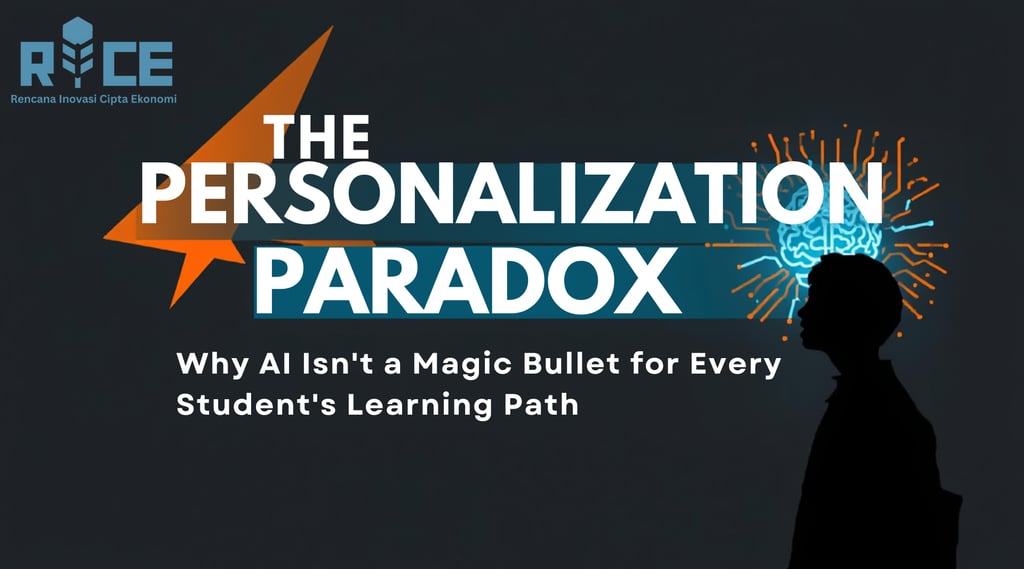
The Personalization Paradox: Why AI Isn't a Magic Bullet for Every Student's Learning Path
This article examines AI's strengths and critical limitations, advocating for a human-centric approach in education.
INDUSTRIES
Rice AI (Ratna)
1/13/20267 min read
The promise of artificial intelligence in education is compelling: hyper-personalized learning paths, tailored content, and adaptive assessments designed to unlock every student's full potential. It paints a picture of a future where no learner is left behind, where every curriculum dynamically adjusts to individual needs and paces. This vision, while inspiring, often overlooks a critical reality—the "personalization paradox." While AI undoubtedly offers transformative tools, a deeper examination reveals it is not a universal magic bullet capable of independently crafting truly effective learning journeys for every student.
The enthusiastic embrace of AI in our classrooms requires a nuanced perspective. We must critically assess where AI excels, where it falls short, and how it can best augment, rather than replace, the indispensable human element in education. This piece will delve into the complexities of AI-driven personalization, highlighting its limitations and advocating for a balanced, human-centric approach to truly revolutionize learning.
The Allure of AI-Driven Individualization
The excitement around AI in education is understandable. Its capacity for processing vast amounts of data and adapting algorithms offers solutions to long-standing challenges in mass education. The theoretical benefits of AI-driven individualization are significant, promising to optimize learning outcomes unlike ever before.
Adaptive Learning Systems: A Closer Look
AI-powered adaptive learning systems represent the forefront of personalized education technology. These platforms utilize sophisticated algorithms to analyze a student's performance, identifying strengths, weaknesses, and preferred learning modalities. Based on this data, the system dynamically adjusts the difficulty, pace, and presentation of content. For instance, if a student struggles with a particular math concept, the system can provide additional exercises, supplementary materials, or alternative explanations until mastery is achieved. Conversely, a student excelling might be presented with more challenging problems or advanced topics. This responsiveness theoretically optimizes engagement and efficiency, particularly in subjects requiring repetitive practice or foundational skill acquisition, such as language acquisition or basic mathematics.
Data-Driven Insights and Student Pathways
Beyond immediate content delivery, AI offers powerful data analytics capabilities. It can track student progress across numerous metrics, predict future performance, and even flag students at risk of falling behind. This allows educators to gain insights into learning patterns that would be impossible to discern manually. The theoretical ideal is a system that maps out an optimal learning pathway for every student, continuously refining it based on real-time data, ensuring each learner is on the most efficient and effective route to knowledge acquisition. This ability to inform instructional decisions with robust data is a cornerstone of the appeal of AI in education and personalized learning platforms.
Unpacking the Limitations: Where AI Falls Short
Despite its undeniable strengths, AI personalization encounters significant hurdles when confronted with the multifaceted nature of human learning. The "magic bullet" narrative falters when we consider the aspects of education that extend beyond quantifiable data points.
Beyond Algorithms: The Non-Quantifiable Aspects of Learning
Human learning is not merely the consumption and recall of information; it is deeply intertwined with emotional, social, and creative development. These crucial, non-quantifiable aspects often lie beyond the current capabilities of even the most advanced AI.
Emotional Intelligence and Social Development
AI, by its nature, operates on algorithms and data patterns. It struggles immensely with understanding and responding to the complex spectrum of human emotions. A student’s motivation, frustration, anxiety, or excitement profoundly impacts their learning experience. A human teacher can sense a student's discouragement, offer a comforting word, or adjust their approach to re-engage. AI lacks this emotional intelligence and empathetic capacity. Furthermore, much of learning occurs through social interaction—peer collaboration, group discussions, and the dynamic interplay between student and teacher. These interactions foster critical social learning skills, such as negotiation, conflict resolution, and perspective-taking, which AI cannot replicate. Without the human touch, important aspects of student well-being and holistic development can be overlooked.
Critical Thinking and Creativity's Nuances
While AI can be an excellent tool for drilling facts or solving well-defined problems, it struggles to foster true critical thinking and creativity. These higher-order skills demand divergent thinking, questioning assumptions, synthesizing disparate ideas, and generating novel solutions—processes that often defy algorithmic prediction. A human educator can challenge a student's perspective, encourage debate, or guide them through ambiguous problem spaces where there isn't a single "correct" answer. AI, typically trained on existing data, may default to reinforcing established patterns rather than encouraging innovative leaps. Real-world application of knowledge often requires nuanced judgment and an understanding of context that current AI systems find difficult to grasp, highlighting a significant limitation in fostering genuine intellectual curiosity and originality.
The Diversity of Learning Needs and Contexts
The concept of "personalization" itself is complex, encompassing far more than simply adjusting content difficulty. Students come from diverse backgrounds, possess unique cognitive profiles, and operate within varying socioeconomic landscapes, all of which influence how they learn.
One Size Does Not Fit All: Cognitive, Cultural, and Socioeconomic Factors
Effective personalization must account for the vast spectrum of human experience, which AI often struggles to fully integrate into its models. Overlooking these factors risks creating a personalized experience that is superficially tailored but fundamentally ineffective or even inequitable.
Neurodiversity and Unique Cognitive Profiles
The neurological diversity among students presents a profound challenge for AI personalization. Learners with neurodiversity in education, such as those with severe ADHD, dyslexia, or autism spectrum disorder, often require highly individualized pedagogical approaches that go beyond simple data-driven adjustments. While AI can assist with basic accommodations (e.g., text-to-speech for dyslexia), it may struggle with the nuanced, multi-modal, and often intuitive interventions that human educators provide. Understanding a student's specific cognitive learning styles, processing speeds, and executive function challenges demands a human educator's flexibility, empathy, and ability to observe subtle cues that fall outside typical data inputs. Achieving truly inclusive AI in these contexts requires significant human oversight and adaptation.
Cultural Context and Socioeconomic Disparities
Learning is not a culturally neutral activity. Educational content, teaching methodologies, and even the very concept of "success" are deeply embedded in cultural context. AI models, often trained on broad datasets, may lack the nuanced understanding necessary to truly personalize learning in a culturally sensitive manner. This can lead to content that feels alienating or irrelevant to students from diverse backgrounds. Furthermore, socioeconomic disparities significantly impact access to technology and digital literacy, creating a digital divide that AI personalization, if not carefully implemented, could exacerbate rather than bridge. If personalized learning relies heavily on advanced tech access, students from disadvantaged backgrounds may be further marginalized. AI's effectiveness in these scenarios is limited by its inability to fully comprehend the social and economic realities shaping a student's life and learning environment.
Reimagining the Educator's Role in an AI-Augmented Classroom
Acknowledging AI's limitations is not an indictment of the technology itself, but rather an invitation to redefine its role. The future of AI in education lies not in replacing human educators, but in creating a powerful synergy where human and artificial intelligences collaborate.
From Content Delivery to Facilitation and Mentorship
With AI handling many of the rote, data-intensive tasks—like adaptive drills, immediate feedback on basic assignments, and identifying knowledge gaps—human teachers are freed to focus on what they do best. The educator's role shifts from being primarily a content dispenser to a facilitator, mentor, and guide. Teachers can dedicate more time to fostering higher-order skills, such as critical thinking, creative problem-solving, and complex collaboration. They can provide the human connection that motivates, inspires, and supports students through emotional challenges. This reimagining of the educator role elevates teaching to its most impactful form, allowing for deeper engagement and more meaningful relationships, crucial for student well-being and overall development. The future of teaching sees the teacher as a skilled orchestrator of learning experiences, leveraging AI as a powerful assistant.
Strategic AI Integration for Enhanced Learning
The most effective human-AI collaboration will involve a strategic integration of AI's strengths to augment human instruction. AI can provide teachers with invaluable insights into student performance, allowing them to intervene proactively and personalize their teaching strategy for a group or individual. For example, AI might identify that a significant portion of a class is struggling with a particular concept, prompting the teacher to re-explain it using a different method.
At Rice AI, we recognize that true educational advancement comes from empowering educators, not replacing them. We develop sophisticated AI solutions that act as intelligent assistants, providing robust data analytics, administrative support, and adaptive tools designed to free up teachers' time. Our platforms offer actionable insights into learning patterns, helping educators identify individual needs and tailor their pedagogical approaches. We believe in strengthening the human element in education by providing teachers with the most advanced tools, ensuring they can focus on mentoring, fostering creativity, and building essential relationships. Our goal is to enhance, not diminish, the irreplaceable role of the human teacher, helping educational institutions navigate the complexities of educational technology with solutions that prioritize ethical AI and meaningful learning outcomes. Effective teacher training in utilizing these AI tools will be paramount to realizing their full potential, ensuring a harmonious blend of technology and human expertise.
Conclusion
The "personalization paradox" in AI-driven education reveals a profound truth: while artificial intelligence possesses extraordinary capabilities for data analysis and adaptive content delivery, it is not, and likely never will be, a standalone magic bullet for every student's learning path. Its limitations in understanding human emotion, fostering nuanced creativity, accommodating the full spectrum of neurodiversity, and appreciating cultural context are significant. Relying solely on algorithms risks reducing the rich tapestry of human learning to mere data points, potentially overlooking the very essence of what makes education transformative.
The future of learning is not one where AI supplants human interaction, but where it profoundly augments it. Human educators remain irreplaceable for their empathy, their ability to inspire, their capacity for nuanced judgment, and their fundamental role in fostering social-emotional development. The most effective AI in education strategies will be those that integrate technology seamlessly into a human-centric framework, empowering teachers and enhancing the learning experience without sacrificing the critical human element. By adopting a balanced, ethical, and collaborative approach, we can harness AI's power to create truly richer, more inclusive, and deeply personalized educational journeys for all students, ensuring that educational technology serves humanity's highest aspirations.
Ready to explore how AI can genuinely enhance learning without losing its human touch? Contact Rice AI today to discuss integrated solutions for your educational institution and discover how to navigate the future of learning effectively.
#AIEducation #PersonalizedLearning #EdTech #FutureOfEducation #HumanAICollaboration #LearningPathways #EducationInnovation #AIinLearning #TeachingWithAI #EduAI #SmartEducation #CustomLearning #DigitalLearning #EthicalAI #RiceAI
RICE AI Consultant
To be the most trusted partner in digital transformation and AI innovation, helping organizations grow sustainably and create a better future.
Connect with us
Email: consultant@riceai.net
+62 822-2154-2090 (Marketing)
© 2025. All rights reserved.

+62 851-1748-1134 (Office)
IG: @riceai.consultant