


Serverless AI's Next Frontier: A Predictive Comparison of Hybrid vs. Multi-Cloud Adoption
Understand key strategies for optimal AI performance, security, and cost-effectiveness.
TECHNOLOGY
Rice
12/10/20257 min read
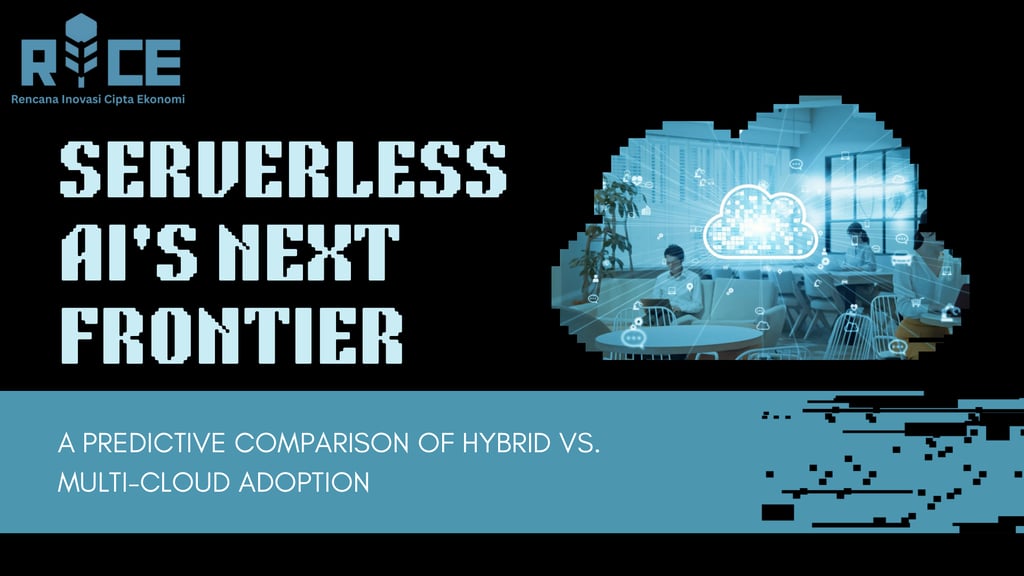
The landscape of Artificial Intelligence is evolving at an unprecedented pace, with serverless architectures emerging as a pivotal force. As organizations increasingly deploy sophisticated AI models, the foundational infrastructure decisions—specifically the choice between hybrid and multi-cloud strategies—become critical. This decision will profoundly shape how efficiently, securely, and scalably AI initiatives are delivered in the coming years.
The future of serverless AI hinges on intelligent cloud strategies that navigate complexity while maximizing performance and cost-effectiveness. Industry experts are now grappling with these strategic choices, predicting which models will dominate the next wave of AI innovation. Here at Rice AI, we specialize in demystifying these complexities, guiding enterprises towards optimal cloud architectures for their unique AI demands.
Understanding the Landscape of Serverless AI
Serverless AI represents a paradigm shift, enabling developers to build and deploy AI applications without the burden of infrastructure management. This abstraction liberates teams to focus entirely on model development and business logic, accelerating innovation.
The Promise of Serverless AI
Serverless computing allows AI models to execute on demand, dynamically scaling resources up or down based on actual usage. This inherently elastic nature makes it ideal for fluctuating AI workloads, ensuring optimal performance without over-provisioning. The core benefits include significant cost savings due to a pay-per-execution model, faster time-to-market for AI-powered products, and simplified operational overhead. Typical use cases span real-time inference for recommendation engines, event-driven data preprocessing pipelines, and responsive AI chatbots.
The Evolution Towards Distributed AI Architectures
Initially, many organizations deployed their AI workloads within a single cloud provider or solely on-premises. However, limitations such as vendor lock-in, the gravity of large datasets, and latency concerns for geographically dispersed users quickly surfaced. These challenges have spurred a definitive move towards more distributed AI architectures. The necessity for greater flexibility, resilience, and compliance is pushing enterprises to explore strategies that transcend single-provider dependencies. This shift underscores the critical role of hybrid and multi-cloud approaches in the next generation of AI deployments.
Hybrid Cloud: Bridging On-Premises and Public Clouds for AI
The hybrid cloud strategy offers a compelling pathway for organizations seeking to integrate their existing on-premises infrastructure with the dynamic capabilities of public cloud environments. This blend provides a powerful foundation for specific AI workloads.
Definition and Core Advantages
A hybrid cloud environment integrates a private cloud, typically residing on an organization's internal data centers, with one or more public cloud services. This allows for a seamless interplay between sensitive data and compliant workloads kept on-premises, and the scalable, on-demand compute resources of the public cloud. Key advantages for AI include superior data privacy and adherence to stringent regulatory compliance standards, particularly for industries handling personal or classified information. Furthermore, organizations can leverage their significant existing hardware investments while bursting less sensitive or compute-intensive AI tasks to the public cloud. This strategy also ensures low-latency access to highly sensitive data, which is crucial for real-time AI applications that cannot tolerate external data transfer delays.
Challenges and Adoption Dynamics
Despite its clear benefits, implementing a hybrid cloud for AI is not without complexities. Operational overhead can be substantial, requiring specialized skills to manage disparate environments and ensure consistent resource orchestration. Maintaining consistent development and deployment environments across private and public clouds often presents significant integration challenges. Data synchronization between on-premises and cloud resources also demands robust solutions to prevent inconsistencies and ensure data integrity. Predicting adoption, industries with strict data governance requirements, such as healthcare, financial services, and government sectors, are prime candidates for sophisticated hybrid AI strategies. Rice AI excels at navigating these complex hybrid environments, providing expert guidance and solutions to mitigate integration challenges and optimize performance.
Predictive Trajectory for Hybrid Serverless AI
Looking ahead, hybrid serverless AI is poised for significant growth in niche but critical areas. It will become the de facto standard for edge AI applications, where real-time inference close to the data source is paramount (e.g., smart factories, autonomous vehicles). Federated learning, a method where AI models are trained on decentralized data without explicit data sharing, also finds a natural home in hybrid architectures. This allows sensitive data to remain on-premises while collaborative model improvements occur. Expect to see substantial advancements in orchestration tools and unified control planes that abstract away much of the underlying complexity, making hybrid deployments more manageable and efficient.
Multi-Cloud: Maximizing Flexibility and Resilience for AI
In contrast to hybrid, a multi-cloud strategy embraces the use of multiple public cloud providers concurrently. This approach champions vendor neutrality and resilience, offering a distinct set of advantages for global AI deployments.
Definition and Core Advantages
Multi-cloud involves distributing workloads, including AI applications, across two or more public cloud platforms, such as AWS, Azure, and Google Cloud Platform. The primary advantage for AI is significant vendor independence, preventing reliance on a single provider's ecosystem and pricing structures. This strategy enhances disaster recovery capabilities by ensuring that an outage in one cloud does not cripple an entire AI operation, as workloads can failover to another provider. Multi-cloud also grants access to a wider array of specialized AI services and hardware accelerators, allowing organizations to cherry-pick the "best-of-breed" tools from different providers for specific AI tasks. Furthermore, it offers opportunities for cost optimization through cloud arbitrage, dynamically shifting workloads to the most cost-effective provider.
Challenges and Adoption Dynamics
Implementing a multi-cloud strategy introduces its own set of hurdles. The increased complexity in managing multiple cloud environments, each with its unique APIs, authentication mechanisms, and operational tools, can be daunting. Data transfer costs, particularly egress charges for moving data between clouds, can quickly accumulate and erode cost savings. Ensuring consistent security policies and governance across disparate cloud platforms also poses a significant challenge, leading to potential "security sprawl." We predict that multi-cloud will be favored by tech-forward companies and enterprises with global operations, seeking ultimate innovation, agility, and diversified risk. Rice AI offers comprehensive strategies to mitigate multi-cloud complexities, designing robust management frameworks and optimizing data flows to ensure seamless AI operations.
Predictive Trajectory for Multi-Cloud Serverless AI
The future of multi-cloud serverless AI is bright, particularly for organizations with a global footprint or those requiring hyper-specialized AI capabilities. We anticipate a surge in multi-cloud strategies for AI applications demanding global reach, enabling models to be deployed closer to diverse user bases for reduced latency. It will also be pivotal for leveraging specific cognitive services or custom hardware from different providers that excel in particular AI domains. The next generation will see the emergence of advanced multi-cloud management platforms that provide a unified pane of glass for monitoring, deploying, and managing serverless AI across all providers. Unified AI/MLOps platforms will simplify the orchestration of complex machine learning pipelines across heterogeneous cloud environments.
The Convergence: Where Hybrid Meets Multi-Cloud
As AI deployments mature, the clear distinctions between hybrid and multi-cloud are beginning to blur, pointing towards a future of integrated, flexible architectures. The industry is moving beyond binary choices.
Blurred Lines and Emerging Architectures
The lines separating hybrid and multi-cloud are becoming increasingly indistinct, with many enterprises now adopting a blended approach. We are witnessing the rise of truly "distributed hybrid multi-cloud" architectures, where sensitive data and critical real-time AI inference occur on-premises or at the edge, while massive data processing and less sensitive model training leverage multiple public clouds. This highly interconnected ecosystem emphasizes unified control planes and sophisticated abstraction layers that provide a consistent operational experience across all infrastructure components. The goal is a single, logical platform for AI development and deployment, regardless of the underlying physical location.
Key Decision Factors for AI Adoption
Choosing the right cloud strategy for serverless AI is a complex, multi-faceted decision. Several critical factors must be rigorously evaluated. Data gravity and its physical location heavily influence where AI computations can efficiently occur, especially for large datasets. Stringent regulatory and compliance requirements often dictate whether data can reside in the public cloud or must remain on-premises. Existing infrastructure investments represent sunk costs that can inform a hybrid approach. Performance and latency needs for specific AI workloads, particularly real-time applications, are paramount. Furthermore, the total cost implications, including data egress charges, compute resources, and storage, must be thoroughly analyzed. Finally, an organization's internal capabilities and skill sets will determine its ability to manage the complexity of each model. Rice AI provides strategic consulting to help define and implement tailored cloud strategies, ensuring your AI adoption aligns perfectly with your business goals and technical realities.
Predictive Outlook: A Tailored Approach Dominates
Our predictive outlook suggests that there will be no single "winner" in the hybrid versus multi-cloud debate. Instead, the future belongs to highly customized, dynamic strategies that selectively combine elements of both approaches. Organizations will architect their serverless AI solutions on a case-by-case basis, optimizing for specific AI use cases, data sensitivity, and performance requirements. Flexibility and adaptability will be the hallmarks of successful AI infrastructures, allowing enterprises to seamlessly shift workloads and leverage diverse resources as needs evolve. The "cloud continuum," extending from edge to core to multiple public clouds, will become the norm for sophisticated, high-performing serverless AI deployments.
Conclusion
The journey into serverless AI’s next frontier reveals a compelling landscape of strategic choices. Both hybrid and multi-cloud architectures offer distinct advantages, each presenting a viable path forward depending on an organization’s unique constraints and aspirations. Hybrid cloud provides a powerful solution for data sensitivity and leveraging existing investments, while multi-cloud champions flexibility, resilience, and specialized service access.
Our predictive analysis indicates that the future of serverless AI will be characterized by increasingly sophisticated, tailored cloud strategies. The choice is less about an exclusive commitment to one over the other, and more about intelligently integrating the strengths of both. Organizations will adopt customized solutions that blend on-premises security with multi-cloud agility, optimizing for specific AI use cases, data governance, and performance metrics. This necessitates continued innovation in orchestration, management, and security tools that can span these complex, heterogeneous environments.
Navigating this evolving landscape requires deep expertise and a forward-thinking approach. Rice AI stands as your trusted partner, providing unparalleled insights and practical solutions for designing, implementing, and optimizing serverless AI deployments across complex hybrid and multi-cloud environments. We empower enterprises to make informed decisions, transforming predictive trends into tangible, high-performing AI capabilities. Let Rice AI guide your organization through the complexities of cloud-native AI, ensuring your infrastructure is robust, scalable, and future-proof.
#ServerlessAI #HybridCloud #MultiCloud #AIStrategy #CloudAdoption #MachineLearning #AIOps #CloudComputing #EnterpriseAI #DigitalTransformation #FutureOfAI #RiceAI #AIInnovation #CloudArchitecture #DataPrivacy #DailyAITechnology
RICE AI Consultant
To be the most trusted partner in digital transformation and AI innovation, helping organizations grow sustainably and create a better future.
Connect with us
Email: consultant@riceai.net
+62 822-2154-2090 (Marketing)
© 2025. All rights reserved.


+62 851-1748-1134 (Office)
IG: @riceai.consultant