

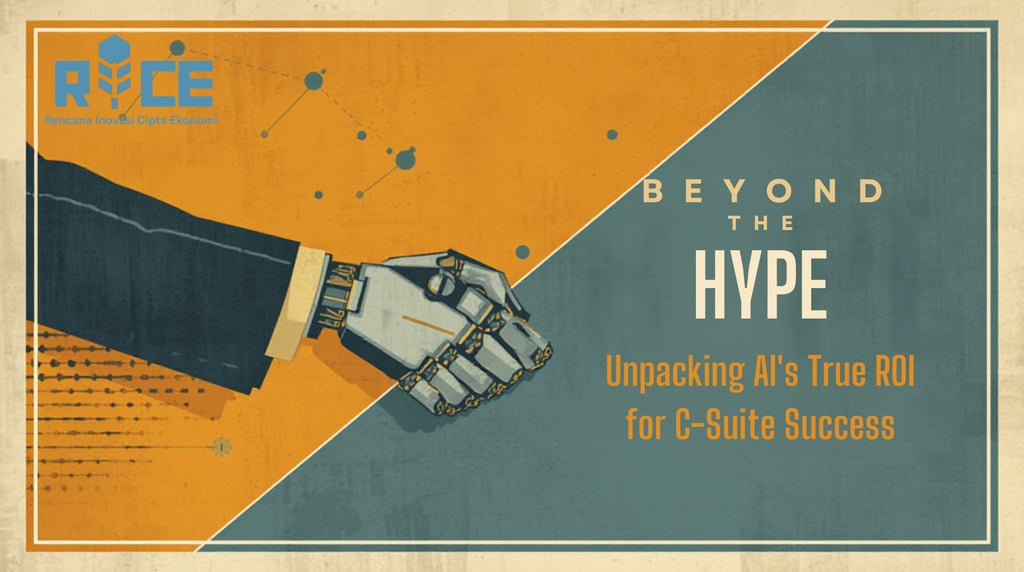
Beyond the Hype: Unpacking AI's True ROI for C-Suite Success
Move beyond hype to strategic alignment, measurable gains, and successful implementation for sustained competitive advantage.
INDUSTRIES
Rice AI (Ratna)
3/16/20267 min read

The era of Artificial Intelligence is not just arriving; it has firmly embedded itself in global business discourse. Boardroom discussions frequently revolve around AI's transformative potential, often accompanied by a mix of enthusiasm and skepticism. While the initial wave of AI hype focused on groundbreaking technological feats, C-suite leaders are now rightly shifting their gaze. The critical question is no longer merely "What can AI do?" but rather, "What tangible, measurable return on investment (ROI) can AI deliver for our strategic objectives?"
Navigating this complex landscape requires more than just understanding the technology; it demands a strategic perspective that aligns AI initiatives directly with core business outcomes. True C-suite success in the age of AI hinges on moving beyond pilot projects and superficial implementations. It’s about building a robust framework for identifying, implementing, and rigorously measuring AI’s impact across the enterprise. This blog post delves into how executive leadership can effectively unpack AI's true ROI, ensuring that every AI investment propels the organization forward.
The Strategic Imperative: Aligning AI with Business Objectives
For AI to truly deliver value, it must be intricately woven into the fabric of an organization's strategic vision. Piecemeal adoption or technology-first approaches often lead to isolated successes that fail to scale or impact the broader business. A top-down mandate for AI integration, guided by clear business objectives, is paramount.
From Pilot Projects to Pervasive Impact
Many organizations begin their AI journey with small, contained pilot projects. While these can be valuable for learning and validation, they often struggle to transition into widespread enterprise adoption. The challenge lies in scaling these initial successes into pervasive solutions that fundamentally transform operations and deliver sustained value. C-suite leaders must ensure that every AI initiative is evaluated not just on its technical merit but on its potential for broad, strategic impact. This involves fostering a culture where AI is seen as a strategic enabler, rather than merely a departmental tool.
Strategic alignment means moving beyond ad-hoc experimentation. It demands a holistic view of how AI can enhance competitive advantage, optimize resource allocation, and drive innovation across all business units. Without this overarching strategic perspective, AI efforts risk becoming fragmented and failing to achieve their full ROI potential.
Identifying High-Value Use Cases
The most significant AI ROI stems from identifying use cases that address critical business challenges or unlock substantial new opportunities. This requires a deep understanding of organizational pain points and strategic priorities. High-value use cases often fall into categories such as enhancing customer experience, optimizing operational efficiency, reducing costs, or mitigating risks.
For instance, applying AI to predictive maintenance in manufacturing can significantly reduce downtime and maintenance costs. In customer service, AI-powered chatbots and virtual assistants can improve response times and resolution rates. Each potential application must be rigorously assessed for its alignment with strategic goals and its potential for measurable impact. Crucially, the success of these use cases heavily depends on the availability of high-quality, relevant data to train and operate AI models effectively.
Quantifying the Returns: A New Lens for ROI
Measuring AI's ROI demands a sophisticated approach that goes beyond traditional financial metrics. While direct cost savings and revenue gains are important, the strategic and indirect benefits often represent the true long-term value. C-suite leaders need a comprehensive framework to assess both tangible and intangible returns.
Direct Financial Gains: Tangible Metrics
Direct financial gains are the most straightforward aspect of AI ROI measurement. These typically manifest as increased revenue, reduced operational expenses, and improvements in productivity. For example, AI-driven automation in back-office processes can significantly cut administrative costs and free up human capital for higher-value tasks. AI in sales and marketing can enhance lead generation, personalize customer interactions, and optimize pricing strategies, directly contributing to revenue growth.
Consider AI in supply chain management, where predictive analytics can optimize inventory levels, reduce waste, and streamline logistics, leading to substantial cost savings. In financial services, AI-powered fraud detection systems can minimize losses and protect revenue. The key is to establish clear, quantifiable KPIs before implementation and continuously monitor performance against these benchmarks. While measuring these direct impacts can be complex, robust data collection and analytical tools are essential for accurate attribution.
Indirect & Strategic Value: The Long-Term Perspective
Beyond immediate financial returns, AI offers profound indirect and strategic value that underpins long-term C-suite success. These benefits, though harder to quantify with traditional metrics, are often crucial for sustained competitive advantage. Enhanced decision-making is a prime example, as AI provides deeper insights from vast datasets, enabling more informed and agile strategic choices. Innovation is another, with AI accelerating R&D processes and fostering the creation of new products and services.
Improved customer experience, driven by personalized interactions and predictive service, can significantly boost brand loyalty and reputation. Furthermore, an organization that effectively leverages AI can attract and retain top talent, seeing it as a forward-thinking and innovative employer. These "soft" benefits contribute to a resilient, adaptive, and future-ready enterprise, ultimately translating into sustained market leadership. AI thus helps cultivate a data-driven culture, transforming how an organization approaches problems and opportunities.
The Cost Side: Beyond Initial Investment
A thorough understanding of AI's ROI must encompass a comprehensive analysis of its total cost of ownership. The initial investment in AI software or models is often just the tip of the iceberg. C-suite leaders must account for ongoing expenses related to data acquisition, storage, and cleaning, which can be substantial. Infrastructure costs, including cloud computing resources and specialized hardware, also play a significant role. Furthermore, the cost of specialized AI talent, including data scientists, machine learning engineers, and AI ethicists, can be high due to demand.
Integration costs, involving weaving AI solutions into existing legacy systems, are often underestimated. Ongoing maintenance, model monitoring, and retraining are continuous expenses essential for maintaining AI system performance. Moreover, the evolving landscape of ethical considerations and regulatory compliance adds another layer of cost and complexity. At Rice AI, we pride ourselves on helping organizations develop transparent, comprehensive cost models. This ensures that every AI investment is viewed through the lens of long-term sustainability and predictable financial planning, avoiding unexpected expenditures down the line.
Navigating Implementation: Mitigating Risks and Maximizing Success
Successful AI implementation goes beyond technical deployment; it involves navigating complex organizational, ethical, and operational challenges. Proactive risk mitigation and strategic planning are essential for maximizing AI's positive impact and ensuring C-suite success.
Data Governance and AI Ethics
Robust data governance is the bedrock of ethical and effective AI. Poor data quality, privacy breaches, or biased datasets can severely undermine AI initiatives, leading to inaccurate outcomes and reputational damage. C-suite leaders must champion comprehensive data governance frameworks that ensure data accuracy, security, and ethical use throughout its lifecycle. This includes establishing clear policies for data collection, storage, access, and retention.
Equally critical are AI ethics. The potential for algorithmic bias, lack of transparency, and accountability issues demands proactive attention. Organizations must develop ethical guidelines that align with their values and regulatory requirements. This ensures AI systems are fair, transparent, and operate responsibly. C-suite leadership plays a crucial role in setting the tone for responsible AI development and deployment, embedding ethical considerations into every stage of the AI lifecycle.
Talent and Organizational Readiness
The scarcity of specialized AI talent is a significant barrier to widespread adoption. C-suite leaders must invest in upskilling and reskilling the existing workforce to bridge this talent gap. This involves not only training technical teams but also educating business leaders on AI's capabilities and limitations. Fostering an AI-ready culture means promoting continuous learning and encouraging collaboration between technical and business functions.
Bridging the gap between technical expertise and business understanding is vital for successful AI integration. Ensuring that data scientists understand business problems and that business leaders comprehend AI's potential enables more effective solution design. Rice AI offers comprehensive training programs and expert change management consulting. We ensure that your workforce is prepared, engaged, and empowered to embrace new AI-driven workflows, facilitating a smooth organizational transition and maximizing adoption.
Scalability and Integration Challenges
AI solutions must be designed with scalability in mind from the outset. A pilot project that works well for a small dataset may not perform optimally when scaled across an entire enterprise. C-suite executives must prioritize flexible and modular AI architectures that can adapt to evolving business needs and growing data volumes. Seamless integration with existing legacy systems presents another significant challenge. Many organizations operate with complex IT infrastructures, and forcing new AI solutions into incompatible environments can lead to costly delays and operational disruptions.
A pragmatic approach involves identifying integration points early and developing APIs or middleware solutions. These enable smooth data flow and interoperability. Strategic planning for enterprise-wide scalability minimizes future bottlenecks and ensures that AI investments continue to deliver value as the organization grows. Choosing AI platforms and partners that prioritize open standards and flexible integration capabilities is key to overcoming these hurdles.
Case Studies and Best Practices: Realizing Value
Examining real-world applications highlights how organizations are successfully translating AI investments into measurable ROI. These case studies underscore the strategic imperatives and best practices discussed, offering tangible proof of AI's transformative power across diverse industries.
Industry-Specific AI ROI Examples
Across industries, AI is demonstrating its ability to deliver significant ROI. In manufacturing, predictive maintenance, powered by AI, analyzes sensor data to anticipate equipment failures, dramatically reducing unplanned downtime and maintenance costs. Quality control systems use computer vision to detect defects with greater accuracy and speed than human inspection.
The finance sector leverages AI for sophisticated fraud detection, real-time credit scoring, and personalized financial advice, leading to improved security and customer engagement. Healthcare sees AI enhancing diagnostics through image analysis, accelerating drug discovery, and optimizing hospital operations for greater efficiency. In retail, AI-driven personalized marketing campaigns, demand forecasting, and supply chain optimization are directly boosting sales and reducing waste.
The Rice AI Difference: Partnership for Performance
At Rice AI, we understand that C-suite leaders demand more than just technology; they need tangible results and a clear path to ROI. Our approach is rooted in strategic partnership, working closely with your executive team to define specific business challenges and opportunities where AI can deliver the most significant impact. We move beyond generic solutions, developing customized AI strategies and implementations that are meticulously aligned with your unique organizational goals.
Our methodologies are built on proven frameworks for identifying high-value use cases, robust data governance, and comprehensive ROI measurement. We guide organizations through every stage, from initial strategy formulation and pilot project execution to enterprise-wide scaling and continuous optimization. With Rice AI, your AI investments are not just expenditures; they are strategic assets that consistently translate into tangible, sustainable success, ensuring your organization remains at the forefront of innovation and competitive advantage.
Conclusion
Moving beyond the pervasive hype, AI's true ROI for C-suite success is undeniably real and multifaceted. It extends far beyond immediate cost savings, encompassing profound strategic value that drives long-term competitive advantage, fosters innovation, and enhances organizational resilience. The journey to unlocking this value requires a deliberate and comprehensive approach.
For C-suite leaders, success hinges on strategic alignment, ensuring that every AI initiative directly supports overarching business objectives. It demands a sophisticated framework for quantifying both direct financial gains and critical indirect benefits, such as enhanced decision-making and improved customer experience. Furthermore, proactive navigation of implementation challenges from robust data governance and ethical AI practices to comprehensive talent development and seamless integration is paramount. The future belongs not to those who merely adopt AI, but to those who strategically leverage it as a fundamental driver of sustained success. Organizations that embrace a disciplined, outcome-oriented approach to AI are poised to redefine their industries and achieve unprecedented levels of performance.
#AIROI #CSuiteSuccess #DigitalTransformation #ArtificialIntelligence #BusinessStrategy #AIStrategy #OperationalEfficiency #Innovation #DailyAIIndustry
RICE AI Consultant
To be the most trusted partner in digital transformation and AI innovation, helping organizations grow sustainably and create a better future.
Connect with us
Email: consultant@riceai.net
+62 822-2154-2090 (Marketing)
© 2025. All rights reserved.


+62 851-1748-1134 (Office)
IG: @riceai.consultant