


Retail AI Adoption: Are You Making These 3 Costly Mistakes?
Learn how to avoid these pitfalls and unlock AI's true potential for your business.
INDUSTRIES
Rice AI (Ratna)
10/17/20258 min read
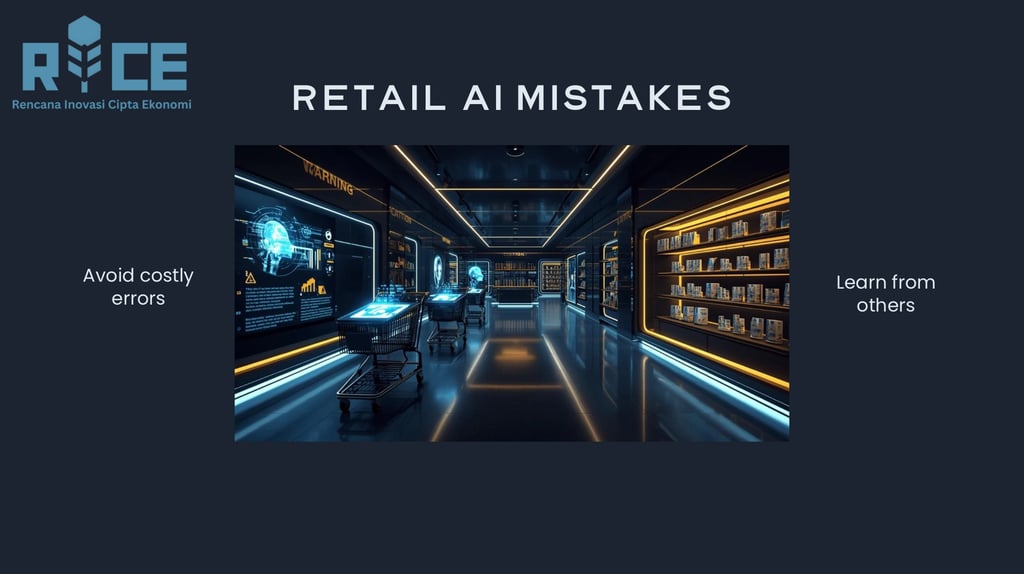
The retail landscape is undergoing a profound transformation, with Artificial Intelligence (AI) emerging as a pivotal force. From hyper-personalized customer experiences to optimized supply chains and predictive inventory management, AI promises unprecedented efficiencies and competitive advantages. Retail leaders are recognizing this paradigm shift, with significant investments flowing into AI initiatives designed to redefine how businesses operate and interact with customers. However, the path to successful AI adoption is fraught with challenges. Many retailers, despite their eagerness, inadvertently fall into common, yet costly, traps that derail their AI ambitions and squander valuable resources.
Adopting AI isn't merely about integrating cutting-edge technology; it's about strategically embedding intelligence into every facet of your retail operations. This isn't a speculative future; it's the present reality shaping winners and losers in the market. Ignoring the foundational principles for effective AI deployment can lead to inefficient systems, inaccurate insights, and a failure to realize the technology's full potential. As an industry expert, I've observed recurring patterns that lead to significant setbacks. Let's delve into the three most common and costly mistakes retailers make when embracing AI, and how you can avoid them to ensure your AI investments yield truly transformative results.
Mistake 1: Lack of a Clear AI Strategy and Defined KPIs
One of the most pervasive and expensive mistakes in retail AI adoption is diving into technology without a well-defined strategic roadmap and clear, measurable objectives. Many organizations are swayed by the hype or perceived competitive pressure, adopting AI solutions without a fundamental understanding of what specific business problems they aim to solve. This approach often leads to disconnected projects, wasted investments, and a failure to demonstrate tangible ROI.
Rushing into Technology Without Business Goals
Implementing AI without a clear purpose is like setting sail without a destination. AI is not a magic bullet that automatically fixes all business challenges; it is a powerful tool that requires precise application. Retailers often make the error of selecting an AI solution because it’s new, popular, or a competitor has adopted it, rather than first identifying core business pain points that AI can genuinely address. Are you struggling with excessive inventory holding costs, high customer churn, or inefficient last-mile delivery? These are the types of specific problems that an AI strategy should target.
A successful AI journey begins with a meticulous assessment of your business operations and strategic priorities. This involves pinpointing areas where AI can create the most significant impact, whether it’s enhancing the customer journey, streamlining supply chain logistics, optimizing pricing strategies, or improving operational efficiency. Without this foundational understanding, AI projects risk becoming isolated experiments that consume resources without delivering sustained value. Your AI initiatives must directly align with broader business objectives, ensuring every technological investment serves a strategic purpose.
Neglecting Measurable Key Performance Indicators (KPIs)
Even when a business goal is identified, a lack of clear, quantifiable Key Performance Indicators (KPIs) renders success immeasurable and accountability elusive. How will you know if your new AI-powered recommendation engine is truly effective if you haven't established baseline conversion rates or average order values to compare against? Without defined KPIs, evaluating the true impact of AI on your retail operations becomes an exercise in guesswork, making it impossible to justify further investment or scale successful pilots.
Before any AI deployment, it is imperative to establish a robust framework of measurable KPIs. These metrics should be directly linked to your initial business goals. For instance, if your AI targets inventory optimization, KPIs might include reduction in stockouts, decrease in carrying costs, or improvement in inventory turnover ratio. If the focus is on enhancing the customer experience, relevant KPIs could be increased customer lifetime value (CLTV), higher website conversion rates, or improved customer satisfaction scores. Setting these benchmarks early allows you to accurately track progress, quantify ROI, and make data-driven decisions about the future of your AI initiatives. Rice AI specializes in collaborating with retailers to meticulously define strategic AI roadmaps and align robust solutions with clear, measurable KPIs, ensuring every deployment contributes tangibly to your bottom line. This meticulous approach guarantees that your AI investments are not just technologically advanced but also strategically sound and performance-driven.
Mistake 2: Underestimating Data Quality and Integration Challenges
AI thrives on data. It learns from it, makes predictions based on it, and its intelligence is directly correlated with the quality, quantity, and accessibility of the information it processes. A prevalent and costly mistake retailers make is underestimating the foundational importance of high-quality data and the complexities involved in integrating disparate data sources across their ecosystems.
The "Garbage In, Garbage Out" Reality
The adage "garbage in, garbage out" has never been more relevant than in the context of AI. Implementing sophisticated AI models on poor-quality data is a recipe for disaster. Inaccurate, incomplete, inconsistent, or outdated data will inevitably lead to flawed predictions, unreliable recommendations, and ultimately, poor business decisions. For example, an AI system trained on dirty customer data might generate irrelevant product suggestions, leading to decreased engagement and wasted marketing spend. Or, an inventory forecasting model fed with erroneous sales data could lead to costly overstocking or damaging stockouts.
Retail environments are notoriously complex, often characterized by data silos stemming from legacy systems, disparate departmental databases, and a multitude of third-party vendors. Point-of-sale (POS) systems, e-commerce platforms, customer relationship management (CRM) tools, supply chain management software, and even IoT sensors generate vast amounts of data that often reside in isolation. This fragmented data landscape hinders AI's ability to gain a holistic view of the customer, products, and operational processes. A robust data governance strategy, including data validation, standardization, and regular auditing, is critical to ensure the integrity of the information feeding your AI systems.
Overlooking Data Integration Complexities
Beyond quality, the sheer complexity of integrating disparate data sources is frequently underestimated. Creating a unified, accessible data foundation that can feed various AI models requires significant technical expertise, infrastructure investment, and meticulous planning. Retailers often struggle to harmonize data from various touchpoints—online sales, in-store purchases, loyalty programs, social media interactions, and supply chain movements—into a single source of truth.
This fragmentation creates significant technical hurdles. Data formats may differ, integration APIs might be challenging, and ensuring real-time data flow can be a monumental task. The failure to overcome these integration complexities means AI systems operate on incomplete pictures, limiting their predictive accuracy and strategic value. Investing in robust data lakes or data warehouses, along with powerful integration platforms, is not merely a technical detail; it is a strategic imperative for unlocking AI's full potential. For best practices in data integration, consider consulting industry guides from leading data platform providers like :
The Importance of Data Cleansing and Preparation
The grunt work of data cleansing, transformation, and preparation is often the least glamorous but arguably the most critical step in any AI initiative. This process involves identifying and correcting errors, filling in missing values, standardizing formats, and labeling data for machine learning algorithms. Retailers frequently underestimate the time, effort, and specialized skills required for this foundational work. Skipping or rushing this stage inevitably leads to compromised AI performance.
A significant portion of an AI project's timeline and budget should be dedicated to this crucial groundwork. Without clean, well-structured, and appropriately prepared data, even the most advanced AI models will struggle to deliver accurate and actionable insights. Investing upfront in data preparation capabilities and talent ensures that your AI models learn from reliable information, leading to more precise predictions, better recommendations, and ultimately, a higher return on your AI investment.
Mistake 3: Failing to Invest in Talent, Training, and Change Management
Even the most sophisticated AI systems are ultimately tools that require human interaction, oversight, and adoption to be truly effective. A common and expensive oversight retailers make is focusing exclusively on the technological aspects of AI deployment while neglecting the crucial human element—the talent, training, and robust change management strategies necessary for successful integration and sustained value creation.
The Human Element: More Than Just Algorithms
Successful AI adoption is fundamentally a people-centric endeavor. While AI algorithms automate complex tasks and generate insights, skilled human professionals are essential to design, deploy, monitor, and interpret these systems. Retailers need to cultivate a diverse talent pool, including data scientists to build and refine models, AI engineers to integrate solutions, and business analysts who can translate AI outputs into actionable business strategies. The current demand for these specialized skills often outstrips supply, creating a talent gap that many organizations struggle to fill.
Beyond technical experts, existing staff across all retail functions—from store associates to merchandising managers and marketing teams—must be equipped to understand and leverage AI tools in their daily roles. Without a knowledgeable workforce that can effectively interact with AI systems, the technology risks being underutilized, misinterpreted, or even actively resisted, undermining its intended benefits. Recognizing that AI complements, rather than fully replaces, human intelligence is key to fostering a collaborative environment where technology empowers people.
Neglecting Comprehensive Training Programs
The introduction of new AI technologies necessitates comprehensive and ongoing training programs. It's not enough to simply deploy a new AI tool; employees need to understand why it's being implemented, how it works, and what its benefits are for their specific roles and the organization as a whole. Without adequate training, frontline staff might struggle to use AI-powered point-of-sale systems, or managers might not fully grasp how AI-driven insights can inform their strategic decisions. This lack of proficiency can lead to operational inefficiencies, user frustration, and a failure to capitalize on the AI's capabilities.
Training should not be a one-time event during implementation but an ongoing process that evolves with the technology and employee needs. It should cover not only the technical aspects of using the tools but also the conceptual understanding of AI's role in improving their work and enhancing customer experiences. Investing in robust, tailored training ensures that your team feels confident and competent in leveraging AI, transforming potential resistance into enthusiastic adoption and advocacy.
Overcoming Resistance Through Effective Change Management
Perhaps one of the most critical, yet often overlooked, aspects of AI adoption is effective change management. The introduction of AI can evoke fear, uncertainty, and resistance among employees, particularly concerns about job displacement or increased workload. Without a proactive and transparent change management strategy, these anxieties can undermine even the most promising AI initiatives.
Successful change management involves clear communication, stakeholder engagement, and demonstrating the tangible benefits of AI to employees. This means articulating how AI will augment their capabilities, free them from mundane tasks, and enable them to focus on more strategic and creative work. Engaging employees early in the process, soliciting their feedback, and providing opportunities for them to contribute to the AI implementation can foster a sense of ownership and reduce resistance. A well-executed change management plan transforms potential skeptics into advocates, ensuring that the entire organization embraces and champions the new AI-driven capabilities. Rice AI also focuses on comprehensive training and support to ensure smooth integration and user adoption, empowering your team to thrive alongside new AI solutions. We believe in bridging the gap between cutting-edge technology and practical application through continuous learning and robust support systems.
Conclusion
The promise of AI in retail is immense, offering unparalleled opportunities for efficiency, personalization, and sustained growth. However, realizing this potential requires a strategic, holistic approach that extends beyond mere technological deployment. The costly mistakes of lacking a clear strategy and defined KPIs, underestimating data quality and integration challenges, and failing to invest in talent, training, and change management can severely impede your progress and drain valuable resources.
By proactively addressing these pitfalls, retailers can pave the way for successful AI adoption. This means starting with clear business objectives, rigorously preparing your data foundation, and empowering your people through comprehensive training and empathetic change management. It’s about building a robust AI ecosystem that is supported by sound strategy, fueled by quality data, and championed by a skilled and engaged workforce. Avoiding these common traps isn't just about saving money; it's about unlocking a true competitive advantage, delivering superior customer experiences, and positioning your retail business for enduring success in an increasingly intelligent world.
Are you ready to optimize your retail AI journey and avoid these common traps? Contact Rice AI today for an expert consultation on developing a robust, data-driven AI strategy tailored to your specific retail needs. We help you navigate the complexities of AI adoption, ensuring your investments deliver measurable, transformative results.
#RetailAI #AIAdoption #RetailTech #DigitalTransformation #RetailStrategy #DataScience #ChangeManagement #RetailInnovation #SmartRetail #AIConsulting #BusinessIntelligence #FutureOfRetail #OperationalEfficiency #CustomerExperience #AIinRetail #DailyAIIndustry
RICE AI Consultant
To be the most trusted partner in digital transformation and AI innovation, helping organizations grow sustainably and create a better future.
Connect with us
Email: consultant@riceai.net
+62 822-2154-2090 (Marketing)
© 2025. All rights reserved.


+62 851-1748-1134 (Office)
IG: @riceai.consultant