

Can Generative AI Revolutionize Product Design and Innovation in Industrial Manufacturing?
Generative AI is revolutionizing industrial manufacturing by transforming product design. It enables faster cycles, optimized products, and unlocks unprecedented creative potential, redefining innovation.
INDUSTRIES
Rice AI (Ratna)
1/5/20267 min read
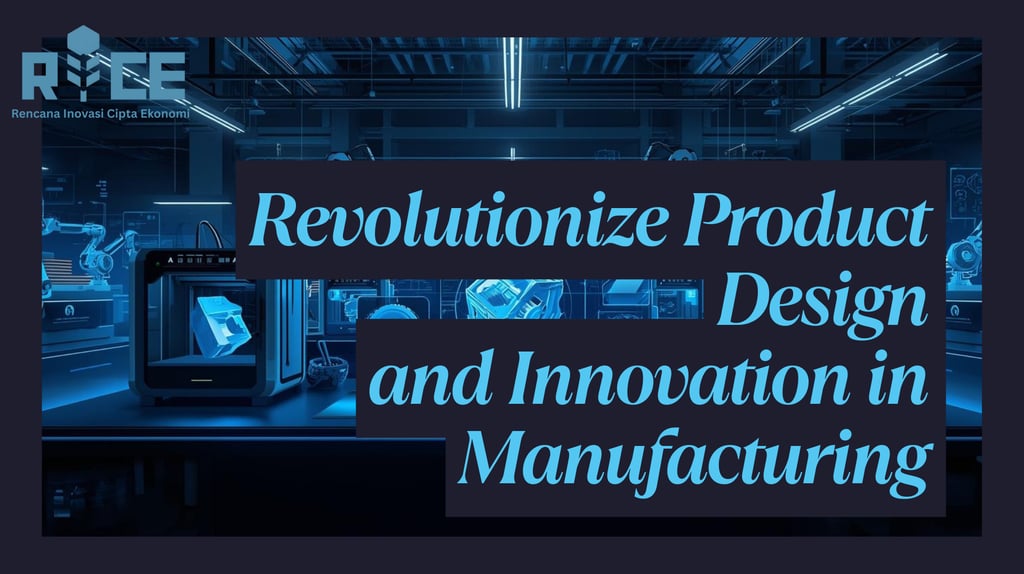
The industrial manufacturing landscape stands at the precipice of a profound transformation, driven by an unprecedented wave of technological advancements. For decades, product design has relied on iterative, human-centric processes, often constrained by time, resources, and the limits of individual imagination. But what if we could transcend these limitations? Can Generative AI truly revolutionize product design and innovation in industrial manufacturing, ushering in an era of unprecedented creativity, efficiency, and performance? The answer is a resounding yes, although the path forward requires careful navigation and strategic foresight.
Generative AI, with its capacity to autonomously create novel designs, optimize existing ones, and explore vast solution spaces, is poised to redefine how products are conceived, engineered, and manufactured. It promises to unlock new levels of innovation, accelerating development cycles and enabling designs previously deemed impossible. This transformative technology is not merely an incremental improvement; it represents a fundamental paradigm shift, demanding that industrial manufacturers rethink their entire approach to innovation.
The Dawn of a New Design Paradigm
The traditional approach to product design often involves a designer creating an initial concept, which then undergoes multiple iterations of analysis, testing, and refinement. This process is time-consuming and can restrict the exploration of truly innovative solutions due to human cognitive biases and workload constraints. Generative AI offers a compelling alternative, pushing the boundaries of what's possible.
Beyond Traditional CAD: The Power of Algorithmic Exploration
Generative AI moves beyond the confines of traditional Computer-Aided Design (CAD) by shifting from a descriptive modeling approach to a prescriptive one. Instead of designers manually creating shapes, engineers define desired performance objectives, material constraints, manufacturing processes, and cost targets. The AI then autonomously generates a multitude of design options that meet these criteria. This algorithmic exploration allows for the discovery of highly optimized and often counter-intuitive geometries that human designers might overlook. It systematically navigates an enormous design space, identifying solutions that maximize efficiency, minimize material usage, or enhance specific performance metrics. To learn more about advanced CAD techniques and their evolution, further resources can be explored.
Accelerating the Innovation Cycle
The ability of Generative AI to rapidly generate and evaluate thousands of design variations significantly accelerates the innovation cycle. What once took weeks or months of manual iteration and simulation can now be achieved in hours or days. This drastic reduction in time-to-market is a critical competitive advantage in today's fast-paced industrial environment. Manufacturers can respond more quickly to market demands, test more hypotheses, and bring groundbreaking products to fruition with unprecedented speed. This fosters a culture of continuous innovation, where new ideas can be rapidly prototyped, refined, and deployed, keeping businesses at the forefront of their industries.
Core Applications of Generative AI in Industrial Manufacturing
The practical applications of Generative AI in industrial manufacturing span various stages of the product lifecycle, from initial concept to optimized production. Its utility extends beyond mere aesthetics, impacting performance, sustainability, and economic viability.
Topology Optimization and Lightweighting
One of the most impactful applications of Generative AI is in topology optimization. This involves designing the optimal material distribution within a given design space, resulting in components that are incredibly lightweight yet exceptionally strong. By intelligently removing unnecessary material while maintaining structural integrity, Generative AI enables the creation of parts with superior strength-to-weight ratios. This is particularly crucial in sectors like aerospace and automotive, where every gram saved translates into fuel efficiency and reduced operational costs. The resulting organic, bionic-like forms are not just aesthetically intriguing but are engineered for peak performance and material efficiency, contributing significantly to sustainable manufacturing practices. For more detailed research on specific material advancements driving lightweighting innovations, external resources are available.
Mass Customization and Personalized Products
The demand for personalized and customized products is growing across consumer and industrial markets. Generative AI makes mass customization economically viable by enabling the automated design of unique product variations at scale. Whether it's custom-fitted medical implants, personalized consumer electronics, or tailor-made industrial components for specific operational environments, Generative AI can rapidly generate individualized designs based on user input or specific operational parameters. This capability allows manufacturers to cater to niche markets and individual customer preferences without incurring prohibitive costs or extensive lead times, unlocking new revenue streams and enhancing customer loyalty.
Optimizing Manufacturing Processes and Tooling
Generative AI's influence isn't limited to the product itself; it also extends to optimizing the very processes used to manufacture it. This includes the design of jigs, fixtures, and other tooling components, as well as the layout of production lines. By considering manufacturing constraints and machine capabilities, Generative AI can generate tool designs that are more efficient, easier to produce, and minimize material waste. Furthermore, it can simulate and optimize entire production workflows, identifying bottlenecks and suggesting improvements for throughput and cost reduction. At Rice AI, our solutions empower industrial manufacturers to not only design revolutionary products but also to optimize their tooling designs for maximum efficiency and robust production, translating innovative product concepts into tangible realities with seamless integration into existing operational frameworks. This comprehensive approach ensures that the entire manufacturing ecosystem benefits from AI-driven intelligence.
Challenges and Considerations for Adoption
Despite its immense potential, the successful integration of Generative AI into industrial manufacturing is not without its challenges. These hurdles encompass technical, organizational, and ethical dimensions that require careful planning and strategic investment.
Data Requirements and Model Training
Generative AI models are data-hungry. Their effectiveness hinges on the availability of vast amounts of high-quality, relevant data pertaining to design specifications, material properties, performance metrics, and manufacturing constraints. Cleaning, structuring, and labeling this data can be a resource-intensive task. Furthermore, training sophisticated Generative AI models demands significant computational resources and specialized expertise in machine learning and data science. Companies must invest in robust data infrastructure and cultivate or acquire the necessary talent to manage and leverage these complex systems effectively. Considerations around data privacy and security are also paramount, particularly when dealing with proprietary designs and intellectual property.
Skill Gaps and Workforce Transformation
The introduction of Generative AI necessitates a significant evolution in the roles and skills of human designers and engineers. Rather than performing repetitive design tasks, professionals will shift towards defining problems, interpreting AI-generated solutions, and applying their domain expertise to refine and validate outcomes. This requires a new blend of creativity, critical thinking, and proficiency in AI tools and data interpretation. Bridging this skill gap necessitates comprehensive training programs and a proactive approach to workforce transformation. Collaboration between humans and AI will become the norm, with AI augmenting human capabilities rather than simply replacing them. Explore our resources on AI talent development to prepare your team for the future of industrial design
Ethical Implications and Bias
As Generative AI becomes more integrated into critical design processes, ethical considerations rise to the forefront. Ensuring fairness and avoiding algorithmic bias in design outcomes is crucial. If the training data contains biases (e.g., favoring certain materials, manufacturing methods, or performance characteristics unintentionally), the AI may perpetuate or even amplify these biases in its generated designs. Establishing clear ethical guidelines, implementing robust validation processes, and ensuring accountability for AI-driven outcomes are essential for responsible deployment. Manufacturers must consider the broader societal impact of their AI-designed products and commit to ethical AI development.
The Future Landscape: Synergies and Strategic Imperatives
The true power of Generative AI in industrial manufacturing will be fully unleashed through its integration with other cutting-edge technologies and through a strategic, long-term vision. The future promises a hyper-connected, intelligent manufacturing ecosystem.
Integrating Generative AI with Digital Twins and IoT
The synergy between Generative AI, Digital Twins, and the Internet of Things (IoT) holds immense potential. IoT sensors can collect real-time performance data from manufactured products in the field, which can then feed into a Digital Twin—a virtual replica of the product. This Digital Twin can simulate performance under various conditions. Generative AI can then leverage this real-time feedback and simulation data to continuously refine and optimize product designs, creating a closed-loop system of continuous improvement. This allows for predictive design changes, addressing potential issues before they arise, and enhancing product lifecycle management. This holistic approach is fundamental to the broader vision of digital transformation and the smart factory.
Strategic Investment for Competitive Advantage
Adopting Generative AI is not merely a technological upgrade; it is a strategic imperative for industrial manufacturers seeking to maintain and gain competitive advantage. Early adopters who successfully integrate this technology will be uniquely positioned to innovate faster, optimize costs, and deliver superior products to the market. Investing in Generative AI requires a long-term vision, encompassing not just software and hardware but also talent development, data governance, and organizational change management. Starting with pilot projects and gradually scaling implementation allows organizations to build expertise and demonstrate tangible returns on investment. Rice AI partners with industrial leaders to craft bespoke Generative AI strategies, ensuring seamless integration and measurable ROI that translates into sustainable competitive advantage. Our consultative approach helps companies navigate the complexities of AI adoption, from initial assessment to full-scale implementation.
Conclusion
The question of whether Generative AI can revolutionize product design and innovation in industrial manufacturing is no longer a matter of 'if,' but 'how soon' and 'to what extent.' The technology is clearly demonstrating its capacity to fundamentally alter traditional design paradigms, offering unprecedented avenues for innovation, efficiency, and customization. From generating ultralight components through topology optimization to enabling mass personalization and optimizing production tooling, Generative AI is poised to redefine the capabilities of industrial manufacturers.
While significant challenges remain – primarily related to data acquisition, talent development, and ethical governance – these are surmountable with strategic planning and investment. The industrial sector must proactively embrace these changes, fostering an environment where human ingenuity collaborates seamlessly with AI capabilities. The integration of Generative AI with other Industry 4.0 technologies like Digital Twins and IoT promises a future where product design is not just reactive but predictive, continuously optimized, and intrinsically linked to real-world performance. The manufacturers who lead this charge will be the ones shaping the future of innovation, delivering products that are not only better performing and more sustainable but also brought to market with unmatched speed and adaptability. The era of intelligent design is here, and its potential is boundless for those ready to seize it.
Ready to explore how Generative AI can transform your product design workflow and drive unprecedented innovation in your industrial manufacturing operations? Contact Rice AI today for a personalized consultation and begin your journey towards a more intelligent, efficient, and innovative future.
#GenerativeAI #IndustrialManufacturing #ProductDesign #Innovation #AIDrivenDesign #SmartManufacturing #DigitalTransformation #ManufacturingAI #AIInnovation #Industry40 #DesignOptimization #FutureOfManufacturing #RiceAI #TechTrends #ManufacturingTechnology #DailyAIIndustry
RICE AI Consultant
To be the most trusted partner in digital transformation and AI innovation, helping organizations grow sustainably and create a better future.
Connect with us
Email: consultant@riceai.net
+62 822-2154-2090 (Marketing)
© 2025. All rights reserved.


+62 851-1748-1134 (Office)
IG: @riceai.consultant