


Ever Wonder How AI 'Learns'? A Peek Behind the Neural Network Curtain
This expert guide breaks down key learning paradigms, optimization, and future advancements, essential for industry professionals
AI INSIGHT
Rice AI (Ratna)
2/9/20268 min read
In an era increasingly shaped by Artificial Intelligence, understanding its foundational mechanisms is no longer a niche pursuit but a professional imperative. As AI systems proliferate across industries, from predictive analytics to autonomous operations, the question "How does AI actually learn?" moves beyond mere curiosity. For industry experts, grasping the intricacies of AI learning—particularly through neural networks—offers a critical advantage in deploying, managing, and innovating with these transformative technologies. This deep dive will pull back the curtain on the "black box," revealing the elegant, complex processes that enable AI to perceive, interpret, and make decisions.
The Foundation: Neural Networks Explained
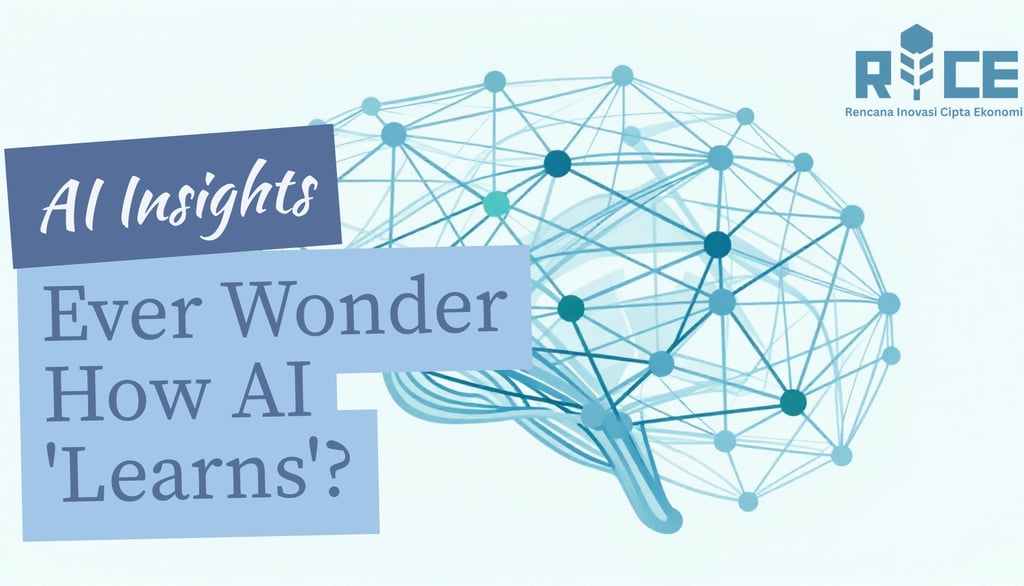
At the core of much of modern AI's learning capability lies the artificial neural network (ANN). Inspired by the biological brain, ANNs are computational models designed to recognize patterns and make decisions in a manner analogous to human thought. They are fundamental to various AI applications, including image recognition, natural language processing, and complex data analysis. Understanding their structure is the first step toward demystifying AI learning.
Biological Inspiration, Digital Implementation
The concept of a neural network originated from attempts to mimic the human brain's structure and function. Biological neurons communicate through electrical and chemical signals, forming complex pathways that enable learning and memory. Artificial neural networks abstract this biological process into mathematical models, using interconnected "nodes" or "neurons" to process information. This parallel allows ANNs to tackle problems that traditional rule-based programming struggles with, especially when dealing with ambiguous or high-dimensional data.
Neurons, Layers, and Connections
An artificial neural network consists of layers of interconnected nodes. The input layer receives raw data, such as pixels from an image or words from a sentence. This data then passes through one or more hidden layers, where complex computations and feature extractions occur. Finally, an output layer produces the network's prediction or classification. Each connection between neurons has an associated "weight," representing the strength or importance of that connection, and each neuron applies an "activation function" to its aggregated input, introducing non-linearity crucial for learning complex patterns.
The Learning Process: From Data to Decisions
The true magic of AI learning happens during the training phase. This is where neural networks adjust their internal parameters to identify meaningful relationships within vast datasets. It's an iterative process of exposure, evaluation, and adjustment, refining the model's ability to perform its designated task accurately.
Data: The Lifeblood of AI Learning
High-quality data sets are the essential fuel for any AI learning algorithm. Without sufficient, relevant, and well-labeled data, even the most sophisticated neural networks cannot learn effectively. Data scientists meticulously collect, clean, and preprocess vast amounts of information—images, text, numerical records—to prepare it for ingestion by the AI model. This initial phase of AI training dictates the potential success and reliability of the resulting system. Organizations must invest in robust data governance strategies to maximize the effectiveness of their AI initiatives.
Algorithms and Mathematical Models
Beneath the surface, AI learning is a sophisticated dance of mathematical algorithms. These algorithms define how the network processes data, adjusts its weights, and ultimately learns from its experiences. From simple linear regression embedded within a neural network's layers to complex backpropagation rules, these mathematical models are the engine driving the AI's ability to identify patterns and predict outcomes. The choice of algorithm profoundly impacts the network's efficiency and accuracy in machine learning tasks.
Training, Validation, and Testing
AI model training is typically divided into three phases. First, the model learns from a "training set" of data, adjusting its weights to minimize errors. Next, a "validation set" is used to fine-tune the model's hyperparameters and prevent overfitting—where the model performs well on training data but poorly on unseen data. Finally, a separate "test set" evaluates the model's performance on completely new, unseen data, providing an unbiased measure of its real-world effectiveness. This rigorous process ensures the AI system is robust and reliable.
Key Learning Paradigms in AI
AI employs various learning paradigms, each suited for different types of problems and data. Understanding these distinct approaches is crucial for selecting the right AI strategy for specific business challenges. Each paradigm represents a unique way an artificial intelligence system processes information and derives insights.
Supervised Learning: Learning with Labels
Supervised learning is perhaps the most common AI learning method. Here, the model is trained on a labeled dataset, meaning each input example is paired with its correct output. For instance, in image recognition, an algorithm might be shown thousands of pictures of cats and dogs, with each image explicitly labeled "cat" or "dog." The network learns to map inputs to outputs by identifying patterns in these labeled examples. Once trained, it can classify new, unlabeled images. This method is highly effective for tasks like classification (e.g., spam detection, medical diagnosis) and regression (e.g., predicting house prices, sales forecasting).
Unsupervised Learning: Discovering Patterns
In contrast, unsupervised learning deals with unlabeled data. The AI algorithm is tasked with finding hidden structures, patterns, or relationships within the data without any explicit guidance. Clustering is a prime example, where the algorithm groups similar data points together (e.g., segmenting customer demographics). Dimensionality reduction is another application, simplifying complex data while retaining essential information. Unsupervised learning is invaluable for exploratory data analysis, anomaly detection, and discovering unforeseen insights, making it a powerful tool for large, unstructured datasets where labeling is impractical.
Reinforcement Learning: Learning by Doing
Reinforcement learning (RL) is inspired by behavioral psychology, where an agent learns through trial and error by interacting with an environment. The AI agent performs actions and receives "rewards" for desirable outcomes and "penalties" for undesirable ones. Over time, it learns a policy—a set of rules—that maximizes its cumulative reward. This paradigm is particularly effective for tasks involving sequential decision-making, such as training self-driving cars, developing game-playing AI (like AlphaGo), or optimizing complex logistical systems. RL models continuously adapt and refine their strategies based on their experiences.
Deep Learning: Layers of Abstraction
Deep learning is a subset of machine learning that utilizes neural networks with many hidden layers—hence "deep." These deep neural networks can automatically learn hierarchical representations of data, extracting increasingly complex features at each successive layer. For example, in image recognition, early layers might detect edges and corners, while deeper layers combine these to identify shapes, and even deeper layers recognize entire objects. This multi-layered approach enables deep learning models to achieve state-of-the-art performance in tasks like speech recognition, natural language understanding, and computer vision, often surpassing human capabilities.
The Role of Optimization and Backpropagation
The ability of a neural network to truly "learn" hinges on its optimization process. This involves systematically reducing the difference between its predictions and the actual target values. Two critical techniques underpin this optimization: gradient descent and backpropagation. These mechanisms allow the network to adjust its internal workings with remarkable precision.
Gradient Descent: Navigating the Error Landscape
Imagine a neural network's performance as a landscape, with hills representing high error rates and valleys representing lower ones. Gradient descent is an optimization algorithm that helps the network "walk" down this landscape towards the lowest point—the global minimum error. It does this by calculating the "gradient" (the slope) of the error function at the current point, indicating the direction of the steepest descent. The network then takes a small step in that direction, iteratively moving closer to optimal performance. The "learning rate" determines the size of these steps; a high learning rate can overshoot the minimum, while a small one can make learning very slow.
Backpropagation: Correcting the Course
Backpropagation is the fundamental algorithm that allows neural networks to efficiently calculate the gradients needed for gradient descent. After a network makes a prediction and compares it to the actual target (calculating the error), backpropagation works backward through the network, from the output layer to the input layer. It calculates how much each weight contributed to the overall error. Based on this, it then adjusts each weight slightly to reduce the error in future predictions. This continuous, iterative adjustment of weights is precisely how a neural network refines its knowledge and improves its accuracy over time, essentially correcting its mistakes.
Advancements and the Future of AI Learning
The field of AI learning is not static; it's a rapidly evolving landscape driven by continuous research and innovation. New techniques are constantly emerging, pushing the boundaries of what AI can achieve and addressing its inherent challenges. Professionals must stay abreast of these developments to leverage AI effectively and responsibly.
Transfer Learning and Few-Shot Learning
One significant advancement is transfer learning, where a pre-trained model (often a deep neural network trained on a massive dataset for a general task) is repurposed for a new, related task. Instead of training a model from scratch, which is resource-intensive, only the final layers are retrained with a smaller, specific dataset. This dramatically reduces training time and data requirements. Few-shot learning takes this a step further, enabling AI models to learn new concepts from only a handful of examples, mimicking the human ability to generalize quickly from limited information. These techniques are vital for deploying AI in data-scarce domains.
Explainable AI (XAI) and Interpretability
As AI systems become more complex and impactful, the demand for transparency grows. Explainable AI (XAI) is a field focused on making AI models more understandable and interpretable to humans. Rather than treating AI as a "black box," XAI aims to provide insights into why an AI made a particular decision or prediction. This is crucial for building trust, ensuring fairness, and enabling debugging, especially in high-stakes applications like healthcare or finance where accountability is paramount. Tools and methodologies for interpreting neural network decisions are an active area of research and development.
The Ethical Imperative in AI Learning
The increasing sophistication of AI learning also brings significant ethical considerations. Biases present in training data can be learned and amplified by AI models, leading to unfair or discriminatory outcomes. Issues of privacy, accountability, and the potential for misuse demand careful attention. As industry experts, it is our collective responsibility to ensure that AI systems are developed and deployed ethically, prioritizing fairness, transparency, and human well-being. This involves rigorous auditing of data, ethical AI governance frameworks, and a commitment to responsible AI development practices.
Partnering for Smarter AI: How Rice AI Empowers Businesses
Navigating the complexities of AI learning and deploying effective neural network solutions can be challenging. This is where Rice AI steps in. With a deep understanding of cutting-edge AI methodologies and extensive practical experience, we empower businesses to harness the full potential of artificial intelligence. Our expertise spans the entire AI lifecycle, from data strategy and model development to deployment and ongoing optimization. We pride ourselves on demystifying AI and making it accessible and impactful for our partners, ensuring robust AI solutions that drive real-world value.
Tailored AI Solutions
At Rice AI, we recognize that every business has unique needs. We don't offer one-size-fits-all solutions; instead, we craft tailored AI strategies and develop custom neural network models designed to address your specific challenges. Whether you need predictive analytics to optimize supply chains, natural language processing for customer service automation, or computer vision for quality control, our team leverages the appropriate learning paradigms—supervised, unsupervised, or reinforcement learning—to build intelligent systems that integrate seamlessly into your operations and provide a competitive edge.
Expertise in Neural Network Deployment
Implementing and maintaining production-grade neural networks requires specialized knowledge. Rice AI excels in the practical deployment of sophisticated AI models, ensuring they are robust, scalable, and secure. We guide our clients through the complexities of model training, validation, and continuous improvement, applying best practices in MLOps (Machine Learning Operations). Our commitment extends to fostering a deeper understanding of AI within your organization, translating complex technical concepts into actionable business insights. Partner with Rice AI to transform theoretical AI potential into tangible business outcomes.
Conclusion
The journey behind the neural network curtain reveals a world of intricate processes, from the biological inspiration of interconnected nodes to the sophisticated algorithms that drive learning. AI doesn't magically "think"; it meticulously learns through exposure to data, iterative refinement of internal parameters, and adherence to specific learning paradigms like supervised, unsupervised, and reinforcement learning. The continuous advancements in deep learning, transfer learning, and Explainable AI signify a future where intelligent systems become even more powerful and transparent.
For industry experts, comprehending these underlying mechanisms is paramount. It enables informed decision-making, effective AI strategy formulation, and the ability to critically evaluate and implement AI solutions responsibly. As the applications of artificial intelligence continue to expand, a solid grasp of how AI learns is not just an advantage—it's a necessity. Embrace this knowledge, explore its potential, and consider how a partner like Rice AI can help your organization leverage these powerful technologies to innovate and lead in the intelligent era.
Ready to unlock the full potential of AI for your business? Connect with Rice AI today to discuss how our expert team can help you build and deploy intelligent solutions that truly understand and adapt.
#AIlearning #NeuralNetworks #MachineLearning #DeepLearning #AITraining #ArtificialIntelligence #DataScience #TechTrends #IndustryExpert #FutureOfAI #RiceAI #AIstrategy #DigitalTransformation #Innovation #ExplainableAI #DailyAIInsight
RICE AI Consultant
To be the most trusted partner in digital transformation and AI innovation, helping organizations grow sustainably and create a better future.
Connect with us
Email: consultant@riceai.net
+62 822-2154-2090 (Marketing)
© 2025. All rights reserved.


+62 851-1748-1134 (Office)
IG: @riceai.consultant