


The Algorithmic Maestro: Decoding How AI Generates Music & Sound for Entertainment
Explore how AI generates music and sound for entertainment, transforming film, games, and advertising.
INDUSTRIES
Rice AI (Ratna)
2/20/20268 min read
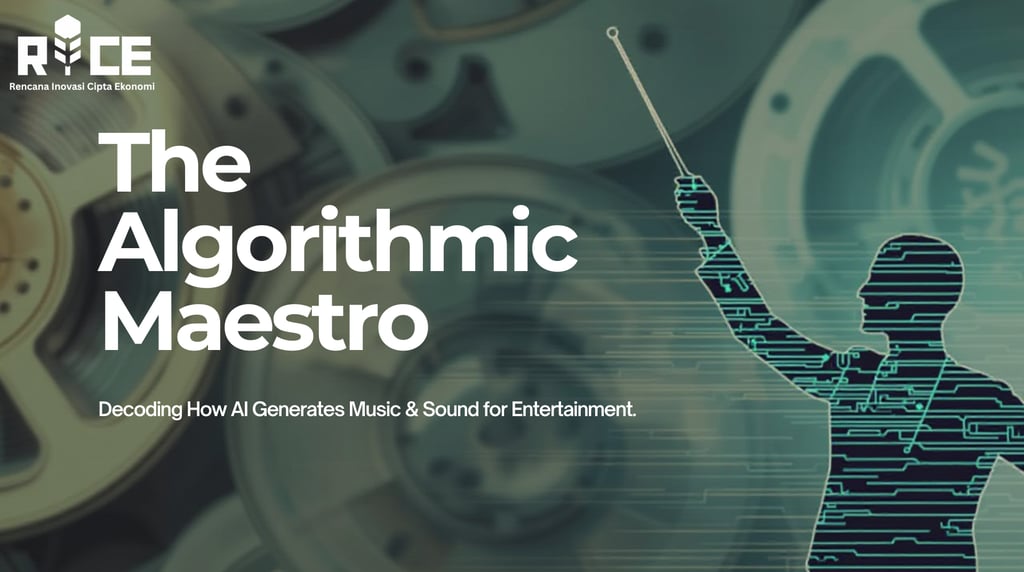
Imagine a world where every scene in a film, every moment in a video game, and every advertisement is accompanied by a perfectly tailored, dynamically generated soundtrack and immersive sound design. This isn't a futuristic fantasy; it's the present reality rapidly unfolding through the power of Artificial Intelligence in music and sound generation. AI is not merely assisting; it is emerging as a true "Algorithmic Maestro," capable of composing, arranging, and producing sonic experiences with unprecedented speed and sophistication.
The integration of artificial intelligence into the creative audio landscape is fundamentally transforming the entertainment industry. From crafting unique scores to synthesizing realistic sound effects, AI is pushing the boundaries of what’s possible, opening new avenues for innovation and efficiency. This shift promises a future where bespoke audio content is more accessible, adaptive, and impactful than ever before. Understanding the mechanisms behind this revolution is crucial for industry professionals seeking to harness its full potential.
Understanding AI's Musical Brain
The foundational premise behind AI's ability to generate music and sound lies in its capacity for deep pattern recognition and synthesis. AI models learn from vast datasets, internalizing the intricate rules and emotional nuances that define human-created audio. This learning process allows them to then generate entirely new, original compositions and soundscapes.
Machine Learning Foundations: From Data to Melody
At the heart of AI music generation are sophisticated machine learning algorithms. These systems are trained on extensive libraries of existing music, sound effects, and musical scores, which allows them to identify underlying patterns in melody, harmony, rhythm, and timbre. Supervised learning, for instance, involves feeding the AI labeled data, teaching it to associate specific musical characteristics with desired outputs. Unsupervised learning, on the other hand, allows the AI to discover hidden structures and relationships within unlabeled data independently. Reinforcement learning trains models through a system of rewards, guiding them towards producing musically coherent and aesthetically pleasing results.
Neural networks, particularly Recurrent Neural Networks (RNNs) and their variants like Long Short-Term Memory (LSTMs), are pivotal in processing sequential data inherent in music. They excel at remembering previous elements in a sequence, enabling them to generate coherent melodies and progressions over time. More recently, Transformer architectures, initially popularized in natural language processing, have shown remarkable promise in handling long-range dependencies in musical sequences, leading to highly complex and structured compositions. These deep learning models empower AI to grasp the intricate grammar of music. They analyze pitch, duration, intensity, and instrumentation, subsequently constructing new audio narratives that resonate with human listeners.
Generative Adversarial Networks (GANs) for Novelty
Generative Adversarial Networks (GANs) represent a significant leap in AI's creative capabilities for music and sound. A GAN operates with two competing neural networks: a generator and a discriminator. The generator's role is to create new data—in this case, musical pieces or sound effects—that mimic the style and characteristics of real-world audio examples. Simultaneously, the discriminator evaluates these generated outputs, attempting to distinguish them from actual human-made content. This adversarial process forces the generator to continuously improve its output, striving for increased realism and creative coherence.
As the generator produces more convincing audio, the discriminator becomes more adept at detecting subtle artificialities, pushing both networks to higher levels of performance. This iterative refinement results in the creation of genuinely novel and often surprisingly sophisticated musical compositions or sound elements. GANs are particularly effective at producing variations on existing themes or generating entirely new sonic textures, which makes them invaluable for artists and producers seeking fresh, innovative sounds. The continuous feedback loop within a GAN system facilitates an evolutionary creative process, bringing forth highly original and diverse auditory content.
AI's Creative Arsenal: Techniques and Architectures
The methods AI employs to construct music and sound are diverse, each offering unique advantages depending on the creative goal. From direct waveform manipulation to abstract symbolic representation, AI leverages a rich toolkit to bring auditory visions to life. Rice AI actively explores these cutting-edge methodologies to provide unparalleled solutions for the entertainment industry.
Symbolic vs. Audio-Based Generation
AI music generation broadly falls into two main categories: symbolic generation and audio-based generation. Symbolic generation focuses on manipulating musical notation and abstract representations, such as MIDI data or sheet music. In this approach, AI algorithms learn the rules of music theory, harmony, and composition, then generate sequences of notes, chords, and rhythmic patterns. The output is a set of instructions that can then be used to synthesize sound via virtual instruments. This method offers precise control over musical structure and allows for easy editing of individual musical elements. It's particularly useful for composers who want to maintain a high degree of artistic control over the generated content, treating AI as a powerful compositional assistant.
Audio-based generation, conversely, works directly with raw audio waveforms. This more complex approach involves deep learning models that synthesize sound from scratch or transform existing audio signals. Technologies like WaveNet and VAEs (Variational Autoencoders) can generate high-fidelity audio, including realistic instrument sounds, vocalizations, and environmental soundscapes. This method allows for the creation of unique timbres and textures that might be difficult to express symbolically. While more computationally intensive, audio-based generation offers unparalleled realism and nuanced sonic detail, crucial for immersive entertainment experiences. Rice AI understands the distinct advantages of both symbolic and audio-based techniques, helping clients choose the optimal approach for their specific creative needs.
From Style Transfer to Inpainting
Beyond generating new pieces from scratch, AI excels at transformative tasks, broadening its utility for sound designers and music producers. AI style transfer in music allows the emotional and structural characteristics of one piece to be applied to another. For example, a classical melody could be re-rendered in the style of a jazz improvisation, or a rock song could acquire the orchestral grandeur of a film score. This capability offers immense creative potential for remixes, genre blending, and exploring novel interpretations of existing works. It allows creators to experiment with sonic identities without manually re-composing entire pieces, saving significant time and effort.
Another powerful application is music inpainting and outpainting, which involves intelligently filling in missing sections of audio or extending existing compositions. If a sound file has a damaged segment, AI can "heal" it by generating plausible audio to bridge the gap, maintaining continuity with the surrounding content. Similarly, outpainting enables AI to extend a musical track seamlessly, creating new verses, bridges, or outros that fit perfectly with the original composition's style and mood. These capabilities are invaluable for post-production, editing, and creating dynamic, extensible sound assets. Furthermore, AI is increasingly being used for automatic mastering and mixing, optimizing loudness, spectral balance, and spatial imaging to enhance overall production quality with professional-grade results.
Where AI's Soundtrack Plays
AI's impact on music and sound is not confined to theoretical discussions; its practical applications are already pervasive across numerous entertainment sectors. This ubiquitous presence highlights AI's role in shaping the sonic future of media consumption.
Film, Television, and Video Games
The entertainment industry, particularly film, television, and video games, is experiencing a profound transformation due to AI music and sound generation. One of the most compelling applications is the creation of dynamic, adaptive soundtracks. In video games, for instance, AI can generate music that evolves in real-time, responding to player actions, narrative progression, or environmental changes. This results in a more immersive and personalized gaming experience, where the soundtrack is always perfectly aligned with the moment. For film and television, AI efficiently generates background scores, ambient soundscapes, and even intricate Foley effects. This significantly reduces production time and costs associated with traditional composition and sound design.
The ability to rapidly prototype multiple musical ideas or generate vast libraries of context-specific sounds empowers creators to explore more creative options and meet tight deadlines. AI can also assist in generating variations of themes, ensuring continuity across a series while adding fresh elements. Rice AI provides tailored AI music solutions, enabling studios to unlock new levels of creativity and efficiency in their audio production pipelines. We believe that custom, scalable audio solutions generated by AI are the future for large-scale projects, allowing artistic vision to flourish without logistical constraints.
Advertising, Podcasting, and Digital Content
Beyond traditional media, AI is revolutionizing audio production for a myriad of digital content forms. In advertising, AI can quickly generate royalty-free music tailored to specific brand identities, target demographics, and campaign objectives. This ensures that advertisements have unique and effective sonic branding without incurring expensive licensing fees or lengthy custom composition processes. Podcasting benefits immensely from AI's ability to create intro/outro music, transitions, and even dynamic background scores that enhance listener engagement. It democratizes high-quality audio production, making professional-sounding content accessible to independent creators and small businesses.
Voice synthesis, powered by advanced AI, is also reaching new heights of realism, enabling the creation of diverse voiceovers and character dialogues without the need for human voice actors in every instance. This is particularly useful for localized content or rapid content iteration. Furthermore, AI can personalize audio experiences for individual users, delivering unique music or sound effects based on their preferences, mood, or listening history. The ability of AI to generate high-quality, relevant audio content on demand effectively lowers the barrier to entry for professional audio production across the entire digital content ecosystem.
The Human-AI Collaboration: A New Paradigm
As AI continues to mature, its role is increasingly shifting from a mere tool to a collaborative partner in the creative process. The "Algorithmic Maestro" is not designed to replace human artistry but rather to augment and amplify it. This synergy is leading to exciting new frontiers in musical and sonic expression.
Enhancing Human Creativity
The rise of AI in music and sound is fostering a new paradigm of human-AI collaboration, enhancing human creativity rather than diminishing it. AI acts as an invaluable co-creator, ideation partner, and assistant, handling many of the labor-intensive or repetitive tasks that often consume a composer's time. This includes generating basic harmonic progressions, exploring rhythmic variations, or even drafting initial melodies based on a set of parameters. By automating these foundational elements, human composers are freed to focus on their unique artistic vision, refine emotional nuances, and explore more complex creative avenues.
This symbiotic relationship allows artists to experiment with genres, styles, and sonic possibilities that might have been too time-consuming or technically challenging to pursue manually. AI can rapidly prototype countless variations of a theme, offering diverse starting points that spark new ideas and push creative boundaries. It provides a vast playground for sonic exploration, enabling artists to discover unexpected combinations and innovations. Rice AI firmly believes in this philosophy, developing AI solutions that augment human potential, ensuring that technology serves as a catalyst for artistic expression. We envision a future where the partnership between human intuition and algorithmic precision unlocks unparalleled levels of creativity.
Ethical Considerations and Future Outlook
As with any transformative technology, the rise of AI in music and sound generation brings with it significant ethical considerations. Questions surrounding originality, copyright ownership for AI-generated content, and the potential displacement of human artists require careful thought and proactive solutions. Ensuring that AI tools are developed and deployed responsibly, with transparency and fairness, is paramount to fostering a healthy creative ecosystem. Discussions around licensing models for AI-created works and establishing clear attribution guidelines are ongoing.
Looking to the future, the "Algorithmic Maestro" is set to continue its rapid evolution. We anticipate even more sophisticated AI models capable of hyper-personalization, where music and sound adapt not just to narrative but also to individual listener biometrics or emotional states. Interactive music experiences, where audiences can subtly influence the ongoing composition, will become commonplace. The integration of emotional AI will allow generated music to better understand and evoke specific human feelings, creating deeply resonant experiences. The continuous refinement of deep learning architectures, coupled with advancements in computational power, promises an era of boundless sonic creativity. We at Rice AI are at the forefront of this journey, navigating these complexities while pushing the boundaries of what AI can achieve in entertainment.
A Symphony of Innovation
The Algorithmic Maestro is irrevocably changing the landscape of music and sound for entertainment. We have seen how sophisticated machine learning models, from RNNs to GANs, learn the intricacies of audio to generate novel compositions and effects. These AI tools are not just producing sound; they are crafting experiences, whether through adaptive soundtracks for games or bespoke sonic branding for advertising. The blend of symbolic and audio-based generation, coupled with techniques like style transfer and inpainting, provides an unprecedented toolkit for creators.
This technological revolution is not about replacing human creativity but about elevating it. AI serves as a powerful co-creator, removing repetitive tasks and opening doors to innovative sonic exploration. The future promises an even deeper integration of AI, leading to hyper-personalized, interactive, and emotionally intelligent audio experiences across all forms of entertainment. However, these advancements necessitate careful consideration of ethical implications, ensuring a balanced and equitable future for both human and artificial intelligence in the creative arts.
For industry professionals ready to embrace this new era, the potential is limitless. Leveraging AI means unlocking unparalleled efficiency, exploring new creative frontiers, and delivering more immersive and impactful audio content than ever before. Discover how Rice AI can help you orchestrate your next sonic masterpiece, offering expert guidance and bespoke AI solutions to navigate and thrive in this exciting new soundscape. Embrace the future of entertainment audio today.
#AIMusicGeneration #AISoundDesign #AlgorithmicComposition #EntertainmentAI #GenerativeAudio #MachineLearningMusic #DeepLearningSound #AdaptiveSoundtracks #AIInFilm #AIForVideoGames #CreativeAI #AudioProductionAI #MusicTech #RiceAI #DailyAIIndustry
RICE AI Consultant
To be the most trusted partner in digital transformation and AI innovation, helping organizations grow sustainably and create a better future.
Connect with us
Email: consultant@riceai.net
+62 822-2154-2090 (Marketing)
© 2025. All rights reserved.


+62 851-1748-1134 (Office)
IG: @riceai.consultant