


From Sci-Fi to Smart Assistant: The Mainstreaming of Artificial Intelligence
This article unveils how machine learning, deep learning, and generative AI integrated into our lives, transforming industries.
TECHNOLOGY
Rice AI (Ratna)
2/13/20267 min read
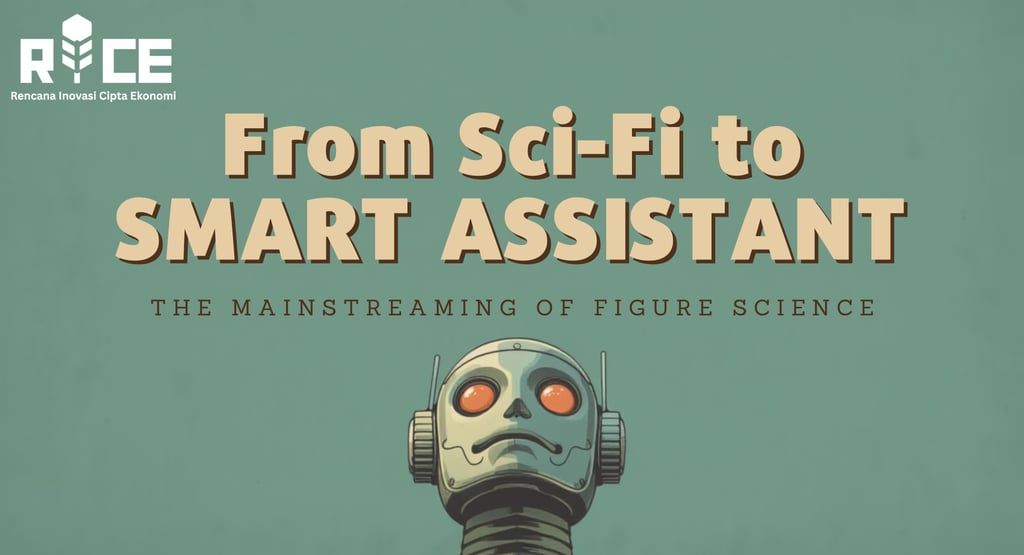
For decades, Artificial Intelligence (AI) resided primarily within the realm of science fiction, an intriguing concept found in speculative novels and futuristic blockbusters. Think of HAL 9000, Data from Star Trek, or the sentient machines of The Matrix. These depictions fueled our imaginations, painting a picture of a world where machines could think, learn, and interact with humans on complex levels. Today, that fantastical vision is rapidly becoming our reality.
AI is no longer a distant dream; it's an invisible, yet indispensable, force shaping our daily existence. From the personalized recommendations on our favorite streaming platforms to the voice commands we issue to our smart speakers, AI has seamlessly integrated itself into the fabric of modern life. This remarkable journey from theoretical concept to pervasive practical application represents one of the most significant technological transformations of our era. Understanding this evolution is crucial for anyone looking to navigate the increasingly AI-driven world. Join us as we trace this incredible trajectory, exploring the pivotal moments and technologies that moved AI from the silver screen into our pockets and homes. Rice AI is committed to demystifying this complex landscape, offering clear insights into how AI drives innovation and practical solutions.
The Early Seeds: Visionary Concepts and Foundational Research
The true genesis of Artificial Intelligence dates back much further than most realize, rooted in the mid-20th century with philosophical ponderings and groundbreaking computational theories. The path to today's smart assistants wasn't a straight line but a winding journey marked by grand ambitions, significant breakthroughs, and periods of skepticism.
Philosophical Origins and Early Computations
The conceptual framework for AI began with visionaries like Alan Turing, whose 1950 paper "Computing Machinery and Intelligence" proposed the famous "Turing Test," a benchmark for machine intelligence. This era questioned whether machines could "think" and laid the groundwork for future research. The term "Artificial Intelligence" itself was coined in 1956 at the Dartmouth Conference, bringing together pioneering researchers who believed that "every aspect of learning or any other feature of intelligence can in principle be so precisely described that a machine can be made to simulate it". Early AI efforts focused on symbolic AI, developing rule-based systems and expert systems that could mimic human decision-making in specific domains, such as medical diagnosis or chess playing. These systems operated on explicit knowledge representation and logical inference.
The AI Winter and Resurgence
Despite initial excitement, the limitations of early AI became apparent. Rule-based systems struggled with ambiguity, common sense, and the vastness of real-world knowledge. The computational power and data needed to overcome these hurdles were simply not available, leading to periods dubbed "AI Winters" where funding and interest waned. However, these periods of stagnation ultimately paved the way for a crucial shift. Researchers began to move away from purely symbolic approaches towards more data-driven methods, particularly machine learning. This new paradigm emphasized algorithms that could learn patterns from data rather than relying solely on pre-programmed rules. This foundational change, coupled with nascent increases in computing power, set the stage for AI's eventual resurgence and mainstream adoption.
The Breakthrough Era: Machine Learning and Big Data
The true inflection point for AI's journey from niche academic pursuit to mainstream technology was the emergence of machine learning, fueled by an unprecedented abundance of data and increasingly powerful computational resources. This era marked a departure from rigid, pre-programmed logic to adaptive, data-driven intelligence.
The Machine Learning Revolution: Algorithms and Data Power
Machine learning revolutionized AI by enabling systems to learn from data without explicit programming. This paradigm shift introduced concepts like supervised learning, where algorithms learn from labeled data (e.g., categorizing emails as spam or not spam), and unsupervised learning, where algorithms find patterns in unlabeled data (e.g., customer segmentation). Early successes were seen in areas like optical character recognition and speech recognition, laying the groundwork for many of today's ubiquitous AI applications. The ability of these algorithms to automatically improve their performance with more data proved to be a game-changer. Fields such as computer vision, which allows machines to "see" and interpret images, and natural language processing (NLP), which enables computers to understand and generate human language, began to make significant strides, moving closer to practical real-world applications.
The Impact of Big Data and Cloud Computing
The proliferation of digital data, often referred to as "Big Data," provided the essential fuel for machine learning algorithms. Every click, search, purchase, and interaction generated valuable information that could be used to train and refine AI models. Simultaneously, the advent of cloud computing platforms offered scalable and affordable computational power, democratizing access to the resources needed to process these vast datasets and run complex AI models. This synergy—Big Data providing the raw material and cloud computing offering the processing capability—created an environment where AI could truly flourish outside of specialized research labs. Suddenly, building and deploying AI solutions became more feasible for businesses and developers, paving the way for the intelligent systems we now take for granted.
AI in Everyday Life: Smart Assistants and Personalized Experiences
The most visible and impactful manifestation of AI's mainstreaming has been its direct integration into our daily routines, most notably through smart assistants and highly personalized digital experiences. These applications have transformed how we interact with technology and consume information, making AI a constant, if often unnoticed, companion.
Conversational AI and Voice Recognition
The arrival of smart assistants like Apple's Siri, Amazon's Alexa, and Google Assistant marked a pivotal moment in AI's journey. These conversational AI systems, powered by advanced natural language processing and voice recognition technologies, allowed users to interact with technology using natural speech. No longer confined to typing commands, we could simply ask our devices to play music, set reminders, answer questions, or control smart home devices. This intuitive interaction lowered the barrier to entry for many users, introducing AI to millions who might not have otherwise engaged with complex technology. The constant refinement of these systems, learning from vast amounts of user interactions, continually improves their understanding and responsiveness, making them increasingly integral to modern households.
Personalization Engines and Recommendations
Beyond voice interfaces, AI silently works behind the scenes to create highly personalized digital experiences across various platforms. Think about your favorite streaming service suggesting your next binge-worthy show, an e-commerce website recommending products you might like, or your social media feed curating content based on your interests. These "personalization engines" are sophisticated AI algorithms that analyze your past behavior, preferences, and even contextual cues to predict what you'll find relevant and engaging. This capability has not only enhanced user experience by making digital interactions more efficient and enjoyable but has also become a cornerstone of modern digital commerce and content consumption, proving AI's profound impact on shaping our preferences and choices.
Deep Learning and Generative AI: The New Frontier
As AI continued its rapid ascent, a subset of machine learning known as deep learning emerged, leading to breakthroughs that once again redefined the capabilities of Artificial Intelligence. This evolution has culminated in the rise of Generative AI, pushing the boundaries of what machines can create and achieve.
Neural Networks and Complex Pattern Recognition
Deep learning, inspired by the structure and function of the human brain, utilizes multi-layered neural networks to process vast amounts of data. This architectural advancement allowed AI models to identify intricate patterns and features automatically, surpassing previous limitations in complex tasks. Convolutional Neural Networks (CNNs), for instance, revolutionized computer vision, enabling highly accurate image recognition and object detection that powers everything from facial recognition in smartphones to autonomous vehicles. Recurrent Neural Networks (RNNs) and their variants excelled in processing sequential data, crucial for advancements in speech recognition and natural language understanding. The landmark victory of Google's AlphaGo over the world champion Go player in 2016 vividly demonstrated deep learning's ability to master highly complex strategic tasks, signaling a new era for AI capabilities
The Emergence of Generative AI
The most recent and perhaps most astounding leap in AI has been the emergence of Generative AI. Models like Large Language Models (LLMs) such as GPT, along with advanced image and audio generation models, can now produce novel, coherent, and often indistinguishable-from-human content. These sophisticated AI systems can write articles, compose music, generate realistic images from text prompts, design marketing materials, and even assist in software development. This capability transcends mere analysis or recognition; it allows AI to create. The applications are vast and transformative, impacting industries from content creation and advertising to product design and scientific research. At Rice AI, we are at the forefront of exploring and implementing these cutting-edge Generative AI technologies, helping businesses unlock new avenues for innovation, efficiency, and creativity. Our expert team leverages these powerful tools to build solutions that not only understand but also generate valuable insights and assets, demonstrating the practical advantages of integrating advanced AI into your operations.
AI's Transformative Trajectory: Challenges, Ethics, and the Future
The journey of Artificial Intelligence from the pages of science fiction to a pervasive force in our daily lives has been nothing short of extraordinary. What began as theoretical concepts has evolved into indispensable tools that enhance productivity, personalize experiences, and drive innovation across virtually every sector. The mainstreaming of AI is a testament to persistent research, technological breakthroughs, and the ever-increasing availability of data and computing power. We've witnessed a dramatic shift from rudimentary expert systems to sophisticated deep learning models and the groundbreaking capabilities of generative AI, which can now create compelling content, designs, and solutions.
This transformative trajectory, however, is not without its complexities and challenges. As AI becomes more integrated into critical systems, ethical considerations around data privacy, algorithmic bias, and accountability become paramount. Ensuring that AI is developed and deployed responsibly, equitably, and transparently is a collective imperative. Regulatory frameworks are emerging globally to address these concerns, guiding the responsible innovation and use of AI technology. The potential for AI to displace certain jobs, while creating new ones, also necessitates a focus on workforce retraining and adapting educational systems to prepare for an AI-driven future. These are not merely technical problems but societal ones, requiring thoughtful deliberation and collaborative solutions from policymakers, researchers, and industry leaders alike.
Looking ahead, the future of AI promises even more profound advancements. We can anticipate further integration of AI into complex decision-making processes, more intuitive human-AI interfaces, and continued breakthroughs in areas like personalized medicine, climate modeling, and scientific discovery. The evolution of AI will likely involve a blending of different AI paradigms, creating hybrid intelligent systems that combine the strengths of various approaches. As AI continues to learn, adapt, and expand its capabilities, it will undoubtedly redefine industries, reshape economies, and fundamentally alter how we live and work. Rice AI remains dedicated to being your trusted partner in this evolving landscape. We provide not only advanced AI solutions but also strategic guidance and deep insights into the ethical implications and future trends of AI, ensuring our clients are well-prepared to harness its power responsibly and effectively. Our commitment extends to helping organizations understand the nuanced dynamics of AI integration, from optimizing operational efficiency to fostering sustainable innovation.
The question is no longer if AI will impact your world, but how profoundly. Are you prepared to embrace the next wave of innovation? Explore the possibilities with Rice AI and discover how intelligent automation, predictive analytics, and generative capabilities can transform your operations and strategic outlook. We invite you to engage with our experts, who can tailor AI strategies to meet your unique business needs and ensure you remain at the forefront of technological advancement.
#ArtificialIntelligence #AIMainstream #DigitalTransformation #TechTrends #FutureOfAI #MachineLearning #GenerativeAI #RiceAI #AIInnovation #DailyAITechnology
RICE AI Consultant
To be the most trusted partner in digital transformation and AI innovation, helping organizations grow sustainably and create a better future.
Connect with us
Email: consultant@riceai.net
+62 822-2154-2090 (Marketing)
© 2025. All rights reserved.


+62 851-1748-1134 (Office)
IG: @riceai.consultant