


Decentralizing Intelligence: A Professional's Introduction to AI in the Web3 Era
Explore the shift to Decentralized AI in the Web3 era. Understand its core technologies, applications, and how it revolutionizes data ownership, ethics, and trust for professionals.
INDUSTRIES
Rice AI (Ratna)
1/22/20266 min read
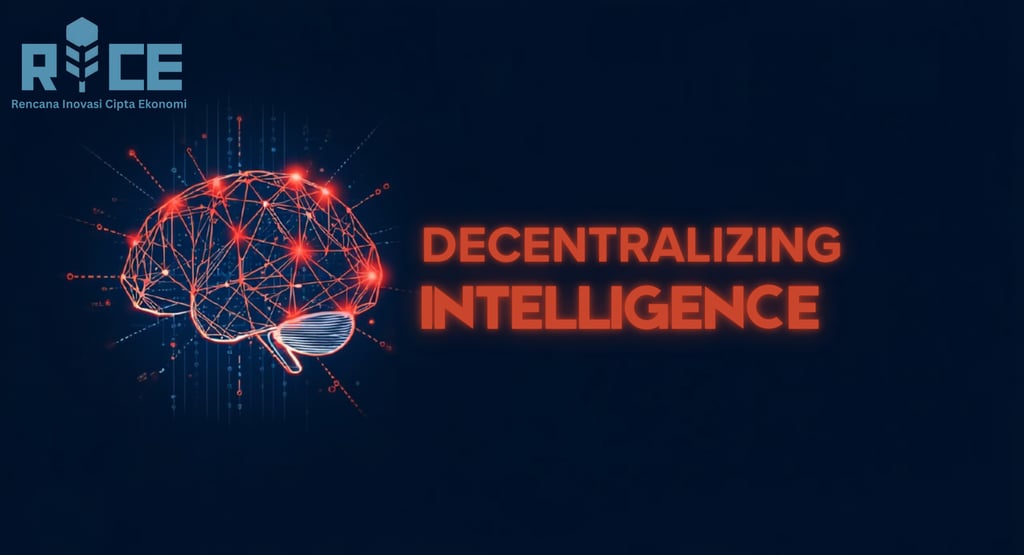
The landscape of Artificial Intelligence is on the cusp of a profound transformation, moving beyond its centralized origins to embrace the decentralized ethos of Web3. Professionals across industries must grasp this paradigm shift, as it promises to redefine how AI is developed, deployed, and governed. Imagine an AI ecosystem where transparency, trust, and user sovereignty are not mere aspirations but foundational principles.
This evolution is more than just a technological upgrade; it represents a fundamental rethinking of intelligence itself. The convergence of AI and Web3 technologies, such as blockchain and distributed ledgers, opens doors to unprecedented opportunities for innovation, ethical development, and broader accessibility. This article will provide an essential introduction, equipping you with the knowledge to navigate and contribute to this exciting new era of decentralized intelligence. We will explore the motivations behind this shift, the core technologies enabling it, its nascent applications, and the challenges and immense opportunities it presents for forward-thinking professionals.
The Centralization Conundrum: Why Decentralize AI?
For years, the development and deployment of Artificial Intelligence have predominantly resided within centralized frameworks, often controlled by a handful of large tech entities. While these models have driven significant advancements, their inherent structure introduces considerable limitations and risks. Understanding these drawbacks is crucial to appreciating the transformative potential of decentralization.
Current AI Limitations and Trust Issues
Traditional AI systems are often plagued by issues stemming from their centralized nature. Data silos prevent comprehensive training, leading to less robust or specialized models. The opaque "black box" nature of many algorithms makes it difficult to understand decision-making processes, fostering a lack of trust and accountability. Furthermore, reliance on central servers creates single points of failure, making systems vulnerable to censorship, data breaches, and malicious attacks. Ethical concerns, particularly regarding data privacy, algorithmic bias, and the potential for misuse, are amplified when control resides with a few powerful players. This centralized power often limits innovation, as access to vast datasets and computing resources remains concentrated.
The Web3 Imperative: Principles of Decentralization
Web3 offers a compelling alternative by fundamentally shifting power dynamics. Its core principles—transparency, immutability, censorship resistance, and user sovereignty—directly address the shortcomings of centralized AI. By distributing control and data across a network, Web3 promotes an environment where no single entity holds undue influence. This inherent design allows for open, verifiable, and community-driven AI development. It promises a democratized future for AI, where participants can collectively own, contribute to, and benefit from intelligent systems, fostering greater trust and collaborative innovation.
Core Technologies Powering Decentralized AI
The ambition of decentralized intelligence is not merely conceptual; it is built upon a robust foundation of cutting-edge technologies. These foundational elements work in concert to enable the secure, transparent, and distributed operation of AI models and data. Understanding these technical pillars is key to comprehending the mechanics of Web3 AI.
Blockchain and Distributed Ledger Technologies (DLTs)
At the heart of Web3 lies blockchain, a decentralized, immutable ledger system. For AI, blockchain serves multiple critical functions: it provides a tamper-proof record of data provenance, model training parameters, and performance metrics, enhancing transparency and auditability. Smart contracts—self-executing contracts with the terms of the agreement directly written into code—automate governance, reward distribution, and access controls for AI services. This ensures that interactions are trustless and executed precisely as programmed, making AI processes more reliable and fair. The inherent security of DLTs helps protect sensitive AI data and intellectual property.
Decentralized Storage and Computing
Centralized cloud providers currently dominate AI training and inference, posing risks to data privacy and creating potential choke points. Decentralized storage solutions like IPFS (InterPlanetary File System) and Arweave offer robust alternatives, allowing AI datasets and models to be stored across a distributed network of nodes, enhancing resilience and censorship resistance. Similarly, decentralized compute networks, such as Golem and Render Network, enable AI training and inference tasks to be crowdsourced to a global network of idle computing resources. This not only democratizes access to powerful computing but also reduces operational costs and dependence on single providers, significantly improving privacy by distributing data processing. These technologies collaboratively form the backbone for a truly decentralized AI infrastructure.
Applications and Use Cases of Decentralized AI
The synergy between Artificial Intelligence and Web3 technologies is unlocking a new wave of innovative applications, addressing long-standing challenges and creating entirely new possibilities. These emergent use cases highlight the practical impact of decentralizing intelligence across various sectors.
Data Ownership and Monetization
One of the most profound shifts brought by decentralized AI is the re-establishment of data sovereignty. In Web3, individuals can retain true ownership of their personal data, rather than it being exploited by centralized entities. Privacy-preserving techniques such as federated learning allow AI models to be trained on distributed datasets without the raw data ever leaving its owner's control. Homomorphic encryption further enables computations on encrypted data, ensuring privacy throughout the entire AI lifecycle. Decentralized data marketplaces are emerging, providing secure and transparent platforms for individuals to selectively license or monetize their data for AI training, ensuring fair compensation and clear usage terms. This model empowers users and fosters a more equitable data economy.
Autonomous Agents and DAOs
The combination of AI with decentralized autonomous organizations (DAOs) creates powerful autonomous agents capable of independent, transparent operation. These AI-powered agents can execute complex tasks, manage resources, and even make decisions on behalf of a DAO, all governed by smart contracts on a blockchain. For instance, an AI agent could manage a decentralized fund, optimizing investments based on predefined criteria, or operate a supply chain, automating logistics and payments. Their actions are auditable on-chain, providing unprecedented transparency and reducing the need for human intervention in routine or rule-based operations. This heralds a new era of self-governing, intelligent systems.
Ethical AI and Bias Mitigation
Algorithmic bias and ethical concerns have been persistent challenges in AI development. Decentralized AI, through its inherent transparency and immutability, offers powerful tools for mitigation. Blockchain can be used to record every step of an AI model's development, from data acquisition and preprocessing to training parameters and deployment. This verifiable provenance allows for thorough auditing of model behavior and decision-making processes, making it easier to identify and correct biases. Community-governed protocols can enforce ethical standards and promote fairness, ensuring that AI systems are developed and used responsibly. Decentralization empowers collective oversight, fostering a more trustworthy and accountable AI ecosystem.
Challenges and Opportunities in the Decentralized AI Landscape
While the promise of decentralized AI is immense, its journey to widespread adoption is not without its hurdles. Navigating these challenges effectively will be crucial for realizing its full potential, opening up significant opportunities for those prepared to innovate.
Technical Hurdles and Scalability
The inherent computational demands of advanced AI models often clash with the current scalability limitations of many blockchain networks. Training complex neural networks requires immense processing power and data throughput, which can strain decentralized infrastructure designed for transaction immutability rather than raw computational speed. Efforts are underway to address this, including the development of specialized AI-focused blockchains, Layer 2 scaling solutions, and optimized distributed computing protocols. Overcoming these technical bottlenecks is paramount to making decentralized AI practical for large-scale, real-world applications. The continued research and development in this area represent a significant opportunity for technological breakthroughs.
Regulatory Frameworks and Adoption
The rapid evolution of decentralized technologies and AI presents a complex landscape for regulators. The absence of clear, harmonized regulatory frameworks creates uncertainty for businesses and developers looking to deploy decentralized AI solutions. Issues around data privacy (e.g., GDPR compliance with immutable ledgers), intellectual property rights for collectively trained models, and accountability for autonomous agents require careful consideration. Driving broader enterprise adoption necessitates not only robust technological solutions but also extensive education and clear demonstration of value propositions. Building bridges between traditional legal structures and the decentralized paradigm will be a long but essential process, offering opportunities for legal tech innovators and policy strategists.
Rice AI's Role in Shaping the Future
At Rice AI, we are not merely observing this transformation; we are actively engineering its future. We are dedicated to bridging the gap between cutting-edge AI research and the robust, transparent frameworks of Web3. Our focus is on developing scalable, secure, and verifiable AI models within decentralized architectures [suggest internal link to Rice AI solutions page]. Our platform empowers enterprises to explore these advanced capabilities without compromising data integrity or security, leveraging the very principles of Web3 to deliver next-generation AI solutions. We provide expert consulting and offer a suite of cutting-edge tools designed to help organizations navigate the complexities of decentralized intelligence, ensuring our clients remain at the forefront of this technological revolution. By integrating privacy-preserving AI with blockchain-based governance, Rice AI is committed to fostering an ecosystem where intelligence is truly decentralized and democratized.
The Future is Decentralized: Embracing a New Paradigm
The journey towards decentralized intelligence marks a pivotal moment in the evolution of Artificial Intelligence. We are moving beyond a model of centralized control and opaque algorithms toward a future defined by transparency, user sovereignty, and collective innovation. This paradigm shift promises to unlock unprecedented opportunities across virtually every industry, from finance and healthcare to supply chain management and creative arts.
The benefits are clear: enhanced data privacy through federated learning and decentralized storage, verifiable AI models that mitigate bias and foster trust, and the emergence of truly autonomous agents operating within transparent, community-governed frameworks. These advancements fundamentally redefine how intelligence is created, owned, and utilized, leading to more equitable and robust AI ecosystems. For professionals, understanding this shift is no longer optional; it is essential for future-proofing strategies and identifying new avenues for growth and impact.
This is not merely a technological transition but a philosophical realignment, challenging established norms and demanding a fresh perspective on collaboration and governance. The challenges of scalability and regulation are significant, yet they are fertile ground for innovation and leadership. As organizations and individuals, we have the collective opportunity to shape an AI future that is more ethical, resilient, and inclusive.
#DecentralizedAI #Web3 #ArtificialIntelligence #Blockchain #AIEthics #DataSovereignty #SmartContracts #FutureOfAI #DistributedComputing #AIInnovation #TechTrends #CryptoAI #PrivacyTech #DAOs #MachineLearning #DailyAIIndustry
RICE AI Consultant
To be the most trusted partner in digital transformation and AI innovation, helping organizations grow sustainably and create a better future.
Connect with us
Email: consultant@riceai.net
+62 822-2154-2090 (Marketing)
© 2025. All rights reserved.


+62 851-1748-1134 (Office)
IG: @riceai.consultant