


The Empathy Engines: The Unseen Human Touch Behind Our Most Responsive AI
Uncover how human intelligence, from meticulous data curation to ethical design, is the true 'empathy engine' behind our most responsive AI systems, shaping their ability to understand and connect.
INDUSTRIES
Rice AI
12/24/20256 min read
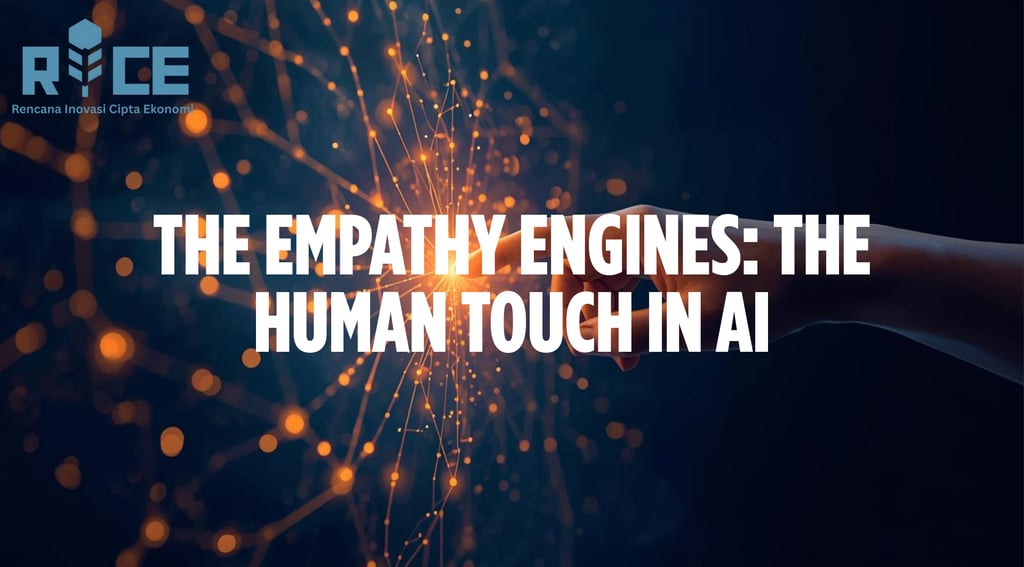
In an age where Artificial Intelligence increasingly handles complex interactions, from customer service to personalized recommendations, a compelling question arises: how does AI achieve such remarkable responsiveness, often seeming to understand and even anticipate our needs? While we marvel at algorithms and processing power, the true "empathy engines" driving these sophisticated systems are not silicon circuits, but the dedicated human minds that conceive, design, train, and refine them. This intricate dance between human insight and artificial computation is the bedrock of truly intelligent AI.
The perception of AI’s responsiveness and its ability to engage in a seemingly empathetic manner isn't a miraculous self-development; it's a testament to profound human effort. It’s a deliberate architectural choice, infused through meticulous data curation, thoughtful ethical frameworks, and iterative human-in-the-loop refinement. This critical human contribution transforms raw data into nuanced understanding, propelling AI beyond mere automation into the realm of genuine intelligent assistance. Understanding this unseen human touch is crucial for any industry expert navigating the evolving landscape of AI.
Understanding Algorithmic Empathy
The term "empathy" when applied to AI often sparks debate, yet its manifestation in AI interactions is undeniable. How do these systems seem to grasp context, tone, and even emotional subtext in our communication? The answer lies not in sentient feeling, but in sophisticated simulation powered by human-engineered foundations.
The Illusion of Feeling
Modern AI, particularly advanced conversational AI and recommendation engines, excels at simulating understanding and generating contextually appropriate responses. This simulation capability is a direct result of highly advanced Natural Language Processing (NLP) and Machine Learning (ML) models. These technologies analyze vast amounts of human communication data to identify patterns, nuances, and relationships between words, phrases, and intended meanings. The AI doesn't feel empathy, but it learns to recognize and respond to indicators that humans associate with empathetic interaction. This allows for interactions that feel intuitive and supportive, fulfilling the user's needs effectively.
The Human-Curated Data Foundation
At the heart of any responsive AI lies its training data, and the quality and diversity of this data are absolutely paramount. This is where the human touch becomes indispensable. Human annotators, linguistic experts, and cultural specialists meticulously label, categorize, and validate vast datasets, effectively teaching the AI the subtleties of human communication. They imbue the data with context, intent, and emotional markers, allowing the AI to learn how to interpret and generate appropriate responses. Without this granular, human-led curation, AI would struggle to move beyond simplistic keyword matching.
The Role of Human-Centric Design
Beyond the data itself, the way AI systems are designed and integrated into human workflows fundamentally shapes their perceived empathy and responsiveness. It's about more than just functionality; it's about crafting an experience that resonates with human expectations and needs.
Intentional Design for Intuitive Interaction
User Experience (UX) and User Interface (UI) designers play a critical role in bridging the gap between complex AI algorithms and intuitive human interaction. They translate deep human needs and cognitive patterns into accessible and engaging AI functionalities. This involves designing conversational flows that feel natural, visual interfaces that are clear, and interaction models that anticipate user behavior. The goal is to make the AI feel like a helpful assistant rather than a rigid machine, ensuring that its responses are not only accurate but also delivered in a manner that is easy to understand and act upon. This human-centric approach ensures AI solutions are truly effective.
Ethical Frameworks and Bias Mitigation
Perhaps one of the most critical, yet often unseen, human contributions to responsive AI is the ongoing work in ethical AI development and bias mitigation. Ethicists, sociologists, and policy makers are essential in defining the responsible boundaries and guidelines for AI deployment. Their work ensures that AI systems are developed with fairness, transparency, and accountability in mind. Humans actively work to identify and reduce inherent biases within algorithms and their training data. This crucial oversight prevents AI from perpetuating or amplifying societal inequalities, ensuring that its responses are fair and inclusive for all users. At Rice AI, we are deeply committed to these ethical principles, understanding that truly responsive AI must first be equitable AI. Our development processes incorporate rigorous ethical reviews and bias detection mechanisms, ensuring our solutions are not just intelligent, but also responsible and trustworthy.
Iterative Human-AI Collaboration
The development of responsive AI is not a one-time event but a continuous process of learning and refinement. This iterative cycle heavily relies on the dynamic interplay between human intelligence and machine learning, ensuring AI systems constantly evolve to meet changing user expectations.
User Feedback as a Catalyst
The real-world interactions users have with AI systems are invaluable feedback loops that drive continuous improvement. Every query, every response, and every user satisfaction rating provides data points that human analysts interpret to refine AI models. This feedback helps identify areas where the AI's understanding could be improved, where its responses might be ambiguous, or where it fails to meet user expectations for empathy and helpfulness. Human oversight ensures that these learnings are systematically integrated, making the AI smarter and more responsive over time. This collaborative approach makes AI truly adaptive.
Expert Oversight and Model Refinement
Beyond general user feedback, the ongoing involvement of domain experts and AI engineers is critical for fine-tuning complex models. These professionals delve into the intricacies of AI behavior, conducting rigorous testing and making precise adjustments to algorithms. They are essential for handling edge cases, adapting the AI to new regulatory environments, or integrating new knowledge domains. This expert human intervention ensures that the AI remains robust, accurate, and capable of addressing increasingly complex problems with a high degree of responsiveness. It’s a perpetual cycle of learning and enhancement.
Beyond Responsiveness: Towards Genuine Understanding
The evolution of AI continues, pushing the boundaries of what these systems can achieve in terms of human-like interaction. The next frontier involves moving beyond mere responsiveness to a deeper, more nuanced form of understanding.
Advancements in Affective Computing
Emerging fields like affective computing are exploring how AI can not only detect but also interpret and respond to human emotions in more sophisticated ways. This involves analyzing vocal tone, facial expressions, and physiological cues to infer emotional states. While still in early stages, these advancements promise AI systems that can tailor their interactions based on a deeper reading of a user's emotional context, leading to more genuinely empathetic engagements. Ethical considerations around privacy and manipulation are paramount here, requiring careful human deliberation in their development and deployment. The goal is to enhance, not exploit, human interaction.
The Blurring Lines: AI as a Collaborative Partner
As AI becomes more sophisticated, its role is shifting from a mere tool to a collaborative partner. Future AI systems will not just execute tasks but will actively assist in problem-solving, offer creative insights, and even anticipate challenges before they arise. This partnership model emphasizes AI that augments human intelligence, enhancing our capabilities and freeing us to focus on higher-level strategic thinking. This collaborative future is built on the understanding that AI's intelligence is a product of its human creators, and its true potential is realized when it works in concert with human ingenuity. At Rice AI, we are pioneering solutions that embody this collaborative spirit, designing AI systems that serve as powerful extensions of human teams, driving innovation and efficiency across industries.
In the grand narrative of Artificial Intelligence, the human touch remains the indelible mark of its true potential. The responsiveness, the helpfulness, and the perceived empathy of our most advanced AI systems are not accidents of code but deliberate acts of human ingenuity, ethics, and relentless refinement. From the meticulous curation of data to the thoughtful design of interactions and the continuous feedback loops that improve performance, every layer of sophisticated AI development is permeated by human effort.
AI is not a self-generating entity, but rather a profound reflection of our collective intelligence, values, and aspirations. It is a mirror showing us what we deem important in communication, problem-solving, and assistance. The future of AI, therefore, lies not just in advancing algorithms, but in continuously deepening the human commitment to its thoughtful and responsible development. This ensures that as AI becomes more integrated into our lives, it remains aligned with human values and serves humanity’s best interests. By understanding and actively nurturing these unseen human contributions, we can truly unleash AI's transformative power.
For industry experts and innovators, the imperative is clear: prioritize the human element in every stage of your AI strategy. Foster environments where designers, ethicists, data scientists, and users collaborate to build systems that are not just smart, but also wise, fair, and genuinely responsive. We invite you to explore how Rice AI integrates these very principles into our cutting-edge solutions, empowering robust and ethical human-AI collaboration for an intelligent future.
#AIEmpathy #HumanCenteredAI #EthicalAI #ResponsiveAI #AIDesign #MachineLearning #NLP #FutureOfAI #HumanInTheLoop #AIInnovation #TechForGood #SmartTech #DigitalTransformation #AIConsulting #RiceAI #DailyAIIndustry
RICE AI Consultant
To be the most trusted partner in digital transformation and AI innovation, helping organizations grow sustainably and create a better future.
Connect with us
Email: consultant@riceai.net
+62 822-2154-2090 (Marketing)
© 2025. All rights reserved.


+62 851-1748-1134 (Office)
IG: @riceai.consultant