


From Pixels to Perfection: A Data History of Deepfake Evolution
This data-driven history uncovers algorithmic advancements, ethical challenges, and profound implications for digital authenticity.
TECHNOLOGY
Rice AI (Ratna)
2/19/20267 min read
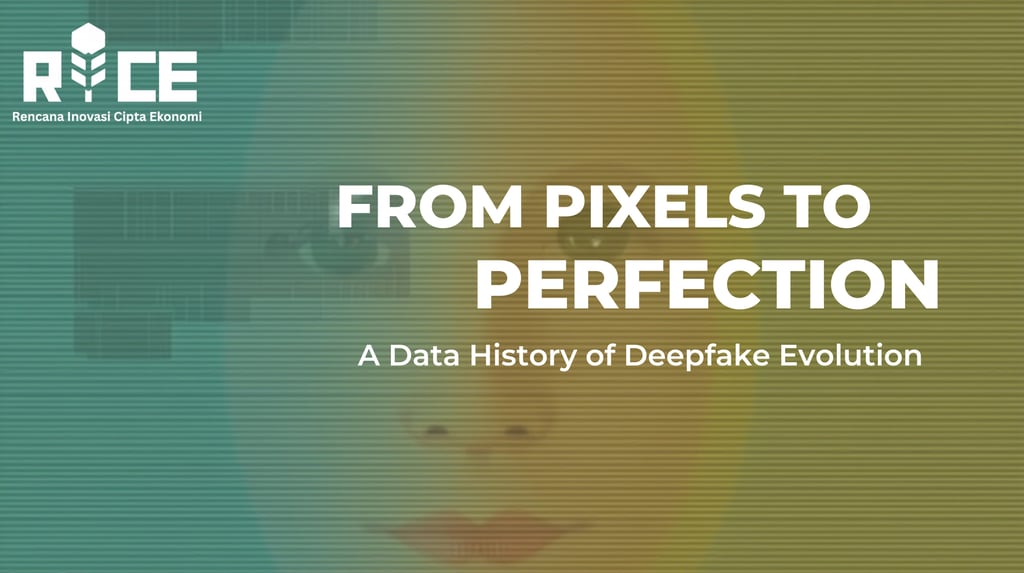
Have you ever paused to consider the sheer pace at which Artificial Intelligent Technology is reshaping our digital reality? From rudimentary image manipulation to hyper-realistic video synthesis, the evolution of deepfakes stands as a powerful testament to this progress. What began as a nascent technological curiosity now represents a profound shift in how we perceive and interact with digital information, challenging our very understanding of authenticity. For industry experts and professionals, comprehending this data-driven journey is not merely academic; it is crucial for navigating the complex future of digital media. This exploration delves into the historical data landscape that fueled the rise of deepfakes, tracing their lineage from simple concepts to the sophisticated, often indistinguishable, creations of today. We will examine the pivotal algorithmic advancements and the escalating data demands that have propelled deepfakes from niche experiments to a prominent feature of our global technological discourse.
The Dawn of Synthesized Reality: Early Forays into Deepfakes
The concept of altering media is far from new. For decades, artists and technicians manipulated photographs and videos using conventional editing software. However, the true inflection point arrived with the advent of advanced machine learning. The shift was profound: from manual, pixel-by-pixel alteration to automated, data-driven synthesis.
Proto-Deepfakes and the Data Imperative
Before deepfakes became a household term, rudimentary forms of synthetic media began to emerge, often as academic curiosities. These early attempts, while crude by today’s standards, laid the groundwork by demonstrating the potential of algorithms to learn and generate new content. Researchers quickly understood that the fidelity of these generated outputs directly correlated with the quantity and quality of the training data. This data imperative meant gathering extensive collections of images and videos to teach neural networks the intricate patterns of human appearance and behavior. Without these foundational datasets, the leap to sophisticated deepfake technology would have been impossible.
The real breakthrough arrived with the introduction of Generative Adversarial Networks (GANs) in 2014. Developed by Ian Goodfellow and his colleagues, GANs presented a novel architecture where two neural networks, a generator and a discriminator, competed against each other. The generator's task was to create synthetic data (e.g., images) that looked real, while the discriminator's role was to distinguish between real and generated data. This adversarial process allowed GANs to progressively refine their output, producing increasingly convincing synthetic media. The training data for GANs involved vast libraries of real images, enabling the networks to learn intricate statistical properties of various subjects. For instance, to generate realistic human faces, a GAN needed to analyze millions of facial images, understanding everything from skin texture to eye placement. This iterative, data-intensive training loop was a game-changer, fundamentally altering the trajectory of generative AI and setting the stage for what would become known as deepfakes.
From Research Labs to Mainstream: The Autoencoder Era
The mid-2010s witnessed deepfake technology transition from abstract academic research to a more accessible, albeit still complex, phenomenon. This period was largely defined by the rise of autoencoders and the burgeoning availability of computational power.
Data Volume and Algorithmic Sophistication
Deepfakes as we largely recognize them today—face-swapped videos—gained significant traction around 2017-2018. This popularization was heavily reliant on autoencoder architectures. An autoencoder works by compressing input data into a lower-dimensional representation (encoding) and then reconstructing the original data from this representation (decoding). For face swapping, a deepfake system typically trains two autoencoders: one for the source face and another for the target face. Both autoencoders learn to encode and decode the faces of their respective subjects. Crucially, they share an encoder. This shared component allows the system to take a video of a target person, encode their facial movements and expressions, and then use the decoder trained on the source person’s face to reconstruct a new face, effectively imposing the source’s identity onto the target’s movements.
The effectiveness of this autoencoder approach hinged entirely on the training data. To produce a convincing face swap, the models required extensive datasets of both the source and target individuals. This typically meant hours of video footage of each person from various angles, with different expressions, and under diverse lighting conditions. The more varied and comprehensive the dataset, the better the autoencoder could learn the unique features and nuances of each face, leading to more realistic and seamless swaps. The computational demands were substantial, requiring significant GPU power for training, which, fortunately, was becoming increasingly accessible to researchers and hobbyists alike. This accessibility, coupled with the algorithmic leap, led to a surge in deepfake creation, sparking widespread ethical concerns about misrepresentation and disinformation. At Rice AI, our research into data efficiency for generative models helps clients navigate these complex data needs, ensuring high-quality output without compromising ethical standards or data integrity. We understand the critical importance of robust datasets and optimal training methodologies to achieve both realism and responsible deployment in Artificial Intelligent Technology.
The Cutting Edge: Diffusion Models and Hyper-Realism
While GANs and autoencoders laid the foundation, the latest chapter in deepfake evolution has been written by diffusion models. These models represent a significant leap in generative AI, pushing the boundaries of realism and creative capability far beyond their predecessors.
Unprecedented Data Scales and Model Complexity
Diffusion models, exemplified by systems like DALL-E 2, Midjourney, and Stable Diffusion, operate on a fundamentally different principle than GANs. Instead of an adversarial battle, they learn to generate data by progressively adding noise to an image and then reversing this process to 'denoise' it back to a coherent, high-fidelity image. This iterative denoising process allows for unparalleled control and quality in synthesis. Unlike earlier deepfake techniques primarily focused on face swapping, diffusion models can generate entire scenes, create intricate objects, and even synthesize realistic audio and text from simple prompts. This shift has broadened the scope of synthetic media from mere alteration to true creation.
The data requirements for these cutting-edge models are immense, dwarfing those of previous generations. To achieve their stunning capabilities, diffusion models are trained on datasets containing billions of image-text pairs, carefully curated to link visual concepts with natural language descriptions. For instance, Stable Diffusion's training data included subsets of LAION-5B, a dataset comprising 5.85 billion image-text pairs. This unprecedented scale of data enables the models to understand and synthesize a vast array of concepts, styles, and details, leading to outputs that are often indistinguishable from real photographs or videos. The sheer volume and diversity of data empower these models to produce outputs with a level of photorealism and contextual understanding previously unimaginable. The complexity of these models, combined with their data hunger, presents new challenges in terms of computational resources, ethical deployment, and the evolving landscape of deepfake detection and digital forensics. This highlights a critical area of focus for Industry Experts and Professionals in the field of Artificial Intelligent Technology.
Beyond Malign Intent: Legitimate Applications and Evolving Landscape
While the darker implications of deepfakes often dominate headlines, it's crucial to recognize the dual-use nature of this powerful Artificial Intelligent Technology. The underlying generative AI, powered by vast datasets, holds immense potential for legitimate and beneficial applications across various sectors.
Data Governance, Ethics, and the Future of Synthetic Media
The same technology that can create convincing fake videos can also revolutionize industries. In film and television, deepfakes facilitate seamless de-aging of actors, realistic voice synthesis for voiceovers, and the creation of digital doubles, significantly reducing production costs and timelines. In education, synthetic media can generate personalized learning content or historical simulations. Virtual assistants and digital avatars are becoming increasingly lifelike, enhancing user experience through realistic facial expressions and natural language processing. Even in accessibility, deepfake technology can enable individuals with speech impediments to communicate more clearly or generate sign language avatars. These positive applications underscore the importance of robust data governance and ethical frameworks.
However, the rapid advancement of deepfake generation has ignited an equally rapid "arms race" in deepfake detection. This ongoing battle is driven by data scientists and cybersecurity experts developing sophisticated algorithms to identify synthetic content. Techniques involve analyzing subtle inconsistencies in pixel patterns, facial movements, and even physiological markers that generative models struggle to replicate perfectly. The increasing sophistication of both generation and detection methods highlights the critical importance of data provenance, digital watermarking, and advanced digital forensics. Ensuring the trustworthiness of digital media in the future will depend heavily on developing robust systems that can trace the origin and modifications of content. At Rice AI, we believe in harnessing the power of advanced AI for ethical innovation, developing tools that empower creativity while bolstering defenses against misuse. Our solutions are built on a foundation of responsible data practices and cutting-edge algorithmic integrity, providing essential guidance for Industry Experts and Professionals.
Looking ahead, the evolution of deepfakes will likely see even more photorealistic real-time generation, the synthesis of emotions, and cross-modal generation—where text generates video, or audio generates lifelike avatars. These advancements will further blur the lines between reality and simulation, making the role of policy, regulation, and public education paramount. As Artificial Intelligent Technology continues its relentless march, establishing clear guidelines for the responsible creation and dissemination of synthetic media, supported by advanced data science, becomes an imperative.
The Future is Now: Navigating the Deepfake Horizon
The journey from rudimentary pixel manipulation to the seamless synthetic perfection of modern deepfakes is a profound testament to the power of Artificial Intelligent Technology. Our data-driven history has shown that each leap in deepfake capability has been inextricably linked to two critical factors: the increasing availability of vast, diverse datasets and the ingenious algorithmic innovations that leverage this data. From the adversarial training of GANs to the sophisticated denoising processes of diffusion models, the narrative is clear – more data, coupled with smarter algorithms, equals more convincing synthetic realities.
For industry experts and professionals, understanding this evolution is no longer optional. Deepfakes are not merely a technological curiosity; they are a permanent and increasingly sophisticated feature of our digital landscape, impacting everything from media authenticity to cybersecurity, and even the very fabric of trust in information. The challenge lies in balancing the immense creative and beneficial potential of generative AI with the imperative to mitigate its risks. This demands continuous investment in deepfake detection technologies, robust ethical guidelines for AI development, and proactive measures in data governance and digital literacy.
As the landscape of Artificial Intelligent Technology continues to evolve, understanding its nuances, particularly in areas like deepfakes, is paramount. Rice AI stands at the forefront of this evolution, offering deep insights and robust solutions designed to empower industry experts and professionals to navigate these complex digital waters safely and effectively. We provide comprehensive analytical tools and strategic guidance for managing the profound implications of synthetic media, from development to detection. The future will undoubtedly bring even more advanced generative capabilities. It is our collective responsibility to ensure that these advancements serve humanity responsibly. Explore how Rice AI can help your organization understand and strategically manage the profound impacts of advanced generative AI, ensuring you are prepared for the next wave of innovation in synthetic media.
#DeepfakeEvolution #AITechnology #GenerativeAI #SyntheticMedia #AIData #DigitalTransformation #AIethics #DeepfakeDetection #FutureOfAI #IndustryExpert #RiceAI #ArtificialIntelligence #Innovation #Cybersecurity #DailyAITechnology
RICE AI Consultant
To be the most trusted partner in digital transformation and AI innovation, helping organizations grow sustainably and create a better future.
Connect with us
Email: consultant@riceai.net
+62 822-2154-2090 (Marketing)
© 2025. All rights reserved.


+62 851-1748-1134 (Office)
IG: @riceai.consultant