

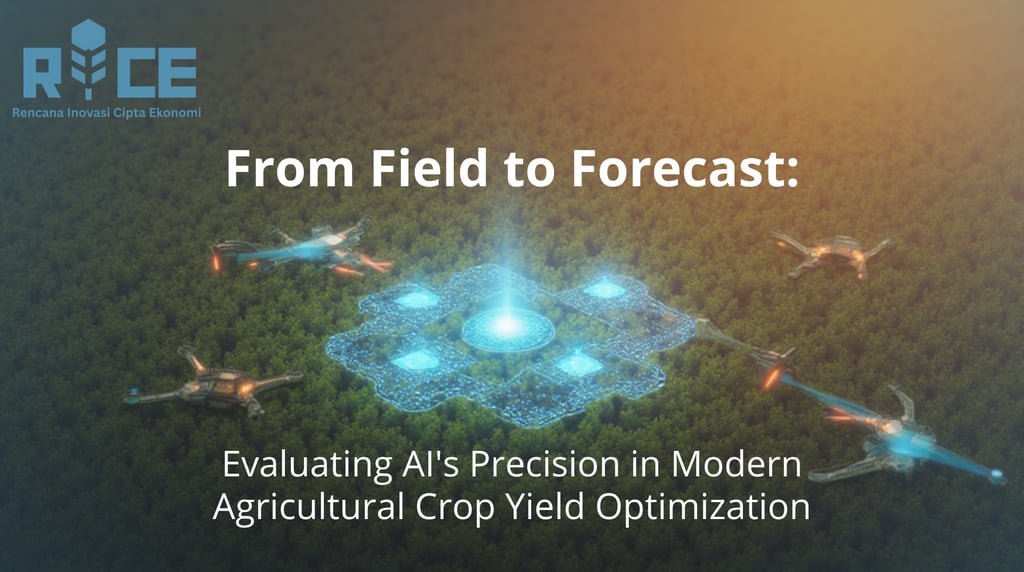
From Field to Forecast: Evaluating AI's Precision in Modern Agricultural Crop Yield Optimization
This article details how AI optimizes crop yields, enhances food security, and drives sustainable farming practices.
AI INSIGHT
Rice AI (Ratna)
12/1/20257 min read
The global agricultural landscape faces unprecedented pressures, from escalating climate change impacts to the relentless demand of a growing population. Ensuring food security while optimizing resource utilization has become the defining challenge of our era. Traditional farming methods, while foundational, are often reactive and less efficient in the face of these complex variables. This necessitates a paradigm shift towards more sophisticated, data-driven approaches.
Artificial Intelligence (AI) emerges as a powerful, transformative force, promising to revolutionize how we cultivate crops and manage agricultural resources. By leveraging advanced algorithms and machine learning, AI offers the potential for unparalleled precision in crop yield optimization. However, the true value of AI lies not just in its application, but in a thorough and ongoing evaluation of its precision and efficacy. This article delves into the mechanisms, benefits, challenges, and future trajectory of AI in modern agriculture, exploring how it moves us from reactive field management to proactive, data-informed forecasts that redefine productivity.
The Imperative of Precision: Why AI Matters in Agriculture
The agricultural sector stands at a critical juncture, balancing the need for increased production with environmental stewardship. Achieving this balance requires a level of insight and control that traditional methods simply cannot provide. This is where the power of AI in agriculture becomes indispensable.
Addressing Global Food Security
With projections indicating a global population of nearly 10 billion by 2050, the demand for food is set to surge dramatically. Simultaneously, arable land is diminishing, and climate volatility introduces significant uncertainty to farming operations. AI offers a pathway to increase agricultural output without necessarily expanding land use, focusing instead on maximizing the productivity of existing farmland. This precision approach is crucial for securing a sustainable food supply for future generations.
Moving Beyond Traditional Methods
Conventional farming often relies on broad-stroke approaches, applying uniform treatments across vast fields based on historical averages or anecdotal experience. This can lead to inefficient resource allocation, such as over-fertilization, excessive water usage, or delayed pest intervention. Precision farming, powered by AI, moves beyond these limitations by enabling highly localized and adaptive decision-making. It transforms farming from an art informed by experience into a science driven by real-time data and predictive insights, allowing farmers to address specific needs at a granular level.
AI's Arsenal: Technologies Driving Crop Yield Optimization
The technological backbone of AI in agriculture is diverse, encompassing a suite of advanced tools working in concert. These technologies collect, process, and analyze vast amounts of data to provide actionable intelligence for farmers. Understanding these components is key to appreciating AI's precision capabilities.
Machine Learning and Predictive Analytics
At the core of crop yield optimization are machine learning algorithms, which analyze historical and real-time data to identify patterns and make accurate predictions. These models process inputs like weather patterns, soil composition, historical yield data, and satellite imagery to forecast future yields, recommend optimal planting times, and predict potential risks. For instance, regression models can estimate harvest volumes, while classification algorithms can identify specific crop health issues. This predictive analytics capability empowers farmers to make informed decisions proactively, minimizing losses and maximizing efficiency.
Deep Learning and Computer Vision
More advanced forms of AI, particularly deep learning, are revolutionizing visual data analysis in agriculture. Computer vision systems, often integrated into drones or ground-based robots, can rapidly scan fields for subtle signs of disease, pest infestations, or nutrient deficiencies that might be invisible to the human eye. These systems analyze images pixel by pixel, learning to distinguish healthy plants from affected ones with high accuracy. This early detection allows for targeted interventions, reducing the need for broad-spectrum pesticide applications and preserving crop health efficiently. The synergy of deep learning and robotics enables automated precision spraying or harvesting.
Internet of Things (IoT) Integration
The effectiveness of agricultural AI hinges on access to rich, real-time data from the field. This is where the Internet of Things (IoT) plays a pivotal role. Networks of sensors embedded in soil or mounted on equipment constantly monitor critical parameters such as soil moisture levels, pH, nutrient content, air temperature, and humidity. These IoT devices feed continuous streams of data to AI models, providing a dynamic picture of crop conditions. The integration of IoT sensors with AI platforms allows for immediate data interpretation and adaptive responses, making smart farming truly intelligent and responsive.
Quantifying Precision: Evaluating AI's Impact on Yields
Evaluating the true precision of AI in agriculture moves beyond theoretical capabilities to demonstrable, measurable outcomes. Understanding these metrics is crucial for farmers and investors alike to gauge the return on investment and the overall effectiveness of adopting agricultural technology. The promise of AI is not just to collect data, but to transform it into tangible improvements.
Metrics for Success
The precision of AI can be quantified through several key performance indicators. Foremost among these is yield per acre, where AI-driven insights lead to demonstrably higher harvests from the same land area. Beyond just quantity, resource efficiency is a critical metric, measuring reductions in water, fertilizer, and pesticide usage while maintaining or increasing yields. This translates directly to lower operational costs and enhanced sustainability. Furthermore, the reduction in crop loss due to early disease or pest detection, combined with improved crop quality, represents significant economic returns for farmers. Ultimately, the financial viability and environmental benefits underscore AI's precision.
Case Studies and Real-World Applications
Across the globe, pilot projects and commercial deployments are showcasing AI's impact. For instance, AI-powered irrigation systems, by precisely measuring soil moisture and plant water needs, have been shown to reduce water consumption by 20-30% in certain crops, while maintaining optimal growth. Similarly, computer vision systems identifying specific weed species allow for highly targeted herbicide application, drastically cutting chemical use. In disease management, early detection through AI analysis of drone imagery can prevent localized infections from spreading, saving entire fields. Platforms like Rice AI are pioneering solutions that offer farmers actionable intelligence, demonstrating tangible improvements in harvest outcomes and resource efficiency.
Navigating the Challenges: Barriers to AI Adoption and Precision
Despite the immense potential of AI in agriculture, its widespread adoption and the consistent delivery of high precision face several significant hurdles. Addressing these challenges is paramount for unlocking the full benefits of this transformative technology.
Data Quality and Accessibility
The efficacy of any AI system is directly tied to the quality, quantity, and accessibility of the data it consumes. Agricultural data is often fragmented, collected using disparate systems, and can be inconsistent or incomplete. Ensuring robust, clean, and interoperable datasets is a major challenge. Furthermore, the sheer volume of data generated by sensors and imaging devices requires significant infrastructure for storage and processing. Establishing standardized data collection protocols and ensuring seamless integration across different farming technologies are critical steps towards enhancing AI's precision.
Cost and Complexity
The initial investment required for implementing advanced AI solutions, including sensors, autonomous machinery, and sophisticated software platforms, can be substantial. This poses a significant barrier for many farmers, especially small and medium-sized operations with limited capital. Beyond the initial outlay, the complexity of these systems often necessitates specialized technical expertise for installation, maintenance, and data interpretation. Bridging this knowledge gap through training programs and user-friendly interfaces is essential to democratize access to agricultural AI.
Ethical Considerations and Data Privacy
As AI becomes more integrated into farming practices, important ethical questions arise, particularly concerning data ownership and privacy. Who owns the vast amounts of agricultural data collected by sensors and AI platforms? How is this data secured against breaches or misuse? Furthermore, there is a risk of bias in AI models, potentially leading to unequal access to technology or disadvantaging certain farming communities. Establishing clear ethical guidelines, robust data governance frameworks, and ensuring equitable access are crucial for responsible and sustainable AI deployment in agriculture.
The Horizon of Agricultural AI: Future Trends and Outlook
Looking ahead, the evolution of AI in agriculture promises even more profound transformations, moving towards increasingly integrated, intelligent, and sustainable farming systems. The future will see AI not just optimizing existing processes but enabling entirely new paradigms of cultivation.
Hyper-Personalized Farming
The next frontier for AI accuracy involves hyper-personalized farming, where interventions are tailored not just to specific sections of a field, but to individual plants. This could involve combining sensor data with advanced genomics to understand each plant's unique needs, from its ideal nutrient profile to its genetic susceptibility to diseases. AI will analyze these micro-level details to deliver ultra-precise nutrient delivery, water management, and pest control, maximizing the potential of every single crop. This level of granularity promises unparalleled resource efficiency and yield maximization.
AI-Powered Supply Chain Optimization
The influence of AI will extend beyond the farm gate, impacting the entire agricultural supply chain. From forecasting market demand and optimizing logistics for produce transportation to reducing post-harvest waste through intelligent storage solutions, AI will enhance efficiency from farm to fork. Blockchain integration with AI could also create transparent and traceable supply chains, ensuring food safety and building consumer trust. This holistic approach promises to tackle systemic inefficiencies, leading to more resilient and responsive food systems globally.
Policy and Collaborative Frameworks
The full potential of AI in agriculture cannot be realized without supportive policy frameworks and collaborative efforts. Governments, academic institutions, and private sector innovators must work together to establish standards for data sharing, invest in research and development, and create incentives for AI adoption. Public-private partnerships will be crucial for developing accessible AI tools and training programs for farmers. At Rice AI, we believe collaborative innovation is key to democratizing advanced agricultural AI, making precision farming accessible and impactful for growers worldwide. Such collaborations will foster an ecosystem where AI can thrive, addressing both the technological and societal challenges of food production.
Conclusion
The journey from traditional farming practices to AI-driven agricultural intelligence marks a pivotal shift in our approach to feeding the world. AI in agriculture is not merely an incremental improvement; it is a fundamental re-imagining of how we manage our most vital resources to ensure both productivity and sustainability. By offering unparalleled precision farming capabilities, AI enables farmers to move beyond guesswork, embracing data-driven farming that optimizes every aspect of crop cultivation.
From sophisticated machine learning models that predict yields with remarkable AI accuracy to deep learning algorithms that detect early signs of distress, AI is equipping the agricultural sector with tools previously unimaginable. We have explored how technologies like the IoT are feeding these intelligent systems with real-time data, enabling a dynamic and responsive approach to farm management. The evaluation of this precision through metrics like increased yield per acre and enhanced resource efficiency clearly demonstrates the tangible benefits and economic returns that AI offers.
While challenges such as data quality, implementation costs, and ethical considerations remain, they are not insurmountable. They represent opportunities for innovation, collaboration, and policy development that will strengthen the foundation of smart farming. The future promises hyper-personalized farming, integrated supply chain optimization, and a global framework of collaboration, all powered by AI. As industry experts and professionals, it is our collective responsibility to champion these advancements, ensuring that the transformative power of AI is harnessed responsibly and equitably.
Embracing AI is essential for creating a more resilient, sustainable, and productive agricultural future. It empowers us to meet the growing demand for food while safeguarding our planet's resources. The era of sustainable agriculture, guided by intelligent insights, is here. Explore how advanced agricultural analytics can redefine your operational efficiency and contribute to a thriving global food system.
#AIinAgriculture #PrecisionFarming #CropYieldOptimization #SmartFarming #AgriculturalTechnology #MachineLearning #DeepLearning #SustainableAgriculture #FoodSecurity #AgriTech #FarmManagement #PredictiveAnalytics #IoTagriculture #FutureofFarming #AgriInnovation #DailyAIInsight
RICE AI Consultant
To be the most trusted partner in digital transformation and AI innovation, helping organizations grow sustainably and create a better future.
Connect with us
Email: consultant@riceai.net
+62 822-2154-2090 (Marketing)
© 2025. All rights reserved.

+62 851-1748-1134 (Office)
IG: @riceai.consultant