

The AI Future of Customer Service: Bots vs. Enhanced Agents
This deep dive for SMBs analyzes the ROI of bots vs. AI-enhanced agents, offering strategies for a hybrid model to boost efficiency and customer loyalty.
TECHNOLOGY
Rice AI (Ratna)
3/28/20269 min read
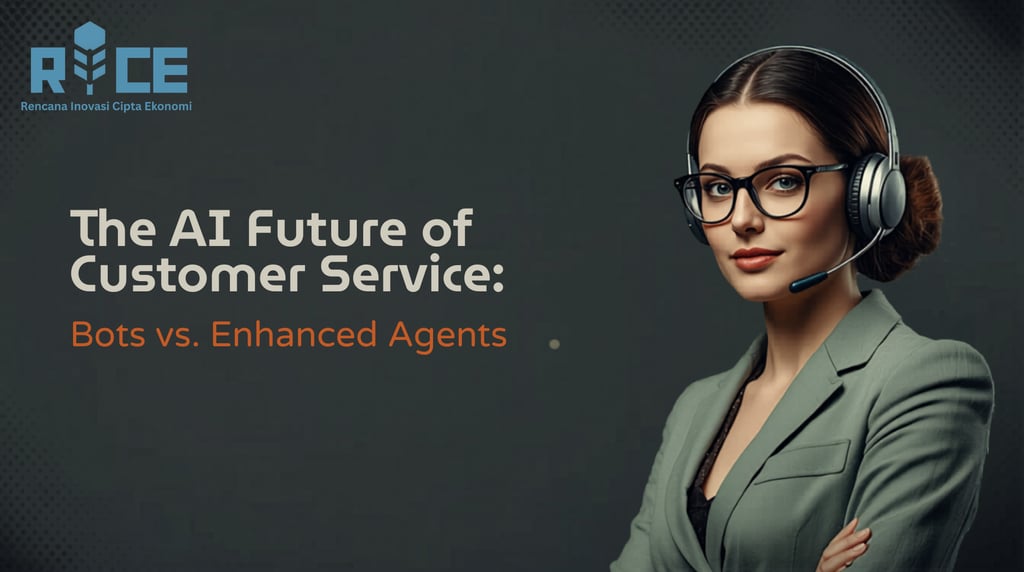
Imagine your small business customer service in 2029. Will it be a fully automated fortress of chatbots, or will human agents, supercharged by artificial intelligence, be the new standard? The landscape of customer interaction is rapidly evolving, driven by advancements in AI technology. For small and medium-sized businesses (SMBs), understanding this shift isn't just about staying competitive; it's about securing a tangible return on investment (ROI) and fostering lasting customer loyalty.
This comprehensive outlook explores the strategic decisions SMBs face regarding AI implementation in customer service. We will dissect the strengths and weaknesses of both AI-powered bots and AI-enhanced human agents. By projecting to 2029, we aim to provide a clear roadmap for maximizing your AI customer service ROI and navigating the complex choices ahead. The goal is to illuminate how these technologies will redefine efficiency, customer satisfaction, and profitability for your business in the coming years.
The Dawn of AI in Customer Service: A 2029 Landscape
The integration of artificial intelligence into customer service is no longer a futuristic concept; it is a present reality rapidly shaping the future. By 2029, AI will be an indispensable component of successful customer support strategies, particularly for SMBs seeking scalable and efficient solutions. This shift necessitates a clear understanding of AI's capabilities and its potential to transform operational paradigms.
Current State and Rapid Evolution
Today, many SMBs are tentatively adopting basic AI tools like chatbots for frequently asked questions (FAQs) or simple query routing. These initial forays demonstrate AI's potential to streamline operations and handle a growing volume of customer interactions. However, current AI is merely scratching the surface of its prospective impact.
Looking towards 2029, AI will have matured significantly. Conversational AI, powered by increasingly sophisticated natural language processing (NLP) and machine learning (ML), will offer much more nuanced and context-aware interactions. This will move beyond simple script adherence to truly understanding customer intent and sentiment, even anticipating needs. For small business AI, this means capabilities previously reserved for large enterprises will become accessible and affordable.
Expect AI systems to integrate seamlessly across multiple channels, including voice, chat, email, and social media. This omnichannel capability will ensure consistent and personalized customer experiences, regardless of how a customer chooses to interact. The underlying data analytics, fueled by AI, will provide SMBs with unprecedented insights into customer behavior and preferences.
AI Bots: The Efficiency Powerhouse
AI bots represent a significant leap in customer service automation. Their allure lies in their ability to handle high volumes of inquiries, operate 24/7, and reduce operational costs. For SMBs, bots offer a compelling proposition for achieving immediate efficiencies.
Core Capabilities and Cost Savings
By 2029, AI chatbots will be adept at far more than just answering FAQs. They will efficiently manage password resets, update order statuses, provide product information, and even guide customers through troubleshooting steps. These bots excel at repetitive and rule-based tasks, freeing up human agents for more complex interactions.
The primary ROI driver for bots is significant cost reduction. Deploying bots can drastically lower the need for extensive human agent staffing, especially for round-the-clock support. Businesses can achieve substantial savings on salaries, benefits, and training costs. Furthermore, bots eliminate wait times for common queries, improving customer satisfaction metrics and potentially reducing call abandonment rates. This directly translates into a measurable bot ROI through optimized resource allocation.
Bots also offer unparalleled scalability. During peak seasons or unexpected surges in demand, bots can seamlessly handle an increased volume of inquiries without requiring additional human resources. This elasticity is crucial for SMBs experiencing rapid growth or fluctuating customer contact patterns. Their ability to deliver consistent responses also ensures brand messaging and service quality remain high.
Limitations and Customer Perception
Despite their advantages, AI bots are not a panacea. Their primary limitation stems from their current inability to genuinely empathize or handle highly emotional and complex issues. Customers often become frustrated when a bot cannot understand their specific problem, leading to repetitive inputs or a forced escalation to a human agent. If not carefully managed, this can degrade the overall customer experience.
By 2029, while NLP will be significantly advanced, true emotional intelligence in AI will still be nascent. Bots may struggle with ambiguous language, sarcasm, or nuanced cultural references. Furthermore, security and privacy concerns remain paramount, especially when bots handle sensitive customer data. SMBs must ensure their bot implementations comply with all relevant data protection regulations.
Another challenge is the initial setup and ongoing maintenance. While reducing long-term operational costs, developing a sophisticated AI bot requires an upfront investment in technology, programming, and continuous data feeding for training. Bots need to be regularly updated and retrained with new data to remain effective and relevant. A poorly designed bot can quickly become a liability rather than an asset.
Strategic Deployment for SMBs
For SMBs, the strategic deployment of bots is key to maximizing their value. Bots are most effective as a first line of defense, handling initial customer contact and filtering inquiries. They can quickly resolve simple issues, ensuring customers with straightforward questions receive instant gratification. This significantly improves customer service automation and reduces the burden on human agents.
Consider using bots for pre-qualification, data gathering, or directing customers to the correct department or resource. This minimizes the time human agents spend on administrative tasks, allowing them to focus on high-value interactions. Implementing a robust hand-off mechanism, where bots seamlessly transfer complex or emotionally charged conversations to human agents, is vital. This ensures customers never feel stuck in an endless bot loop.
By focusing bots on specific, well-defined tasks, SMBs can leverage their efficiency without sacrificing the quality of complex customer interactions. This targeted approach allows small businesses to test, learn, and scale their bot capabilities incrementally, ensuring a positive customer experience and a clear return on investment.
Enhanced Agents: The Human-AI Synergy
While AI bots offer undeniable efficiencies, the future of exceptional customer service for SMBs will increasingly rely on the synergy between human empathy and AI's analytical power. This model, where AI enhances rather than replaces human agents, promises a superior customer experience and a robust augmented customer service model.
AI as an Agent Enabler
By 2029, AI will function as a powerful co-pilot for human agents. AI tools will provide agents with real-time access to comprehensive customer profiles, purchase histories, and past interaction logs, regardless of the channel. This immediate data access empowers agents to offer highly personalized and contextually relevant support from the very first contact.
AI-powered agents will utilize predictive analytics to anticipate customer needs and potential issues before they even arise. Imagine an agent receiving an alert about a customer's recent product usage patterns or a recurring technical glitch, along with suggested solutions, even before the customer expresses a problem. This proactive approach significantly elevates the service experience. AI can also analyze sentiment during a conversation, alerting agents to a customer's growing frustration or satisfaction, allowing them to adjust their approach dynamically.
Furthermore, AI can automate mundane aspects of an agent's workflow, such as summarizing calls, logging data into CRM systems, or retrieving relevant knowledge base articles. This reduces administrative burden, allowing agents to focus their energy on problem-solving and relationship-building. The result is a more efficient, less stressed, and ultimately more effective human workforce.
Superior Customer Experience and Complex Problem Solving
The true value of human-AI collaboration lies in its ability to deliver an unparalleled customer experience. While bots handle routine tasks, enhanced agents become specialists in resolving complex, unique, or emotionally sensitive issues. They combine human traits like empathy, critical thinking, and nuanced communication with AI's speed and data processing capabilities.
Customers often seek human interaction for assurance, understanding, and creative problem-solving. An AI-enhanced agent can offer this human touch while being supercharged with all the information needed to resolve issues swiftly and accurately. This hybrid approach ensures that customers receive both efficiency and genuine care. This is particularly vital for building strong customer relationships, which are the backbone of SMB success.
By offloading repetitive tasks to bots, and empowering human agents with AI, SMBs can allocate their most valuable resource—human talent—to interactions that truly require it. This leads to higher customer satisfaction, increased loyalty, and positive word-of-mouth referrals. The ability to quickly and effectively resolve intricate problems can turn a frustrated customer into a loyal advocate.
Investment and Training Considerations
Implementing AI to enhance human agents involves a strategic investment. This includes the cost of AI software and platforms, integration with existing CRM and communication systems, and potentially hardware upgrades. However, the most critical investment lies in training. Agents need to be trained not just on how to use the new AI tools, but how to effectively collaborate with them.
Training programs should focus on new skill sets, such as prompt engineering for AI tools, data interpretation, and advanced problem-solving leveraging AI insights. The role of an agent shifts from being a data retriever to a strategic problem solver and empathetic communicator. This upskilling is essential to unlock the full potential of AI-powered agents and maximize the ROI.
While the initial investment might seem higher than simply deploying bots, the long-term returns in customer loyalty, reduced churn, and improved brand reputation can be significantly greater. Enhanced agents are better equipped to handle customer inquiries, leading to faster resolution times and fewer escalations. This efficiency, combined with superior service, ultimately contributes to a robust and sustainable business model.
2029 ROI Outlook for SMBs: Navigating the AI Crossroads
For SMBs, the question isn't whether to adopt AI, but how to adopt it to achieve maximum ROI by 2029. The decision between relying solely on bots or investing in enhanced agents, or more likely, a hybrid model, will define competitive advantage. Understanding how to quantify and optimize this return is paramount.
Quantifying ROI
Measuring the ROI of AI in customer service involves looking beyond immediate cost savings. While reduced operational expenses (e.g., fewer agents, lower training costs for basic tasks) are easily quantifiable with bots, the full picture includes improvements in customer experience and operational efficiency for both models.
Key metrics to track include:
* Reduced Average Handle Time (AHT): AI can speed up resolution for both bots (instant answers) and enhanced agents (quicker access to information).
* Increased First Contact Resolution (FCR): Bots can resolve simple queries immediately, while enhanced agents, with AI support, can solve complex issues on the first try.
* Improved Customer Satisfaction (CSAT) Scores: This is crucial. While bots excel at speed, enhanced agents drive satisfaction for complex emotional issues.
* Lower Customer Churn Rates: Satisfied customers are loyal customers. AI, especially with enhanced agents, can significantly reduce churn.
* Increased Agent Productivity: AI offloads repetitive tasks, allowing human agents to handle more meaningful interactions per shift.
* Sales Conversion Rates: For sales-focused support, AI can guide customers to the right products or services, potentially boosting conversions.
By consistently monitoring these metrics, SMBs can accurately assess the financial impact of their AI investments. This data-driven approach allows for continuous optimization and strategic adjustments to maximize ROI AI over time.
The Hybrid Model: The Future for Most SMBs
By 2029, the most effective SMB AI strategy for the vast majority of small and medium-sized businesses will undoubtedly be a blended or hybrid customer service model. This approach leverages the distinct strengths of both AI bots and human agents, creating a seamless and efficient customer journey.
Bots will serve as the initial point of contact, handling routine inquiries, providing instant answers to FAQs, and gathering essential customer information. This ensures quick resolutions for common issues, improving efficiency and reducing wait times. For example, a bot might process a return request or provide shipment tracking information instantly.
When an inquiry becomes too complex, emotionally charged, or requires human empathy and critical thinking, the bot will seamlessly escalate the interaction to an AI-enhanced human agent. The agent will receive all the context from the bot interaction, ensuring a smooth transition and preventing the customer from having to repeat themselves. This preserves the customer experience while maximizing the efficiency of both human and AI resources. This strategic blend offers the best of both worlds: the efficiency and scalability of AI with the empathy and problem-solving skills of humans.
Key Factors for Success
Successful AI implementation in customer service for SMBs extends beyond simply choosing between bots and enhanced agents. Several critical factors will determine long-term success and ROI:
1. Clear Strategy and Phased Implementation: Start with clearly defined goals. Begin with smaller, manageable AI projects and scale up incrementally. Don't try to automate everything at once.
2. Data Quality and Quantity: AI systems are only as good as the data they are trained on. SMBs must invest in collecting, cleaning, and labeling high-quality customer interaction data.
3. Seamless Handoff Mechanisms: The transition between bot and human must be smooth and transparent to the customer. A clunky handoff can negate the benefits of automation.
4. Continuous Learning and Optimization: AI models require constant monitoring, feedback, and retraining to adapt to new customer behaviors, product changes, and market trends. This is an ongoing process, not a one-time setup.
5. Agent Training and Buy-in: Human agents must be trained on how to effectively use AI tools and understand their new, augmented role. Their buy-in is crucial for successful adoption.
6. Ethical Considerations and Data Privacy: Ensure AI implementations comply with all data privacy regulations (e.g., GDPR, CCPA). Transparency with customers about AI usage is also vital for building trust.
7. Integration with Existing Systems: AI tools should integrate smoothly with your existing CRM, ticketing, and other customer management systems to create a unified view of the customer.
By carefully considering these factors, SMBs can build a robust AI customer service framework that delivers consistent value and a strong ROI by 2029.
Conclusion
The future of customer service in 2029 will be undeniably shaped by artificial intelligence. For small and medium-sized businesses, the strategic adoption of AI offers an unparalleled opportunity to enhance efficiency, reduce costs, and, most importantly, significantly elevate the customer experience. The choice is not simply between AI bots or human agents, but rather how to best integrate both into a powerful, symbiotic relationship.
The data suggests that a well-implemented hybrid model – where AI bots handle routine, high-volume tasks, and AI-enhanced human agents provide empathetic, intelligent solutions for complex issues – will yield the highest ROI for SMBs. This balanced approach maximizes cost savings while simultaneously fostering the deep customer loyalty essential for sustainable growth. By prioritizing smooth bot-to-human handoffs, continuous AI learning, and robust agent training, small businesses can create a future-proof customer service operation.
Don't wait until 2029 to embrace this transformation. Begin strategizing your AI customer service journey today. Identify pain points in your current customer support, explore scalable AI solutions, and invest in upskilling your human talent. The businesses that intelligently integrate AI now will be the ones that thrive and lead in the competitive landscape of tomorrow.
#AICustomerService #SMBs #FutureofWork #CustomerExperience #AIInnovation #BotsVsAgents #ROI #SmallBusinessAI #DigitalTransformation #DailyAITechnology
RICE AI Consultant
To be the most trusted partner in digital transformation and AI innovation, helping organizations grow sustainably and create a better future.
Connect with us
Email: consultant@riceai.net
+62 822-2154-2090 (Marketing)
© 2025. All rights reserved.

+62 851-1748-1134 (Office)
IG: @riceai.consultant