

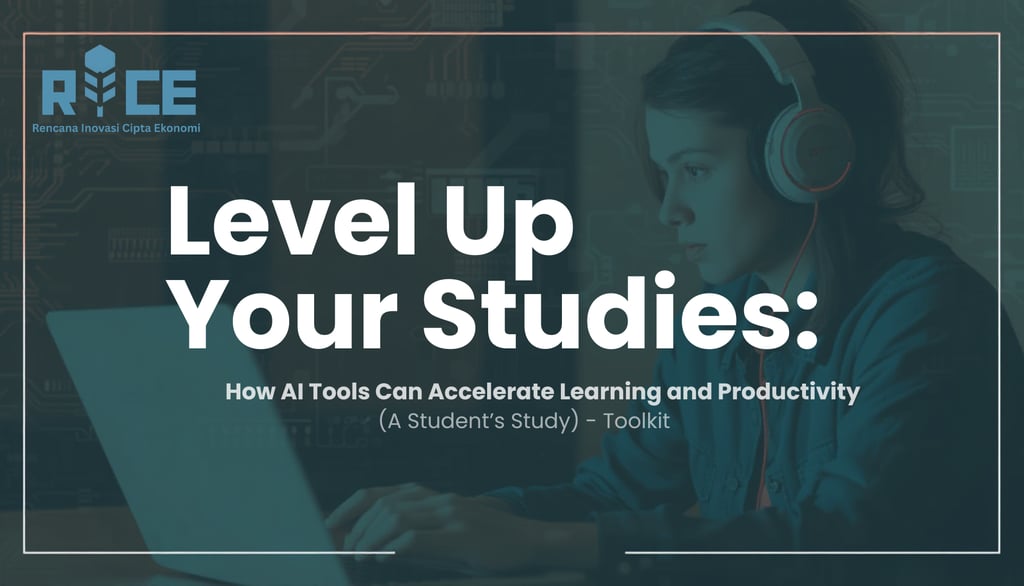
Level Up Your Studies: How AI Tools Can Boost Your Learning and Productivity (A Student's Toolkit)
Unlock academic excellence with AI! This guide explores how AI tools boost student learning, research, productivity, and writing.
TECHNOLOGY
Rice AI (Ratna)
3/13/20265 min read
Could you imagine a future where your study sessions are not just productive, but truly intuitive, personalized, and efficient? The academic landscape is rapidly evolving, and at its forefront is Artificial Intelligence (AI). Far from being a futuristic concept, AI is already transforming how students learn, research, and manage their academic lives. This isn't about replacing human intellect; it's about augmenting it, providing you with powerful tools to conquer complex subjects and optimize your study habits.
This guide delves into the practical applications of AI, offering a comprehensive toolkit designed to elevate your learning and boost your overall productivity. From streamlining tedious tasks to unlocking deeper understanding, we'll explore how integrating intelligent technologies can give you a significant advantage in your educational journey. Prepare to step into a smarter study era.
The Dawn of a Smarter Study Era
Understanding AI's Role in Modern Learning
Artificial Intelligence is not merely a buzzword; it represents a paradigm shift in educational methodologies. For students, AI acts as a sophisticated assistant, capable of analyzing vast amounts of information, identifying patterns, and even personalizing learning experiences. It empowers learners to move beyond rote memorization, fostering deeper comprehension and critical engagement with course material.
The integration of AI into education allows for tailored learning paths, addressing individual strengths and weaknesses effectively. By offloading repetitive tasks, AI frees up valuable time, enabling students to focus on higher-order thinking, creativity, and problem-solving. This symbiotic relationship between human intelligence and AI capabilities redefines what is possible in academia.
Overcoming Initial Apprehensions
It is natural to approach new technologies with a degree of caution, especially concerning ethics and academic integrity. Common concerns include plagiarism, over-reliance on AI, and the potential for misuse. However, responsible integration and a clear understanding of AI's capabilities are key. AI tools should be viewed as assistants, not replacements for your own critical thinking and effort.
Emphasizing ethical use is paramount; these tools are designed to support learning, not circumvent it. Students must learn to critically evaluate AI-generated content and use it to enhance their understanding, not as a shortcut to avoid genuine engagement.
Unlocking Knowledge: AI in Research and Content Creation
Streamlining Research with AI
Research is often a time-consuming aspect of academic life, but AI can dramatically accelerate and refine this process. AI-powered search engines and academic databases now offer advanced capabilities to pinpoint relevant information faster than ever before. These tools can sift through countless articles, journals, and books, presenting you with the most pertinent data.
Beyond simple search, AI excels at summarizing lengthy texts, distilling key arguments and findings from academic papers or book chapters in mere seconds. This allows for rapid comprehension and efficient information gathering, enabling you to grasp core concepts quickly. Tools also exist to help manage your references and citations, ensuring accuracy and saving precious time during bibliography creation. Rice AI offers specialized features for rapid information extraction and synthesis, allowing you to cut through the noise and get straight to the insights you need for your assignments.
Intelligent Note-Taking and Organization
Effective note-taking is crucial for retaining information, and AI can enhance this fundamental study skill. AI transcribers, for example, can convert lecture audio into searchable text, ensuring you never miss a crucial point. These tools often come with features that identify speakers, timestamps, and even key themes, creating a structured and easily reviewable record.
Furthermore, AI can assist in organizing your notes, automatically tagging important concepts, categorizing information, and even generating personalized flashcards for revision. This transforms raw data into an organized knowledge base, making it simpler to retrieve information and prepare for exams.
Mastering Your Schedule: AI for Productivity
Automated Scheduling and Task Management
Juggling multiple courses, assignments, and extracurricular activities requires exceptional organizational skills. AI-powered calendars and scheduling tools can revolutionize how you manage your time. These intelligent assistants can analyze your workload, deadlines, and personal commitments to suggest optimized study blocks, ensuring you allocate sufficient time to each task.
Such tools often go beyond simple scheduling; they can break down large, daunting projects into smaller, manageable steps, providing a clear roadmap to completion. With automated reminders and progress tracking features, you gain a panoramic view of your academic journey, reducing stress and improving accountability.
Personalized Study Plans and Adaptive Learning
One of AI's most profound impacts on education is its ability to personalize the learning experience. Traditional one-size-fits-all approaches often overlook individual learning styles and paces. AI tutors, however, can identify specific knowledge gaps, offer targeted explanations, and recommend supplemental resources perfectly matched to your needs.
Adaptive learning platforms, driven by AI algorithms, dynamically adjust the difficulty and type of content presented based on your performance. This ensures that you are consistently challenged at the right level, maximizing engagement and learning retention. Rice AI's adaptive learning modules are specifically designed to help students identify their optimal learning patterns, suggesting bespoke resources and exercises to solidify understanding and achieve academic goals.
Crafting Clarity: AI for Academic Writing and Communication
AI-Powered Writing Assistance
Academic writing demands precision, clarity, and adherence to specific stylistic guidelines. AI writing assistants have emerged as invaluable allies in this domain. Tools like Grammarly or ProWritingAid offer advanced grammar and spell-checking functionalities, but their capabilities extend much further. They can analyze your writing for tone, clarity, conciseness, and even provide suggestions for improving sentence structure and vocabulary.
While these tools are powerful, it's crucial to use them responsibly. They can assist in paraphrasing and rephrasing for clarity, but the original thought and understanding must always be your own to avoid academic integrity issues. AI can also help in generating outlines and brainstorming ideas, helping you overcome writer's block and structure your arguments logically. Rice AI provides advanced writing refinement tools that support students in articulating complex ideas with precision, always underscoring the importance of original thought and critical analysis.
Enhancing Presentations and Public Speaking
Effective communication extends beyond written assignments to oral presentations and public speaking. AI tools are now available to help students refine their presentation skills. Some applications can analyze your speech patterns, pacing, and even body language through your webcam, providing real-time or post-presentation feedback. This data-driven approach helps you identify areas for improvement, from reducing filler words to maintaining appropriate eye contact.
Furthermore, AI can assist in crafting compelling presentation slides by simplifying complex topics into digestible visuals and concise bullet points. This allows you to focus on your delivery, knowing that your visual aids are clear and impactful. Consider exploring tools like Tome.app, which leverage AI to create stunning presentations with minimal effort.
The Future of Learning, Powered by AI
The integration of AI into your studies marks not just a fleeting trend, but a fundamental shift in how we approach learning and academic achievement. We’ve explored how AI tools can provide unprecedented efficiency in research, offer deeper comprehension through intelligent note-taking, and boost your productivity with automated scheduling. Moreover, AI is transforming academic writing, helping you craft clearer arguments, and even refining your presentation skills for impactful communication. The ability to personalize your learning journey and receive adaptive guidance means education can now be tailored more precisely to your individual needs than ever before.
As you embark on or continue your academic path, embracing these intelligent technologies can unlock new levels of potential. It's about empowering you to think more critically, learn more deeply, and manage your academic responsibilities with greater ease and effectiveness. However, remember that AI is a tool to augment, not replace, your own intellectual effort and critical thinking. Responsible and ethical engagement with these technologies is paramount, ensuring they serve to enhance, rather than diminish, the integrity of your academic work.
The future of learning is here, and it’s intelligent. Don't be left behind. Start experimenting with the AI tools discussed in this guide. Discover which ones resonate with your learning style and specific academic demands. Ready to revolutionize your study habits and achieve unparalleled academic success? Explore the cutting-edge solutions offered by Rice AI, designed to be your steadfast partner in navigating the complexities of modern education.
#AIToolsForStudents #StudentLife #AcademicSuccess #LearningTechnology #StudyHacks #ProductivityBoost #AIinEducation #FutureofLearning #RiceAI #DailyAITechnology
RICE AI Consultant
To be the most trusted partner in digital transformation and AI innovation, helping organizations grow sustainably and create a better future.
Connect with us
Email: consultant@riceai.net
+62 822-2154-2090 (Marketing)
© 2025. All rights reserved.

+62 851-1748-1134 (Office)
IG: @riceai.consultant