

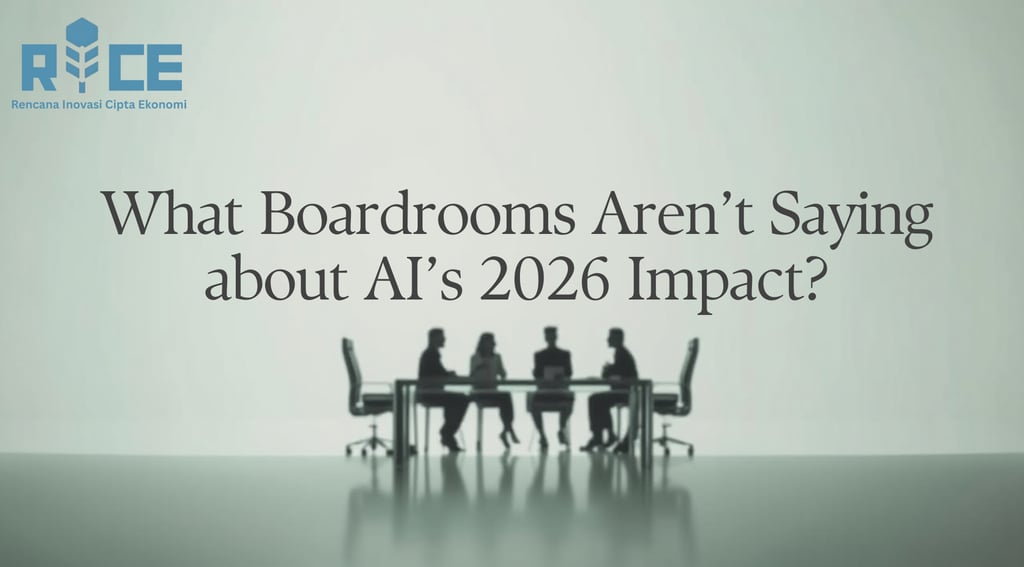
What Boardrooms Aren't Saying About AI's 2026 Impact?
This expert analysis reveals hidden liabilities, strategic blind spots, and proactive measures boards must take to lead in an AI-driven future.
INDUSTRIES
Rice AI (Ratna)
2/7/20266 min read
The executive suites of corporations worldwide are buzzing with discussions about Artificial Intelligence. Board agendas frequently feature AI's potential for efficiency gains, cost reductions, and market disruption. Yet, beneath the surface of these high-level strategic talks, a critical set of conversations remains largely unspoken, posing significant risks and opportunities as we accelerate towards 2026. This isn't just about adopting AI; it's about anticipating the profound, often challenging, implications that extend far beyond initial implementation.
While many focus on the immediate advantages of AI, the true foresight lies in recognizing the unseen currents shaping its long-term impact. The year 2026 stands as a pivotal moment, a near-future threshold where early AI initiatives will have matured, revealing their full strategic footprint. At Rice AI, our deep industry insight reveals that the most critical discussions are precisely those boards are overlooking, from burgeoning technical debt to the subtle erosion of ethical frameworks. We aim to bring these vital considerations to the forefront, empowering leaders to navigate this complex landscape proactively.
The Unspoken Liabilities of AI Integration
Beyond the glamorous headlines of AI breakthroughs, a significant undercurrent of liabilities is developing. These are the hidden costs and complexities that often go unaddressed in the initial enthusiasm for digital transformation. Understanding these factors is crucial for sustainable AI adoption and effective risk management.
Technical Debt and Legacy System Strain
The rapid deployment of AI solutions often overlooks their integration into existing, often brittle, legacy IT infrastructures. This creates substantial technical debt, making future upgrades and maintenance increasingly complex and expensive. Boards must recognize that AI doesn't erase existing infrastructure challenges; it amplifies them.
Ignoring this strain can lead to system failures, data silos, and a bottleneck effect that hinders scalability and innovation. Proactive investment in modernizing foundational systems is not an optional expense but a strategic imperative. This ensures AI initiatives can genuinely thrive without compromising operational stability.
Shadow AI and Data Governance Gaps
The proliferation of easily accessible AI tools has led to "Shadow AI"—unapproved or unmonitored AI usage within organizations. This presents significant data governance challenges, raising concerns about data privacy, security, and regulatory compliance. Many boards lack a clear understanding of where and how AI is truly being utilized across their enterprise.
Without robust AI governance frameworks, companies risk exposure to legal penalties, reputational damage, and compromised intellectual property. Establishing clear policies for AI tool adoption and data handling is paramount. This includes defining accountability for AI-generated outputs and ensuring data integrity.
Workforce Reskilling: Beyond the Headlines
Discussions around AI and the workforce often center on job displacement, but the more nuanced reality involves massive reskilling and upskilling needs. Boardrooms frequently underestimate the scale and complexity of transforming their human capital to work alongside intelligent automation effectively. The challenge isn't just about training; it’s about cultural change and fostering an AI-fluent workforce.
Investing adequately in continuous learning programs and talent development pipelines is critical to harnessing AI's full potential. Organizations that fail to empower their employees with new skills risk alienating their most valuable asset and widening the digital divide within their ranks. This strategic focus ensures a smoother workforce transformation and enhances overall business productivity.
Strategic Blind Spots and Missed Opportunities
While AI promises a wealth of strategic advantages, many organizations are inadvertently creating blind spots that prevent them from fully capitalizing on these opportunities. A superficial approach to AI strategy can lead to significant competitive disadvantages by 2026. Boards need to look beyond the obvious applications and delve into deeper, more impactful strategic considerations.
The Illusion of "Off-the-Shelf" AI Solutions
The market is flooded with ready-made AI tools, tempting organizations to adopt a plug-and-play approach. However, the illusion that generic AI solutions can deliver bespoke strategic advantage is a significant blind spot. True differentiation comes from tailoring AI to unique business challenges and proprietary data.
Relying solely on commoditized AI risks merely catching up, rather than pulling ahead, of competitors. Strategic AI requires deep integration and customization, ensuring alignment with specific business objectives and fostering unique competitive capabilities. This bespoke approach drives genuinely transformative business outcomes.
Ethical AI as a Competitive Differentiator
Ethical considerations in AI are often viewed as compliance burdens rather than strategic assets. However, as public scrutiny intensifies, companies demonstrating strong ethical AI practices will gain a significant competitive edge. Transparency, fairness, and accountability in AI systems are becoming non-negotiable consumer demands.
Boards need to embed ethical AI principles into their core strategy, not just as a defensive measure, but as a proactive value proposition. This includes developing clear guidelines for AI development, deployment, and monitoring. Companies prioritizing ethical AI governance will build trust and enhance brand reputation, attracting both customers and top talent.
Redefining Performance Metrics for AI-Driven Value
Traditional business metrics often fall short when evaluating the true impact and return on investment (ROI) of AI initiatives. Boards are frequently looking at short-term, easily quantifiable gains, missing the long-term, qualitative value that AI can generate. This narrow view creates a strategic blind spot, hindering comprehensive AI adoption.
A shift is required to encompass metrics that capture enhanced decision-making, improved customer experience, accelerated innovation, and strengthened risk management. Redefining these performance indicators helps articulate the full scope of AI impact. This holistic approach ensures that investments in Artificial Intelligent technology are accurately valued and strategically aligned.
The Proactive Boardroom: Navigating the AI Frontier with Rice AI
The organizations that will thrive by 2026 are those whose boardrooms move beyond passive observation to proactive, informed leadership in AI. This requires a fundamental shift in mindset and a commitment to integrating AI strategy into every facet of the business. Rice AI works with leaders to transform these challenges into strategic opportunities.
Building an AI-Fluent Leadership Culture
Effective AI integration starts at the top. Board members and senior executives must develop a foundational understanding of AI's capabilities, limitations, and ethical implications. An AI-fluent leadership culture can ask the right questions, challenge assumptions, and guide the strategic direction of AI initiatives. This goes beyond understanding technical jargon to grasping strategic AI implications.
Investing in executive education and fostering a culture of continuous learning around Artificial Intelligent technology is paramount. This ensures that AI discussions in the boardroom are informed, strategic, and forward-looking. Empowering leaders with this knowledge allows them to champion AI effectively and oversee its responsible deployment.
Robust Risk Management and Resilience Planning
As AI systems become more integral to operations, new forms of risk emerge, including algorithmic bias, cybersecurity vulnerabilities, and systemic failures. Proactive boardrooms prioritize developing robust AI risk management frameworks and resilience plans. This includes anticipating unforeseen consequences and establishing clear protocols for mitigating them.
Developing clear accountability structures for AI systems and investing in continuous auditing and monitoring are essential. This comprehensive approach to risk management helps safeguard organizational assets, maintain regulatory compliance, and ensure operational continuity. Rice AI offers specialized expertise in developing these critical resilience strategies.
Cultivating an Innovation Ecosystem
True AI leadership involves more than just implementing technology; it requires cultivating an internal and external innovation ecosystem. Boards must foster environments where experimentation is encouraged, failures are seen as learning opportunities, and collaboration across departments is seamless. This holistic approach drives continuous AI advancement.
Engaging with startups, academic institutions, and industry consortia can provide access to cutting-edge research and diverse perspectives. Establishing clear pathways for innovative ideas to move from concept to deployment accelerates the realization of AI's full potential. This fosters a dynamic culture of innovation, driving sustained AI impact.
Conclusion: Seizing the Unseen Advantage in 2026
The discussions that are not happening in today’s boardrooms regarding AI will define which organizations lead and which fall behind by 2026. It’s no longer enough to merely acknowledge AI's existence or delegate its implementation to IT departments. The future demands a proactive, ethical, and deeply integrated strategic approach from the highest levels of leadership. Ignoring the burgeoning technical debt, the proliferation of shadow AI, or the urgent need for comprehensive workforce transformation is a recipe for missed opportunity and increased vulnerability. Boards must transcend the superficial excitement surrounding AI to confront its deeper implications, recognizing ethical AI and tailored solutions as critical differentiators.
The organizations poised for success are those embracing AI as a core strategic imperative, not just a technological tool. They are building AI-fluent leadership, implementing robust risk management, and fostering dynamic innovation ecosystems. The insights gleaned from a truly comprehensive view of AI's impact will empower boards to make informed decisions, ensuring their organizations are not just prepared for 2026, but positioned to thrive in an AI-driven future. Don't let your boardroom overlook these crucial conversations. Embrace strategic foresight and transform potential liabilities into unparalleled competitive advantage.
At Rice AI, we specialize in guiding executive leadership through this complex landscape, translating AI's potential into tangible, sustainable growth. We offer comprehensive strategic advisory, governance framework development, and bespoke AI implementation strategies designed for forward-thinking organizations. Contact Rice AI today to schedule a strategic workshop and ensure your boardroom is asking the right questions about AI's profound impact.
#AIFuture #BoardroomInsights #StrategicAI #AIImpact2026 #BusinessTransformation #EthicalAI #AIGovernance #RiskManagement #DigitalTransformation #WorkforceAI #AIStrategy #InnovationLeadership #RiceAI #FutureTech #ExecutiveLeadership #DailyAIIndustry
RICE AI Consultant
To be the most trusted partner in digital transformation and AI innovation, helping organizations grow sustainably and create a better future.
Connect with us
Email: consultant@riceai.net
+62 822-2154-2090 (Marketing)
© 2025. All rights reserved.


+62 851-1748-1134 (Office)
IG: @riceai.consultant