

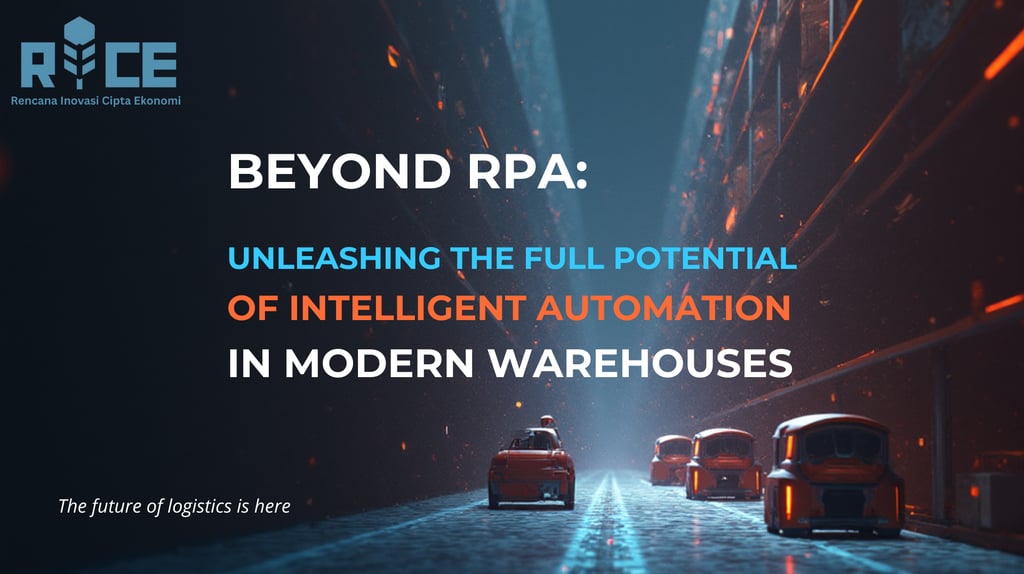
Beyond RPA: Unleashing the Full Potential of Intelligent Automation in Modern Warehouses
Explore how Intelligent Automation (IA) is transforming modern warehouse operations beyond RPA, integrating AI, ML, and computer vision.
INDUSTRIES
Rice AI (Ratna)
11/28/20257 min read
The modern warehouse stands at a pivotal juncture, grappling with ever-increasing demands for speed, accuracy, and resilience. For years, Robotic Process Automation (RPA) offered a foundational step towards digitalizing repetitive tasks. However, the true transformation of warehouse operations lies beyond RPA, in the comprehensive embrace of Intelligent Automation (IA). This paradigm shift integrates artificial intelligence (AI), machine learning (ML), computer vision, and advanced analytics with traditional automation, creating a dynamic, self-optimizing environment.
Intelligent Automation is not merely an incremental upgrade; it represents a fundamental rethinking of how goods are received, stored, picked, packed, and shipped. It empowers warehouses to move from reactive processes to proactive, predictive models, driving unprecedented efficiencies and adaptability. As industry experts, we at Rice AI recognize that understanding this evolution is crucial for any organization aiming to thrive in the competitive logistics landscape. This deep dive will explore how IA is reshaping modern warehouse operations, offering strategic advantages that go far beyond rule-based automation.
The Evolution from RPA to Intelligent Automation
The journey towards fully autonomous and intelligent warehouses often begins with a foundational understanding of automation's progression. Traditional RPA laid important groundwork, but its limitations necessitated a more advanced approach.
Understanding the Limitations of Traditional RPA
Robotic Process Automation excels at automating repetitive, rule-based digital tasks. Think of data entry, invoice processing, or simple system integrations. RPA bots follow predefined scripts, interacting with applications exactly as a human would, but at a much faster pace and without error. This brought initial gains in efficiency and reduced human effort for mundane tasks.
However, RPA's capabilities are inherently narrow. It struggles with unstructured data, requires explicit rules for every scenario, and lacks the ability to learn or adapt to unforeseen circumstances. When faced with exceptions or changes in process, RPA bots often halt, requiring human intervention. This inflexibility can become a bottleneck in dynamic environments like a modern warehouse, where variables are constant. For a deeper understanding of RPA basics, consider exploring our resources on foundational automation principles.
What Defines Intelligent Automation?
Intelligent Automation transcends RPA by embedding cognitive capabilities into automation workflows. It’s the convergence of several advanced technologies working in concert. This includes AI technologies such as machine learning for pattern recognition and prediction, natural language processing (NLP) for understanding human language, and computer vision for interpreting visual data.
IA systems can process complex, unstructured data, learn from experience, and make data-driven decisions. They adapt to changing conditions without constant human reprogramming, exhibiting a level of autonomy that traditional RPA cannot match. For instance, an IA system can not only pick an item but also identify if it's damaged based on visual inspection, then decide the next best action. Rice AI specializes in designing and implementing these sophisticated IA frameworks, enabling warehouses to unlock true operational intelligence.
Core Pillars of Intelligent Automation in Warehouse Operations
Intelligent Automation manifests across various critical functions within the modern warehouse, fundamentally altering how operations are executed and managed. These applications contribute to a holistic system of enhanced efficiency and responsiveness.
Predictive Inventory Management
One of the most impactful applications of IA in warehouses is predictive inventory management. By leveraging AI and machine learning, systems can analyze vast datasets, including historical sales, seasonal trends, market fluctuations, weather patterns, and even social media sentiment. This allows for highly accurate demand forecasting, far surpassing traditional statistical methods.
The result is optimized stock levels: reducing overstocking that ties up capital and occupies valuable space, while simultaneously minimizing understocking that leads to lost sales and customer dissatisfaction. IA systems can also proactively recommend reorder points and quantities, automate procurement processes, and even identify slow-moving or obsolete inventory, enabling strategic liquidation. This precision directly impacts profitability and working capital, ensuring that the right products are available at the right time.
Enhanced Order Fulfillment and Picking
Order fulfillment is a cornerstone of warehouse efficiency, and IA significantly elevates its performance. AI algorithms can optimize picking paths for both human pickers and automated guided vehicles (AGVs) or autonomous mobile robots (AMRs), minimizing travel time and maximizing throughput. Computer vision technology plays a crucial role here, enabling robots to accurately identify, locate, and pick items, even in varied packaging or complex configurations.
Collaborative robots (cobots) work alongside human employees, handling strenuous or repetitive tasks while humans focus on more intricate or judgment-intensive activities. This symbiosis improves both speed and accuracy, drastically reducing picking errors. Furthermore, IA can orchestrate these robotic fleets, dynamically assigning tasks and re-routing based on real-time conditions like congestion or urgent orders. Rice AI's intelligent automation solutions are designed to streamline these complex fulfillment processes, delivering tangible improvements in speed and accuracy.
Dynamic Workforce Management
Intelligent Automation also extends to optimizing the human element within the warehouse. AI-driven systems can analyze operational data to forecast labor needs, dynamically schedule shifts, and allocate tasks based on employee skills, availability, and real-time operational demands. This ensures that the right number of personnel are deployed where and when they are needed most, reducing idle time and preventing bottlenecks.
Beyond scheduling, IA can monitor productivity and identify areas for improvement or training. Wearable technologies integrated with IA platforms can provide real-time guidance to workers, improving task execution and safety. This dynamic management approach not only boosts overall productivity but also enhances employee satisfaction by balancing workloads and optimizing working conditions. The combination of human ingenuity and intelligent machines creates a highly efficient and adaptable workforce.
Strategic Benefits and Competitive Advantages
The adoption of Intelligent Automation offers a multitude of strategic benefits, fundamentally reshaping a warehouse's competitive posture. These advantages extend beyond mere cost savings, impacting every facet of the operation.
Unprecedented Operational Efficiency
Intelligent Automation drives efficiency to levels unattainable with traditional methods. By automating complex, interconnected processes, IA significantly reduces manual errors, a common source of costly rework and delays in warehouse operations. Throughput rates dramatically increase as tasks are executed faster and with greater consistency, around the clock. This relentless optimization of workflows, from inbound receiving to outbound shipping, translates into faster cycle times for orders and reduced operational costs.
Resources, including labor, equipment, and space, are utilized more effectively through AI-driven planning and real-time adjustments. Predictive maintenance, for instance, minimizes equipment downtime, ensuring continuous operation. This holistic approach to efficiency improvement directly impacts the bottom line, allowing warehouses to handle higher volumes with existing or even reduced resources.
Agility and Resilience in Supply Chains
In today's volatile global economy, supply chain agility and resilience are paramount. Intelligent Automation provides the tools necessary to navigate disruptions, from unexpected demand spikes to logistical challenges. IA systems continuously monitor real-time data from various sources, including global events, supplier performance, and shipping updates. This enables warehouses to anticipate potential disruptions and proactively adjust operations.
For example, if a shipment is delayed, an IA system can automatically re-optimize picking schedules, re-route outbound orders, or suggest alternative carriers, minimizing impact. This adaptive capacity ensures business continuity and mitigates risks, transforming potential crises into manageable events. The ability to make real-time, data-driven decisions provides a significant competitive edge, allowing businesses to maintain service levels even amidst uncertainty. For further insights into building robust supply chain resilience, consult recent industry reports.
Data-Driven Decision Making
Intelligent Automation generates and processes vast amounts of data, converting raw information into actionable insights. Unlike simple data collection, IA platforms employ advanced analytics to identify patterns, predict outcomes, and recommend optimal courses of action. This moves decision-making beyond intuition or historical precedent, grounding it in empirical evidence.
From optimizing storage layouts based on product velocity to refining delivery routes in real-time, every decision becomes more informed and strategic. Managers gain unprecedented visibility into their operations, pinpointing inefficiencies, predicting future trends, and identifying opportunities for continuous improvement. This capability transforms the warehouse from a cost center into a strategic asset, driving value across the entire supply chain. Rice AI empowers organizations to harness this data deluge, turning complex information into clear, actionable strategies.
Implementing Intelligent Automation: Challenges and Best Practices
While the benefits of Intelligent Automation are compelling, successful implementation requires careful planning and execution. Organizations must address potential hurdles and adopt best practices to maximize their investment.
Overcoming Integration Complexities
One of the primary challenges in adopting IA is integrating new technologies with existing legacy systems. Many warehouses operate with a patchwork of disparate software and hardware, creating data silos and communication barriers. A seamless flow of information is critical for IA systems to function effectively. This necessitates a strategic integration roadmap that accounts for current infrastructure, identifies necessary upgrades, and ensures interoperability.
A phased implementation approach often works best, starting with pilot projects in specific areas and gradually expanding. This allows organizations to test, learn, and refine their IA strategies before a full-scale rollout. Partnering with technology providers like Rice AI, who have extensive experience in complex system integration, can significantly mitigate these challenges, ensuring a smooth transition and optimal performance.
Cultivating an AI-Ready Workforce
The introduction of Intelligent Automation inevitably impacts the workforce. Concerns about job displacement are common, but the reality is often a shift in roles rather than outright elimination. Success hinges on cultivating an "AI-ready" workforce that can collaborate effectively with automated systems. This requires significant investment in training and upskilling programs to equip employees with the new competencies needed to manage, maintain, and interact with IA technologies.
Focus should be placed on roles that leverage human judgment, creativity, and problem-solving skills, while repetitive tasks are offloaded to automation. A robust change management strategy is essential to communicate the benefits of IA, address employee concerns, and foster a culture of continuous learning and adaptation. Embracing a "human-in-the-loop" strategy ensures that human oversight and intelligence remain integral to the automated processes, leading to more resilient and intelligent operations.
Partnering for Success
Implementing Intelligent Automation is a complex undertaking that benefits immensely from strategic partnerships. Few organizations possess the in-house expertise across all the diverse technologies that comprise IA, from AI and machine learning to robotics and data analytics. Engaging with specialized IA solution providers can bridge these knowledge gaps and accelerate deployment.
A trusted partner can offer invaluable guidance on technology selection, integration strategies, and long-term optimization. They can help define clear objectives, measure ROI, and provide ongoing support to ensure the IA systems evolve with business needs. Rice AI prides itself on being such a partner, guiding businesses through every stage of their automation journey, from initial assessment to full-scale deployment and continuous improvement. Our collaborative approach ensures that your IA solution is tailored to your unique operational challenges and strategic goals, helping you harness the full power of intelligent automation for a competitive edge.
Conclusion
The shift from traditional RPA to comprehensive Intelligent Automation marks a definitive evolution in modern warehouse operations. It’s a transition from automating simple, rule-based tasks to building intelligent, adaptive, and self-optimizing systems that drive efficiency, resilience, and strategic advantage. The integration of AI, machine learning, computer vision, and advanced analytics empowers warehouses to predict demand, optimize inventory, streamline order fulfillment, and dynamically manage their workforce with unprecedented precision.
Warehouses embracing Intelligent Automation are not just enhancing their current operations; they are fundamentally reshaping their future. They are becoming more agile in the face of market volatility, more efficient in resource utilization, and more insightful in their decision-making. This strategic investment is no longer a luxury but a necessity for organizations seeking to remain competitive in an increasingly demanding global supply chain. The path forward is clear: intelligence must be woven into the very fabric of automation. The future of warehousing is intelligent, and the time to act is now.
Ready to explore how Intelligent Automation can revolutionize your warehouse? Connect with Rice AI's experts today to chart your path to a smarter, more efficient future. Visit our website for a personalized consultation and discover how our tailored solutions can empower your operations.
#IntelligentAutomation #WarehouseAutomation #SupplyChain #Logistics #AIinLogistics #MachineLearning #Robotics #DigitalTransformation #RPA #InventoryManagement #OrderFulfillment #OperationalEfficiency #FutureofWork #SmartWarehouse #Industry40 #DailyAIIndustry
RICE AI Consultant
To be the most trusted partner in digital transformation and AI innovation, helping organizations grow sustainably and create a better future.
Connect with us
Email: consultant@riceai.net
+62 822-2154-2090 (Marketing)
© 2025. All rights reserved.


+62 851-1748-1134 (Office)
IG: @riceai.consultant