

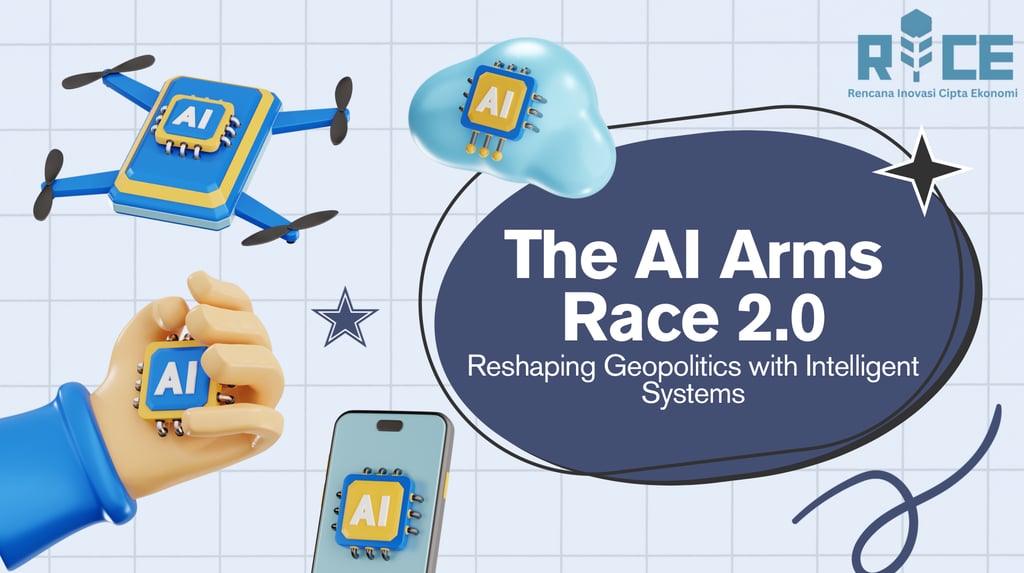
The AI Arms Race 2.0: Reshaping Geopolitics with Intelligent Systems
Dive into its impact on military power, economic dominance, and ethical governance. Explore challenges and opportunities of intelligent systems.
AI INSIGHT
Rice AI (Ratna)
12/9/20256 min read
The digital frontier is no longer just a space for innovation; it has become the primary arena for global power competition. We stand at the precipice of an unprecedented era, characterized by an accelerating "AI Arms Race 2.0." This isn't merely about technological advancement; it's a foundational shift in how nations compete, cooperate, and clash. Understanding this dynamic is crucial for industry experts and policymakers alike, as intelligent systems reshape the very fabric of geopolitics.
Artificial intelligence (AI) is rapidly evolving from a niche technology into a pervasive force, fundamentally altering strategic landscapes worldwide. The stakes in this new AI arms race are incredibly high, influencing everything from national security to economic dominance and societal stability. For industry experts, comprehending these geopolitical AI dynamics is no longer optional; it is essential for strategic foresight and responsible innovation. We must collectively navigate a future where the competition for AI supremacy defines global order.
The Dawn of AI Arms Race 2.0: A New Paradigm of Power
The current phase of the AI arms race transcends previous technological contests like the nuclear age or space race. It is defined by the pervasive integration of intelligent systems into every facet of national power, from military capabilities to economic infrastructure. This race is less about stockpiling physical assets and more about cultivating intellectual capital, data supremacy, and computational power. The very definition of strategic advantage is undergoing a radical transformation.
Redefining Strategic Advantage
AI capabilities, encompassing advanced data processing, predictive analytics, and autonomous decision-making, are becoming the ultimate strategic assets. Nations and leading corporations are investing heavily, recognizing that control over AI equates to significant geopolitical leverage. This competition isn't confined to military applications but extends to economic resilience, technological leadership, and even cultural influence. The ability to innovate and deploy AI effectively directly translates into national power.
Beyond Traditional Warfare
The "race" extends far beyond conventional weaponry, encompassing economic leverage, cyber superiority, and information control. AI is deeply integrated into critical infrastructure, from energy grids to financial networks, making these new vectors of competition. AI-powered tools can optimize supply chains, identify vulnerabilities, and automate complex processes with unprecedented speed and scale. This comprehensive integration means that national security is increasingly intertwined with digital sovereignty.
Key Fronts in the Global AI Contest
The battle for AI supremacy is being waged across multiple critical fronts, each presenting unique opportunities and profound challenges. From defense applications to economic competition and information integrity, AI's influence is expansive. Understanding these distinct domains is essential to grasp the full scope of the AI arms race.
Military and Autonomous Systems
The development of autonomous weapons systems (AWS) represents one of the most contentious and rapidly advancing fronts. Nations are pouring resources into AI-enhanced surveillance, predictive logistics, and robotic warfare platforms. The goal is to gain a decisive advantage in future conflicts, improving decision cycles and operational efficiency. This military push raises significant ethical dilemmas, prompting urgent discussions around the control and accountability of AI in national security.
Economic and Technological Sovereignty
The pursuit of AI supremacy in foundational technologies is equally intense. This includes a global scramble for dominance in semiconductor manufacturing, quantum computing, and advanced AI algorithms. Nations are striving for digital sovereignty, aiming to control their data infrastructure, intellectual property, and critical technology supply chains. Economic competition in AI manifests through trade policies, intellectual property disputes, and talent acquisition strategies. Control over these vital technological components is seen as essential for long-term economic prosperity and strategic independence.
Information Warfare and Influence Operations
AI has revolutionized the landscape of information warfare, enabling sophisticated disinformation campaigns, hyper-realistic deepfakes, and automated propaganda at an unprecedented scale. These intelligent systems can analyze vast amounts of social media data, identify susceptible audiences, and tailor persuasive narratives. This poses severe threats to democratic processes, public trust, and societal cohesion, creating a complex challenge for national security and public discourse. The ability to manipulate information at scale through AI is a potent weapon in the AI arms race.
The Stakeholders: Nations, Corporations, and the Public
The AI arms race involves a complex web of actors, each with distinct motivations and contributions. National governments drive strategic initiatives, while the private sector fuels innovation. The public, though often passively involved, is ultimately both the beneficiary and the potential victim of these evolving dynamics. Understanding these roles is crucial for effective governance and responsible development.
National Imperatives and Strategic Investments
Major global powers—the United States, China, the European Union, and increasingly Russia and other nations—are making massive investments in AI research and development. Each region has a unique approach, driven by national imperatives around security, economic growth, and technological leadership. These investments span basic research, talent development, and the integration of AI into government services and defense sectors. The competition for AI talent and intellectual property is a central pillar of these national strategies, reflecting the long-term vision for AI supremacy.
The Role of Private Sector and Tech Giants
Private sector companies, especially tech giants, are at the forefront of AI innovation, often outpacing government capabilities. Their research and development shape the practical applications and ethical considerations of intelligent systems. These corporations are both drivers of technological progress and significant vectors of geopolitical influence. Their control over vast datasets and advanced algorithms can grant them unique power, sometimes blurring the lines between corporate interests and national strategies. Organizations like Rice AI provide critical insights, helping private sector leaders understand and navigate these complex geopolitical currents, ensuring their AI strategies are robust and ethically sound. We assist in translating broad AI trends into actionable intelligence for diverse industries.
The Public as Both Beneficiary and Vulnerability
The general public stands to gain immensely from AI advancements in areas like healthcare, education, and quality of life. However, citizens are also susceptible to the misuse of AI, particularly in surveillance, censorship, and manipulation. The proliferation of AI-powered facial recognition, predictive policing, and targeted propaganda can erode civil liberties and democratic norms. Balancing innovation with privacy and ethical safeguards remains a monumental challenge. Public discourse and education are vital to fostering informed decisions about the future of AI.
Navigating the Ethical and Governance Labyrinth
As the AI arms race intensifies, the imperative for robust AI governance and ethical frameworks becomes ever more urgent. The lack of international consensus on critical issues, from autonomous weapons to data privacy, creates a dangerous vacuum. Addressing these challenges requires a concerted global effort, balancing innovation with responsibility.
The Urgency of AI Governance and Regulation
The rapid pace of AI development has outstripped the ability of international law and national regulations to keep up. There is an urgent need for global dialogue and concrete agreements on AI governance, particularly concerning autonomous weapons and the ethical use of AI in conflict. The absence of clear rules risks unintended escalation, destabilizing global security. Establishing shared norms and regulatory frameworks is paramount to prevent a free-for-all AI arms race that could have catastrophic consequences. This requires multilateral cooperation, bridging diverse legal and cultural perspectives.
Ethical AI: A Global Imperative
Developing AI responsibly means embedding AI ethics from conception to deployment. Issues such as algorithmic bias, transparency, accountability, and human oversight must be central to all AI initiatives. Without these safeguards, AI systems risk exacerbating existing inequalities, leading to discriminatory outcomes, and eroding public trust. For example, biased datasets can lead to unfair decisions in critical areas like employment or criminal justice. At Rice AI, we emphasize that responsible AI development is not just an ethical choice, but a strategic necessity. Our frameworks help organizations embed ethical considerations, ensuring that intelligent systems are developed and utilized in a manner that serves humanity and upholds fundamental values.
Pathways to De-escalation and Collaboration
Despite the competitive nature of the AI arms race, avenues for collaboration and de-escalation do exist. Initiatives like joint research on AI safety, shared standards for AI reliability, and transparency mechanisms can help build trust and prevent miscalculation. International bodies and multi-stakeholder platforms play a crucial role in fostering dialogue and forging consensus on responsible AI governance. Open discussions about AI capabilities and limitations can reduce the likelihood of a purely adversarial race. Investing in diplomatic efforts alongside technological advancements is key to navigating this complex terrain.
The AI arms race is an undeniable reality, fundamentally reshaping the geopolitical landscape. It is a multi-faceted challenge that demands urgent and thoughtful attention from industry leaders, policymakers, and the scientific community. The risks of unchecked competition – including heightened instability, erosion of trust, and potential for catastrophic misuse of intelligent systems – are profound. We stand at a pivotal moment where decisions made today will dictate the future global order.
Yet, amidst these challenges, there is also an immense opportunity. By fostering responsible innovation, prioritizing AI governance, and championing international collaboration, we can steer the AI arms race towards a future that benefits all of humanity. This requires proactive engagement, a commitment to ethical principles, and a willingness to forge common ground even in the face of intense competition. The trajectory of global power and progress will be largely determined by how we collectively manage the rise of artificial intelligence.
Rice AI remains at the forefront of this critical discourse, offering expert analysis, strategic foresight, and actionable strategies to leaders navigating this evolving landscape. Our commitment is to foster intelligent systems that serve humanity, rather than divide it, by providing the AI insights necessary for informed decision-making in a rapidly changing world. We believe that through robust AI development and proactive engagement, a stable and prosperous future powered by AI is within reach.
We urge all industry experts and professionals to engage actively in shaping AI governance and responsible AI development. Your insights are invaluable in charting a course that prioritizes ethical use and global stability. Explore further resources on AI insights and future AI trends to deepen your understanding and contribute to the ongoing dialogue. Learn more about Rice AI's strategic insights on responsible AI development. For deeper dives into international AI policy discussions, consider resources from organizations like the UN or OECD.
#AIArmsRace #GeopoliticalAI #IntelligentSystems #AIGovernance #AutonomousWeapons #AIEthics #NationalSecurityAI #AISupremacy #DigitalSovereignty #AITrends #FutureAI #AIStrategy #TechPolicy #GlobalAI #RiceAI #DailyAIInsight
RICE AI Consultant
To be the most trusted partner in digital transformation and AI innovation, helping organizations grow sustainably and create a better future.
Connect with us
Email: consultant@riceai.net
+62 822-2154-2090 (Marketing)
© 2025. All rights reserved.


+62 851-1748-1134 (Office)
IG: @riceai.consultant