

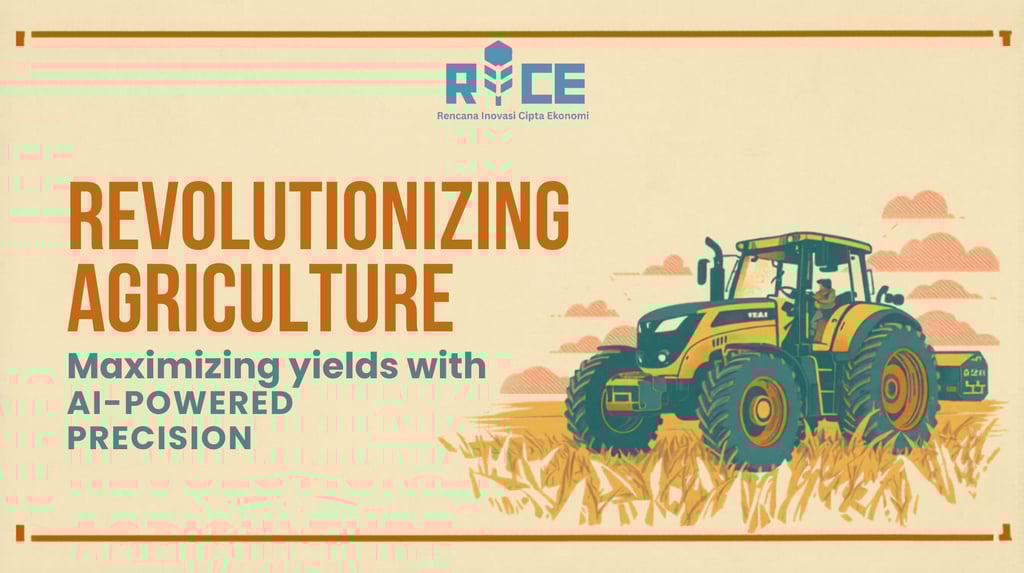
Revolutionizing Agriculture: Maximizing Yields with AI-Powered Precision
Optimize yields, manage resources efficiently, and build a sustainable future for your farm with intelligent, data-driven strategies.
INDUSTRIES
Rice AI (Ratna)
3/31/20267 min read
Are you contemplating the future of your farm, seeking to navigate the inherent complexities of modern agriculture while striving for unparalleled efficiency and significantly higher yields? The agricultural landscape is rapidly evolving, driven by the critical need to feed a growing global population amidst mounting environmental pressures and unpredictable climate patterns. Traditional farming methods, while foundational, often lack the granularity and predictive power required to truly optimize every acre.
The answer lies in embracing AI-powered precision agriculture, a transformative approach that promises to reshape how we cultivate our land. This isn't merely about adopting new technology; it's about fundamentally altering decision-making processes, moving from generalized practices to hyper-specific, data-driven interventions. By leveraging advanced artificial intelligence, farmers can unlock unprecedented levels of efficiency, resource conservation, and ultimately, greater profitability. This guide will explore how integrating AI can elevate your farm's performance, ensuring a more resilient and productive future.
The Dawn of Precision: Understanding AI's Role in Modern Agriculture
For centuries, farming relied on inherited wisdom, observation, and broad generalizations. While effective to a degree, this approach often led to inefficiencies and suboptimal outcomes. AI in agriculture marks a paradigm shift, introducing scientific rigor and predictive accuracy to every aspect of cultivation.
From Guesswork to Data-Driven Decisions
Traditional farming often involves applying resources uniformly across large fields, assuming consistent conditions. This widespread approach frequently results in over-application in some areas and under-application in others, leading to wasted resources and missed yield potential. AI, by contrast, thrives on data. It processes vast amounts of information from diverse sources, including satellite imagery, drone surveys, ground-based sensors, and historical weather patterns.
This data is then analyzed by sophisticated algorithms to create a granular understanding of each specific micro-environment within your farm. From soil composition and moisture levels to individual plant health and disease indicators, AI provides real-time insights that were previously unimaginable. These predictive analytics empower farmers to make proactive, highly targeted decisions, optimizing everything from planting schedules to harvest timing.
Bridging the Digital Divide
The perception that advanced agricultural technology is only for large-scale operations is quickly becoming outdated. AI-driven solutions are becoming increasingly modular, scalable, and user-friendly, making them accessible to farms of all sizes. Many platforms offer cloud-based interfaces, reducing the need for expensive on-site infrastructure and enabling seamless integration with existing farm management systems.
This democratization of advanced agricultural technology is crucial for widespread adoption and impact. Smaller farms can now leverage powerful analytical tools that were once exclusive to large enterprises, leveling the playing field and fostering innovation across the entire industry. Furthermore, ongoing research and development continue to simplify user interfaces and reduce implementation costs, bridging the digital divide more effectively.
Core Pillars of AI-Powered Yield Optimization
The true power of AI in agriculture lies in its ability to enhance multiple facets of farm operations. By providing intelligent oversight and precise recommendations, AI directly contributes to maximizing yields, improving quality, and reducing operational costs.
Intelligent Soil and Crop Monitoring
At the heart of precision agriculture is the continuous, intelligent monitoring of both soil conditions and crop health. AI systems utilize a network of advanced sensors, high-resolution drone imagery, and satellite data to paint a comprehensive picture of your fields. These tools can detect subtle variations in soil nutrient levels, pH balance, and moisture content with remarkable accuracy.
For crops, AI algorithms analyze visual data to identify early signs of stress, disease, or pest infestation, often before they become visible to the human eye. This early detection is critical for timely intervention, preventing widespread damage and protecting yield potential. Moreover, AI enables variable rate application, where fertilizers, pesticides, and herbicides are applied precisely where and when needed, based on specific localized requirements rather than a uniform blanket approach. This targeted strategy ensures optimal nutrient delivery, minimizes chemical runoff, and conserves valuable resources.
Automated Irrigation and Water Management
Water is perhaps the most precious resource in agriculture, and its efficient use is paramount for sustainability and yield optimization. AI revolutionizes irrigation by moving beyond scheduled watering to a dynamic, demand-driven system. Integrated with local weather forecasts, historical precipitation data, and real-time soil moisture sensors, AI platforms can predict irrigation needs with high precision.
These systems automatically adjust watering schedules and volumes based on actual plant requirements, preventing both overwatering and underwatering. Smart irrigation systems can even account for different crop types and growth stages within the same field. This intelligent water management not only conserves vast amounts of water but also reduces energy consumption associated with pumping, leading to significant cost savings and environmental benefits.
Pest and Disease Prediction & Management
Pests and diseases pose constant threats to crop yields, often requiring costly and sometimes indiscriminate interventions. AI-powered systems offer a proactive and highly targeted approach to pest and disease management. By analyzing environmental conditions, historical infestation patterns, and even specific pathogen signatures, AI models can forecast the likelihood of outbreaks.
When a threat is detected or predicted, AI guides precision spraying equipment to target affected areas only, minimizing the use of chemicals. This precision reduces environmental impact, protects beneficial insects, and lowers input costs. Furthermore, AI can recommend the most effective treatment strategies based on the specific pest or disease, ensuring optimal efficacy. This shift from reactive, broad-spectrum application to proactive, targeted intervention is a cornerstone of sustainable and high-yield farming.
Implementing AI: A Practical Roadmap for Farmers
Adopting AI in agriculture might seem daunting, but a structured approach can make the transition smooth and highly beneficial. It's about strategic integration, not an overnight overhaul.
Assessing Your Farm's Needs
The first step in implementing AI-powered precision agriculture is to conduct a thorough assessment of your farm's unique challenges and opportunities. Identify specific pain points: Is it water scarcity? Persistent pest issues? Inconsistent yields across fields? Understanding your primary goals will guide the selection of appropriate AI solutions. Begin by evaluating your existing infrastructure, including internet connectivity, power access, and any current sensor technologies.
Investing in robust data collection infrastructure, such as various IoT devices and advanced sensors, is crucial for feeding the AI system accurate information. This foundational data will be the bedrock for effective AI analysis and decision-making. Prioritize areas where data collection can yield the most immediate and significant improvements.
Choosing the Right AI Solutions
The market for AI in agriculture is expanding rapidly, offering a diverse array of software platforms and hardware integrations. When selecting solutions, consider factors such as scalability, ease of use, and compatibility with your existing farm equipment. Cloud-based AI platforms are often an excellent choice, as they provide powerful processing capabilities without requiring extensive local IT infrastructure.
Look for solutions that offer interoperability, allowing different tools and data sources to communicate seamlessly. A fragmented system can negate many of the benefits of AI. Engage with reputable providers who offer comprehensive support and continuous updates. Consider starting with a pilot program on a smaller section of your farm to evaluate effectiveness before a full-scale deployment.
Training and Adaptation
The success of AI implementation hinges significantly on the willingness and ability of farmers and farm staff to adapt to new technologies. While AI automates many processes, human oversight and understanding remain vital. Invest in comprehensive training programs to familiarize your team with new software interfaces, data interpretation, and maintenance procedures for new hardware.
A phased implementation approach can ease the transition, allowing your team to gradually integrate AI tools into their daily routines. Provide ongoing support and create an environment where questions and feedback are encouraged. Embracing a culture of continuous learning will ensure that your farm maximizes the benefits of its AI investments and remains at the forefront of agricultural innovation.
The Future Harvest: Beyond Yields
The benefits of AI in agriculture extend far beyond simply increasing the quantity of crops harvested. It ushers in an era of farming that is fundamentally more sustainable, economically viable, and strategically intelligent.
Enhancing Sustainability and Resource Efficiency
One of the most profound impacts of AI-powered precision agriculture is its contribution to environmental sustainability. By enabling ultra-precise application of water, fertilizers, and pesticides, AI dramatically reduces waste and minimizes environmental runoff. This leads to healthier soils, cleaner water sources, and a reduced carbon footprint for agricultural operations. Farmers can achieve optimal yields using fewer resources, a critical factor in a world facing climate change and resource scarcity.
Reduced chemical usage also supports biodiversity by protecting pollinators and other beneficial organisms in the farm ecosystem. This commitment to resource efficiency aligns farming practices with global sustainability goals, positioning agriculture as a key player in environmental stewardship. The long-term health of the land is preserved, ensuring productivity for future generations.
Economic Benefits and Risk Mitigation
For farmers, the bottom line is paramount. AI directly enhances profitability by increasing yields and reducing operational costs. Precision application means less money spent on inputs like water, fuel, and chemicals. Early detection of issues prevents costly crop losses, while optimized planting and harvesting schedules ensure maximum output.
Beyond cost savings, AI provides valuable insights into market trends and weather patterns, empowering farmers to make more informed decisions about crop selection, pricing, and resource allocation. This predictive capability helps mitigate risks associated with volatile markets and unpredictable environmental conditions, providing a layer of stability to agricultural businesses. The ability to forecast and adapt positions farms for greater economic resilience.
Empowering Farmers with Knowledge
Perhaps the most significant, yet often overlooked, benefit of AI in agriculture is the empowerment of the farmer. AI transforms raw data into actionable intelligence, providing farmers with an unprecedented understanding of their fields and crops. This deep insight allows for more strategic decision-making, moving beyond reactive responses to proactive management.
Farmers gain a comprehensive view of how various factors interact within their ecosystem, enabling them to fine-tune practices for optimal outcomes. This isn't about technology replacing human expertise; it's about augmenting it, providing farmers with powerful tools to apply their knowledge more effectively and strategically. It fosters a new generation of smart farmers, equipped with the data-driven insights to lead agriculture into a prosperous future.
Conclusion
The future of agriculture is undeniably intelligent, integrated, and incredibly precise. Implementing AI-powered precision agriculture is no longer a futuristic concept but a vital strategy for anyone serious about optimizing yields, enhancing sustainability, and securing long-term profitability. We stand at the precipice of a new era where technology empowers us to cultivate smarter, more efficiently, and with greater respect for our planet.
Embracing AI means moving beyond traditional methods to a dynamic system where every seed, every drop of water, and every nutrient application is optimized for peak performance. It promises higher yields through intelligent monitoring, reduced costs through resource efficiency, and greater resilience against environmental and market volatility. While the initial steps might involve a learning curve, the accessible nature of modern AI tools means this revolution is within reach for farms of all scales. Don't view AI as a replacement for your farming intuition, but rather as an invaluable partner, augmenting your expertise with unparalleled data and predictive power. Take the decisive step towards a future of agricultural abundance. Explore how AI solutions can transform your farming operations today and secure a bountiful tomorrow.
#Agriculture #PrecisionFarming #Farming #YieldOptimization #AgriTech #SustainableAgriculture #AI #DailyAIIndustry
RICE AI Consultant
To be the most trusted partner in digital transformation and AI innovation, helping organizations grow sustainably and create a better future.
Connect with us
Email: consultant@riceai.net
+62 822-2154-2090 (Marketing)
© 2025. All rights reserved.

+62 851-1748-1134 (Office)
IG: @riceai.consultant