

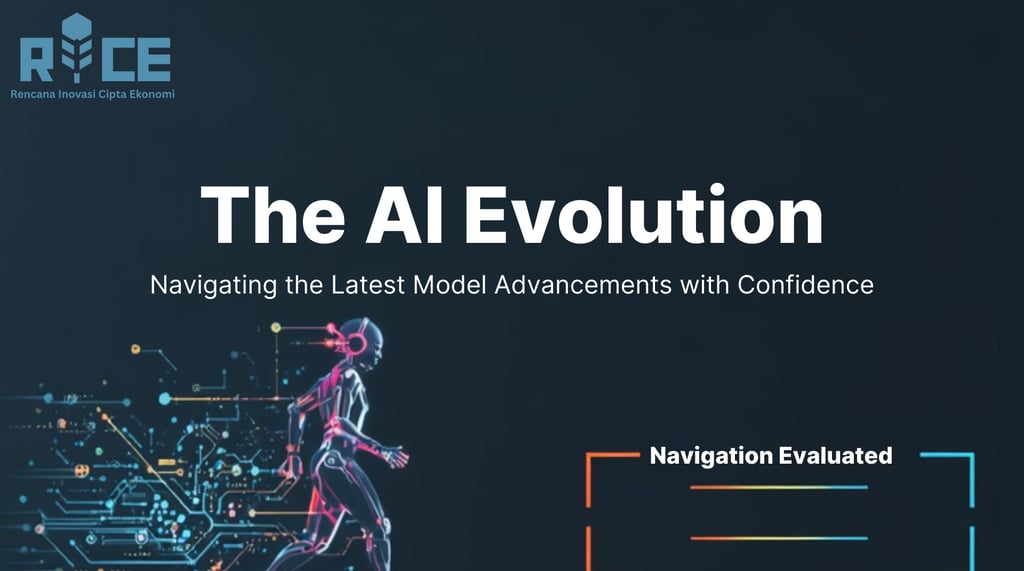
The AI Evolution Explained: Navigating the Latest Model Advancements with Confidence
Learn how to strategically integrate advanced models, ensure ethical implementation, and prepare your workforce for an AI-driven future.
AI INSIGHT
Rice AI (Ratna)
11/26/20256 min read
The landscape of Artificial Intelligence is transforming at an unprecedented pace, challenging businesses and professionals alike to keep up with its rapid advancements. What was once futuristic speculation is now practical reality, driven by increasingly sophisticated AI models. Understanding these shifts isn't just about curiosity; it's about strategic survival and unlocking unparalleled growth opportunities in every sector.
Are you prepared for what’s next? The current generation of AI models represents a significant leap forward, moving beyond mere data processing to creative generation, complex reasoning, and multimodal understanding. This evolution demands a clear understanding of the underlying technologies and their far-reaching implications. Staying informed and strategically adapting to these innovations is paramount for any forward-thinking organization. Here at Rice AI, we believe informed confidence is the key to leveraging this powerful evolution.
Understanding the Core Pillars of Modern AI Models
The bedrock of today’s AI renaissance lies in several transformative model architectures, each pushing the boundaries of what machines can achieve. Grasping these foundational concepts is crucial for anyone looking to effectively deploy AI. These models represent distinct capabilities that, when combined, create incredibly powerful and versatile AI systems.
Generative AI and Large Language Models (LLMs)
Generative AI, particularly Large Language Models (LLMs), stands at the forefront of this revolution. Models like OpenAI's GPT series, Google's LaMDA, and Meta's Llama have redefined how we interact with technology. They are trained on vast datasets of text and code, enabling them to understand, generate, and manipulate human language with remarkable fluency.
Their capabilities extend far beyond simple text generation; LLMs can summarize complex documents, translate languages, write creative content, and even assist with coding tasks. Businesses are leveraging generative AI for automated content creation, powering sophisticated chatbots for enhanced customer service , and streamlining software development workflows. This shift empowers teams to innovate faster and more efficiently.
Multimodal AI: Beyond Text
While LLMs excel with text, Multimodal AI represents the next frontier, integrating and processing information from multiple data types simultaneously. This means combining text with images, audio, and video to create a more holistic understanding and interaction with the world. Platforms like DALL-E and Midjourney exemplify this by generating stunning visuals from text prompts.
The applications are incredibly diverse, from creating personalized marketing campaigns that blend visual and textual elements, to advanced data analysis that can cross-reference information from various sensors. Multimodal AI also fuels innovation in areas like augmented reality and sophisticated human-computer interfaces. This interconnected approach allows AI to perceive and create in ways previously unimaginable.
Foundation Models and Transfer Learning
At the heart of many advanced AI applications are "Foundation Models," massive pre-trained neural networks designed to be highly adaptable. These models are initially trained on broad data at scale, developing a wide range of general capabilities before being fine-tuned for specific tasks. This concept is closely tied to "Transfer Learning," where knowledge gained from one task is applied to another.
The benefits are profound: significantly reduced training time, lower data requirements for specialized tasks, and the democratization of advanced AI capabilities. Businesses can now build sophisticated AI applications without needing to train a model from scratch, saving immense computational resources and expertise. However, the computational cost of creating these foundation models remains significant, alongside ongoing ethical discussions around their embedded biases.
Navigating the Practical Implications for Businesses
The theoretical advancements in AI models translate directly into tangible opportunities and critical challenges for organizations. Successfully integrating these new capabilities requires more than just technological adoption; it demands strategic foresight and careful planning. Businesses must move beyond the hype to realize genuine return on investment.
Strategic Integration: Beyond Hype to ROI
The true value of modern AI models emerges not from their mere presence, but from their strategic integration into core business processes. Organizations must identify key areas where AI can drive measurable operational efficiency, foster genuine innovation, and enhance customer engagement. This requires a clear, well-defined AI strategy aligned with overall business objectives.
Implementing AI effectively means moving beyond pilot projects to enterprise-wide deployment, carefully measuring impact and iterating based on performance. It’s about understanding which models best fit specific problems, whether it's optimizing supply chains, personalizing customer experiences, or automating repetitive administrative tasks. A thoughtful approach ensures AI investments yield substantial returns.
Data Governance and Ethical AI Implementation
As AI models become more powerful and pervasive, the importance of robust data governance and ethical implementation cannot be overstated. High-quality, unbiased data is the lifeblood of effective AI, and ensuring its privacy and security is paramount. Organizations must establish clear policies for data collection, storage, and usage to comply with evolving regulations.
Addressing inherent biases within AI models is another critical challenge, requiring proactive measures in data curation and model testing to ensure fair and equitable outcomes. Developing and deploying AI responsibly involves transparency, accountability, and a commitment to human-centric design. This foundational work builds trust and mitigates potential risks associated with AI deployment.
The Evolving Workforce: Upskilling and Adaptation
The rise of advanced AI models inevitably reshapes the workforce, impacting job roles and demanding new skill sets. Rather than fearing job displacement, organizations should focus on how AI augments human capabilities, enabling employees to perform higher-value, more creative tasks. This shift necessitates a significant emphasis on continuous learning and AI literacy across all levels of an organization.
Companies must invest in upskilling their teams, providing training on how to effectively collaborate with AI tools and understand their outputs. From data scientists to marketing professionals, everyone benefits from understanding AI's potential and limitations. At Rice AI, we specialize in empowering your teams through tailored AI training and consulting, ensuring your workforce is ready to thrive in an AI-powered future. This proactive approach ensures a smooth transition and maximizes human potential.
The Road Ahead: Future Trends and Rice AI's Vision
The current wave of AI advancements is merely a prelude to an even more transformative future. Anticipating these emerging trends allows businesses to position themselves strategically, ensuring long-term competitiveness. The pace of innovation shows no signs of slowing down, demanding continuous adaptation.
Personalization and Hyper-Automation
Expect AI to drive unparalleled levels of personalization across all touchpoints, from hyper-customized product recommendations to adaptive learning platforms. This will move beyond simple segmentation to truly individual experiences, anticipating user needs with remarkable accuracy. Concurrently, hyper-automation will expand, integrating AI, Robotic Process Automation (RPA), and other technologies to automate increasingly complex, end-to-end business workflows. This will free up human capital for strategic initiatives and creative problem-solving. This convergence promises a future where processes are seamless, and customer interactions are deeply intuitive.
Edge AI and Federated Learning
The future of AI processing will increasingly move closer to the data source, leading to the proliferation of Edge AI. This paradigm enables real-time decision-making on devices—from smart sensors to autonomous vehicles—without constant reliance on cloud connectivity. This enhances speed, privacy, and reliability. Complementing this is Federated Learning, a technique that allows AI models to be trained across decentralized devices or servers holding local data samples, without exchanging the data itself. This approach protects sensitive information while still benefiting from collective intelligence. Applications in IoT, healthcare, and industrial automation will see significant growth.
Rice AI: Your Partner in the AI Journey
Navigating this complex and rapidly evolving AI landscape requires expertise and a trusted partner. Rice AI is at the forefront of this evolution, dedicated to helping organizations harness the full potential of these advanced models. We don't just provide technology; we provide strategic guidance, practical implementation, and the knowledge transfer needed to build AI fluency within your organization.
From developing custom AI solutions tailored to your unique business challenges to providing comprehensive consulting on AI strategy, data governance, and workforce upskilling, Rice AI is committed to your success. Our deep understanding of generative AI, multimodal systems, and foundation models ensures that your AI investments are responsible, effective, and future-proof. Partner with Rice AI to confidently transform your operations, innovate faster, and maintain a competitive edge in the AI-driven economy.
Conclusion
The AI evolution is not a distant concept; it is happening now, reshaping industries and creating unprecedented opportunities for those prepared to embrace it. The advancements in generative AI, multimodal capabilities, and foundation models are laying the groundwork for a future where intelligent systems become indispensable tools for innovation and efficiency. Understanding these latest model advancements with confidence is no longer optional; it is a strategic imperative.
Proactive engagement, robust data governance, and a commitment to ethical implementation are crucial for harnessing AI's power responsibly. Organizations must invest in continuous learning, upskilling their workforce to collaborate effectively with AI, and develop clear strategies that align AI initiatives with core business objectives. The potential for enhanced operational efficiency, deeper customer engagement, and groundbreaking innovation is immense for those who navigate this journey wisely.
The future is brimming with possibilities, from hyper-personalized experiences to decentralized intelligence at the edge. By staying informed, adapting strategically, and collaborating with experts, you can ensure your organization not only keeps pace but leads the charge in this new era. Don't let the complexity of AI advancements become a barrier; let it be a catalyst for your next great leap forward.
Ready to confidently navigate the AI evolution and transform your business? Discover how Rice AI’s expert guidance and innovative solutions can unlock your organization's full potential in the age of advanced AI.
#AIEvolution #GenerativeAI #LLMs #MultimodalAI #FoundationModels #AIStrategy #AIDevelopment #AIBusiness #FutureOfAI #RiceAI #DigitalTransformation #Innovation #MachineLearning #AITrends #TechAdvancements #DailyAIInsight
RICE AI Consultant
To be the most trusted partner in digital transformation and AI innovation, helping organizations grow sustainably and create a better future.
Connect with us
Email: consultant@riceai.net
+62 822-2154-2090 (Marketing)
© 2025. All rights reserved.


+62 851-1748-1134 (Office)
IG: @riceai.consultant